

At its core, reputation management for small businesses is about actively monitoring, shaping, and defending how customers see your brand online. Think of it as controlling your business’s story before someone else does. A single bad review can be devastating, but a solid strategy helps you build trust, attract new clients, and ensure your brand thrives.
This guide promises a complete, actionable solution to protect and grow your online presence. We'll cover everything from how to remove negative reviews to proven strategies for building a 5-star reputation that drives real growth.
Why Your Online Reputation Is Your Biggest Asset
Let's be real. When someone needs a service like yours, their first move is to search for it online. What pops up—whether it's a string of glowing five-star reviews or a single, lonely complaint—creates an instant, gut-level feeling about your business.
That digital first impression is everything. It's the difference between landing a loyal customer and watching them click straight over to your competitor. This is why smart reputation management for small businesses isn't just about playing defence; it's one of the most powerful ways to grow.
For Australian small businesses, the game has changed. Online reviews are the new word-of-mouth, and according to recent online review statistics, they have a massive impact on whether a customer trusts you enough to spend their money. That first glance at your reviews on Google, Facebook, or an industry site can either pull customers in or push them away. You can find more stats on why reviews are so crucial for Aussie businesses on Birdeye.com.
The Real Cost of a Bad Reputation
A dodgy reputation isn't just about hurt feelings—it hits your bank account, hard.
Key Stat Alert!
A single negative article can risk losing up to 22% of potential customers. If you get four or more bad mentions, you could lose nearly 70% of your business.
This isn't just about one lost sale. It's the snowball effect of broken trust. A poor online business reputation leads to some serious headaches:
- Sales take a nosedive: People simply won't choose a business with a questionable online presence.
- You disappear from Google: Search engines love businesses with great reviews, pushing those with negative feedback down where no one can find them.
- Hiring good people becomes impossible: The best talent doesn't want to work for a company with a bad name.
This guide is your roadmap. We’ll walk through everything you need to know, from the basics to the smart strategies that will help you build a bulletproof online reputation and turn it into your most valuable asset.
The Four Pillars of a Bulletproof Reputation
Managing your reputation as a small business owner isn't some dark art. It’s actually a pretty straightforward process built on four core pillars. Get these right, and you'll build a solid foundation that doesn't just protect your brand but actively helps it grow.
Think of it like building a house – skip a pillar, and the whole thing gets wobbly. This visual breaks down how each one contributes to a strong, unified brand presence, giving you control over what customers see and say about you online.
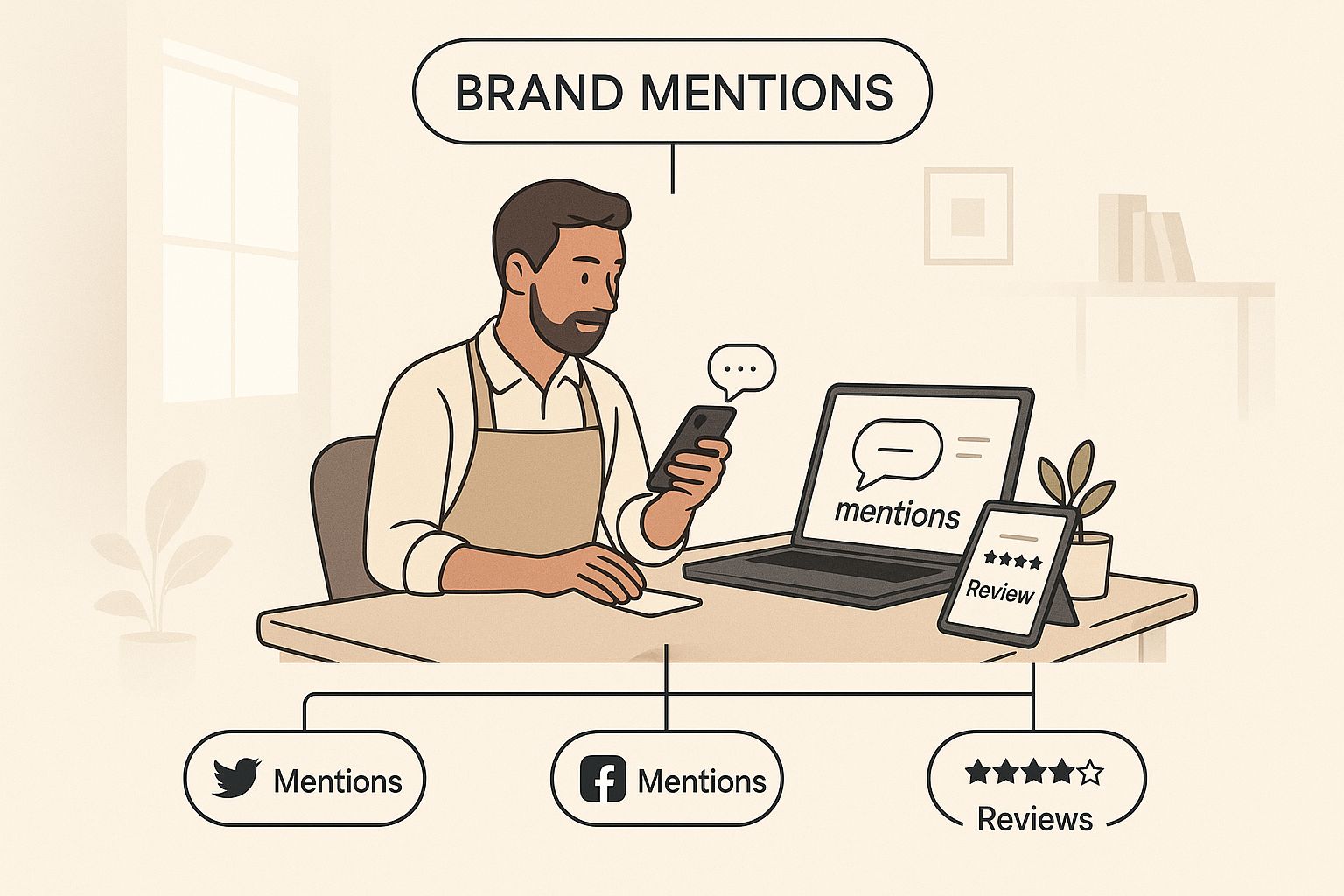
As you can see, a strong reputation means keeping an eye on everything from review sites to social media chatter, because it all feeds into how people perceive your business.
Pillar 1: Proactive Review Generation
Sitting around waiting for reviews to trickle in is a recipe for disaster. It leaves your reputation completely up to chance. The best defence is a good offence, and that means you need to be actively and consistently asking your happy customers to share their experiences.
A steady stream of positive feedback is your most powerful weapon. Make it ridiculously easy for them. Stick a QR code on your receipts that links straight to your Google review page. Set up an automated follow-up email after a purchase. The goal is to make leaving a review feel like a natural, effortless next step.
Pillar 2: Rock-Solid Online Listings
Your business information needs to be identical everywhere it shows up online. I mean everywhere. Inconsistent details, like an old address or the wrong phone number, create instant confusion and erode trust before a potential customer has even picked up the phone.
This consistency is also a massive factor in how search engines like Google see you. Start by claiming and optimising your profiles on the big ones:
- Google Business Profile: This is non-negotiable. It's your most important online asset.
- Facebook: Make sure your business page is complete and current.
- Industry-Specific Sites: Think TripAdvisor for a café or a local trade directory for a plumber.
Your online listings are your digital shopfronts. Inaccurate info is like having a "Closed" sign on the door of an open shop—it sends customers straight to your competitors.
Ensuring your Name, Address, and Phone number (NAP) are identical across the board is a cornerstone of good local SEO. If you want to dive deeper into why this matters so much, check out our guide on what is local search optimisation.
Pillar 3: Authentic Social Media Engagement
Social media isn't just a billboard for your latest offer; it's a conversation. Engaging authentically means showing the human side of your business. Share behind-the-scenes content, celebrate customer stories, and make a point to respond to comments—both the good and the bad.
This kind of interaction shows you're listening and that you genuinely care about your community. That’s how you build a loyal following of people who will defend your brand and become your biggest advocates.
Pillar 4: Unforgettable Customer Experiences
At the end of the day, your reputation is a direct reflection of the experience you provide. Every single interaction—from the first phone call to the final sale—shapes how people see your business. Consistently delivering brilliant service is the most reliable way to generate positive word-of-mouth.
Train your team to go the extra mile. A simple, friendly chat can turn a one-time customer into a lifelong fan who leaves glowing reviews without you even having to ask. This final pillar holds all the others up, creating a cycle of positive reinforcement that builds an unshakeable reputation.
To bring it all together, here’s a quick summary of how these four pillars form a complete strategy.
Core Components of a Reputation Management Strategy
| Pillar | Primary Goal | Key Actions |
|---|---|---|
| Review Generation | Build a strong base of positive social proof. | Actively request reviews, automate follow-ups, and make the process easy. |
| Online Listings | Ensure accuracy and trust across the web. | Claim and optimise key profiles, and maintain consistent NAP information. |
| Social Engagement | Foster a loyal community and humanise your brand. | Respond to comments, share user-generated content, and join conversations. |
| Customer Experience | Create positive word-of-mouth organically. | Train staff in excellent service and focus on every customer touchpoint. |
By focusing your efforts on these four areas, you're not just managing your reputation; you're actively building a brand that customers trust, respect, and want to do business with.
Your Playbook for Managing Online Reviews
Every single review left online is a public conversation. Think about it—it’s not just a comment, it’s a chat between you and a customer that everyone else gets to watch. Whether it’s glowing praise or a stinging complaint, how you reply is on full display for anyone searching for your services.
This is where smart reputation management for small businesses stops being about damage control and starts becoming one of your sharpest marketing tools. When you handle reviews the right way, you’re showing potential customers that you’re transparent, trustworthy, and that you actually care.
Let's break down exactly how you should respond to every kind of review, turning each one into a chance to build a rock-solid brand.
Responding to Positive 5-Star Reviews
It’s tempting to see a 5-star review, smile, and move on. Don't. Responding to the good stuff is a golden opportunity. A quick, genuine "thank you" not only shows you appreciate the effort they took, but it also subtly encourages other happy customers to leave their own feedback.
The key is to make it personal. Mention a specific detail from their review to prove you’ve actually read it. This simple act makes the customer feel seen and valued, reinforcing their great experience.
- Example Response: "Thanks so much, Sarah! We're thrilled you loved the new menu item. Our team works hard on perfecting those recipes, so your feedback means the world to us. We can't wait to see you again soon!"
Handling Neutral 3-Star Reviews
Ah, the 3-star review. It’s the classic "meh" experience—not bad enough to cause a scene, but not good enough to write home about. These reviews are pure gold because they shine a spotlight on exactly where you can improve.
Your goal here is to show you’re listening and you’re committed to getting better. Thank them for their honesty, acknowledge what they said, and if they pointed out a specific problem, briefly explain how you’re working to fix it.
- Example Response: "Hi Mark, thank you for taking the time to share your feedback. We're glad you enjoyed the atmosphere but are sorry to hear the service was slower than expected. We're actively working on our staffing during peak hours to fix this. We hope you'll give us another chance to provide a 5-star experience."
Turning Around Negative 1-Star Reviews
A 1-star review can feel like a punch to the gut. But how you react is everything. Never get defensive and never, ever ignore it. A prompt, professional, and empathetic reply can defuse the situation and show onlookers that you take accountability.
A fast, professional response to a bad review shows everyone you’re accountable and dedicated to making things right. This public display of customer service can be more powerful than a dozen 5-star reviews.
Follow these steps for the perfect response:
- Acknowledge and Apologise: First up, thank them for the feedback and apologise that their experience fell short.
- Show Empathy: Use phrases that connect, like, "We're so sorry to hear that…" or "That’s definitely not the standard we aim for."
- Take it Offline: This is crucial. Offer a direct line—an email or phone number—to sort the issue out privately. It stops a messy public back-and-forth.
- Example Response: "Hi Jane, we are so sorry to hear about your experience. This is not the standard of service we strive to provide. We would appreciate the opportunity to learn more and make this right. Please contact our manager, David, directly at [email/phone]. We value your business and hope to resolve this for you."
Identifying and Reporting Fake Reviews
Unfortunately, fake reviews are a real problem. They might come from a competitor or just someone trying to cause trouble. If a review feels off and you suspect it violates the platform’s rules (e.g., it’s spam, totally off-topic, or contains hate speech), you need to report it.
On Google, for instance, you can flag a dodgy review right from your business profile on Google. When you do, clearly explain why you believe it breaks their guidelines. There’s no guarantee it will be removed, but flagging illegitimate content is a vital step in protecting your reputation.
Using Technology to Manage Your Reputation Smarter
As a small business owner, you can't be everywhere at once. But technology can. Smart tools are your secret weapon for effective reputation management for small businesses, helping you automate the boring stuff, save precious time, and uncover powerful insights.
Putting the right tech in place isn't a luxury anymore; it's a core part of staying competitive. It allows you to spot potential issues before they blow up and consistently build stronger customer loyalty without stretching your team thin.
For Australian small businesses, which make up a staggering 97 percent of all enterprises, technology is a proven growth engine. The 2025 State of Small Business Report found a clear link between tech adoption and success, noting that tech-enabled sellers process 94 percent more sales than their non-digitised counterparts. You can check out more insights in the full State of Small Business Report.
Automate Your Review Generation
Let's be honest, manually asking every single customer for a review is a hassle. It’s time-consuming and easily forgotten when you're flat out. This is exactly where automation becomes a game-changer.
Automated systems can send a polite, personalised review request via email or SMS right after a customer buys something or uses your service. This simple step ensures you’re consistently capturing feedback from happy clients while their positive experience is still fresh in their minds.
Automating your review requests is the single most effective way to build a steady stream of positive social proof. It creates a powerful buffer against the occasional negative comment that every business gets.
Many platforms even let you direct customers to specific review sites like Google or Facebook. This makes it dead simple for them and massively increases the chances they’ll actually leave a review. If you're looking to get this set up, our guide on marketing automation for small business has the practical steps you need.
Understand Feedback with AI-Powered Tools
Trying to read through hundreds of reviews to spot trends is almost impossible for a busy owner. This is where AI-powered sentiment analysis tools come in, giving you a crystal-clear overview of customer feedback at a glance.
These tools scan all your reviews and sort them into positive, negative, or neutral buckets. The more advanced software can even pick up on recurring themes, like constant praise for your friendly staff or common complaints about delivery times.
This kind of insight helps you:
- Identify Strengths: Quickly see what your customers absolutely love.
- Pinpoint Weaknesses: Discover areas for improvement you might have totally missed.
- Track Performance: Watch how customer sentiment changes over time, especially after you've made changes.
Monitor Brand Mentions with Social Listening
Your reputation isn't just on review sites. People are talking about your brand on social media, in forums, and on blogs every single day. Social listening tools act as your digital ears, constantly scanning the web for any mention of your business name.
By setting up alerts, you get a real-time notification whenever someone talks about you online. This lets you jump into conversations, thank customers for their kind words, or quickly tackle any complaints before they gain traction. It's a proactive approach that shows your community you're listening and you actually care.
Future-Proofing Your Business Reputation
The way we connect with customers is always in motion. Staying ahead of the curve is what keeps your reputation management for small businesses strategy sharp, effective, and a massive advantage over your competitors.
It’s all about anticipating what’s next so you can adapt proactively, instead of scrambling to react when you’ve already been left behind. This isn't just about protecting your reputation today; it's about building one that's resilient enough to handle whatever comes tomorrow.
The Growing Link Between Reputation and Local SEO
The line between your online reputation and your local search ranking is getting blurrier by the day. Positive reviews aren't just social proof anymore; they're a direct, powerful signal to search engines like Google that your business is trustworthy and relevant.
Think about it. When a happy customer leaves a glowing review, they often use keywords related to your services and location. This user-generated content tells Google exactly what you do and where you do it, giving your visibility in local search and on Maps a serious boost.
Think of every five-star review as a mini-SEO boost. It tells search engines that real people in your community trust and recommend your business, making you a safer bet to show to other potential customers.
For Australian businesses, this blend of digital trust and local SEO is changing the game. Strong local SEO, fuelled by a stellar reputation, gets you noticed in location-specific searches—something absolutely critical if you rely on community support. AI tools are also becoming non-negotiable, offering real-time insights to help you spot and manage reputation issues before they blow up. You can explore more about the future of brand reputation on vikilinks.com.au.
Embracing AI and Data Analytics
Artificial intelligence is already starting to play a huge role in how we manage customer feedback and interactions, and it's only going to get bigger. Getting on board with these trends now will give you a significant head start.
Here’s a glimpse of what’s coming:
- AI Chatbots for Instant Support: An AI-driven chatbot on your website can give customers immediate answers, 24/7. This smooths out the customer experience and stops small frustrations from turning into negative reviews.
- Predictive Data Analytics: Forget just reacting to feedback. With data analytics, you can spot patterns in customer behaviour, anticipate potential problems, and make smarter, more personalised decisions before things go wrong.
- Hyper-Personalisation: The next wave of tools will let you customise marketing and customer service based on individual preferences and past behaviour. This is how you build deep loyalty and a reputation for genuinely caring about your customers.
By leaning into these forward-thinking strategies, you’re not just protecting the reputation you have now. You’re building an adaptable, resilient brand that’s ready for long-term success.
Common Questions About Reputation Management (Answered)
Stepping into the world of online feedback can feel a bit like walking a tightrope. It's totally normal to have questions. Here are the most common ones we hear from small business owners, with clear answers to help you get moving.
How Long Does It Take to Fix a Bad Online Reputation?
There’s no magic wand here. The timeline really depends on how much damage there is and how consistent you are with your strategy. But the good news is, a proactive approach focused on generating new, positive reviews can start showing real results in as little as 3 to 6 months.
The secret is daily, consistent effort. You’re essentially building a wave of good feedback that pushes the negative stuff down, making it less visible and way less damaging over time.
Should I Offer Discounts for Customer Reviews?
It's tempting, I get it, but this is one to avoid. Offering discounts or freebies for reviews is a big no-no on major platforms like Google and Yelp. It also looks dodgy to potential customers and can make all your reviews seem fake.
A much smarter—and more effective—approach is to just make leaving a review ridiculously easy.
- Pop a QR code on your receipts or business cards that goes straight to your review page.
- Send a simple, friendly follow-up email with a direct link after a purchase.
- Get your team into the habit of asking happy customers if they’d mind sharing their experience.
This way, you’re encouraging real, honest feedback without breaking any rules or trashing your credibility.
The goal isn't to buy good reviews. It's to remove every single barrier that stops a happy customer from sharing their great experience. Make it effortless, and the positive reviews will follow.
What's the Single Most Important Thing I Can Do Today?
Start asking your happy customers for reviews. Consistently. This is the bedrock of good reputation management. If you only do one thing from this entire article, make it this.
Put a simple, repeatable system in place—an automated email, a text message, or even a postcard with a QR code. Whatever it is, make it a non-negotiable part of your process. A steady flow of fresh, positive reviews is your best defence against the odd bit of negative feedback that might come your way.
Can I Just Delete a Bad Review on Google?
Nope. As a business owner, you can't just delete a Google review because you don't like it. Google simply doesn't give you that power.
What you can do is flag a review for removal if it clearly violates Google's content policies. This covers things like fake content, spam, hate speech, or completely off-topic rants.
But for legitimate negative feedback? Your best and only move is to post a calm, professional, and public reply. Acknowledge their issue, apologise for their experience, and offer to take the conversation offline to fix it. This shows everyone else that you're responsive, you take responsibility, and you genuinely care about your customers.
Ready to take control of your online reputation and turn it into your most powerful marketing tool? At Homer Digital Marketing, we help service-based businesses in Australia build bulletproof reputations that attract their ideal clients. We use a mix of Google optimisation, smart content, and automation to make sure you always look your best online. Book a discovery call today and let’s chat about how we can help you grow.
