

Let's be honest, an unpredictable sales pipeline is one of the biggest headaches for any business owner. One month you’re on top of the world, celebrating record growth. The next? You’re staring at an empty calendar, wondering where the next client is coming from. This feast-or-famine cycle makes scaling feel impossible, turning strategic planning into a stressful guessing game.
This is where a lead generation agency comes in. Think of them as a specialised partner whose entire job is to create a predictable, consistent flow of qualified prospects for your business. They build the engine that fuels your growth, letting you focus on what you do best.
Why Your Sales Pipeline Is Your Business Lifeline
Your sales pipeline is the lifeline of your business. It's that simple. Just like a factory needs a steady supply of raw materials to keep the production line moving, your business needs a constant stream of potential customers to generate revenue and grow.
When that supply is all over the place, everything else suffers. You miss opportunities, cash flow becomes a nightmare to manage, and your team’s morale can take a serious hit. A good lead generation agency steps in to fix this, transforming your unpredictable trickle of leads into a reliable, measurable, and scalable engine for growth.

From Guesswork to Growth Engine
Imagine hiring a professional scouting team for your business. Their role isn’t just to find any potential player; it's to identify, vet, and nurture top-tier talent that’s a perfect fit for your team’s needs. A lead generation agency does exactly this for your sales process.
They go way beyond just collecting a list of names and email addresses. Instead, they focus on attracting prospects who have a genuine need for what you offer and are actively looking for solutions. The goal is to fill your pipeline not just with leads, but with sales-qualified opportunities ready for a conversation.
Working with the right agency gives you a few massive advantages:
- Expertise and Specialisation: They live and breathe this stuff. They bring deep knowledge of proven strategies, channels, and tools designed to find and engage your ideal clients.
- Predictable Lead Flow: By running systematic campaigns, they create a consistent stream of prospects, finally smoothing out that volatile sales cycle.
- Time and Resource Savings: Outsourcing this frees up your internal team to focus on what they do best—closing deals and looking after clients—instead of spending endless hours chasing down leads.
The real goal of partnering with a lead generation agency is to turn the chaotic art of finding new business into a repeatable science. This shift lets you forecast revenue more accurately, plan for growth with confidence, and build a much more resilient business.
What a Lead Generation Agency Actually Does

Let's clear something up. A good lead generation agency doesn't just sell you a list of names and wish you luck. They build and run a sophisticated engine designed to attract, engage, and qualify potential customers for your business.
Think of them as the architects and engineers of your sales pipeline. They use a whole toolkit of strategies to create a predictable, steady stream of opportunities, so you're not left wondering where your next client is coming from.
Their work usually splits into two main camps: outbound and inbound marketing. The best agencies know how to blend both, creating a powerful system that actively hunts for new business while also drawing ideal clients right to your doorstep.
Outbound Lead Generation: The Proactive Approach
Outbound is all about proactively reaching out to people who fit your ideal customer profile but might not know you exist yet. A quality agency turns this from a scattergun "cold calling" exercise into a precision-guided mission.
- Targeted Outreach: This isn't about spamming random inboxes. Agencies use smart data and tools to build highly specific lists based on industry, job title, company size, or even recent business activity. They then craft personalised emails or LinkedIn messages that actually speak to that person's challenges.
- Appointment Setting: A key part of the job is turning that initial flicker of interest into a proper conversation. Skilled appointment setters know how to handle objections, qualify prospects, and book meetings directly into your sales team’s calendar. This means your team only spends time talking to people who are genuinely interested.
This direct approach is brilliant for targeting high-value accounts or breaking into a new market quickly. It gets your brand straight in front of the decision-makers you need to talk to.
Inbound Lead Generation: Drawing Prospects to You
Inbound marketing is the art of attracting customers by creating valuable content and experiences they’re actually looking for. A lead generation agency builds the digital infrastructure that turns your website and online presence into a magnet for your ideal clients.
This strategy is all about building trust and authority over time. The leads you get this way are often higher quality and more educated because they’ve come to you seeking a solution to a problem they already have.
Key Takeaway: The real job of a lead generation agency is to bridge the gap between your marketing efforts and your sales results. They build a system that consistently delivers sales-qualified leads, freeing up your team to do what they do best: close deals.
This systematic approach is especially crucial in Australia's crowded market. The lead generation sector here is mature and competitive, with over 150 lead generation companies operating across the country. This means you can find specialists in B2B, e-commerce, or your specific industry. To get a better sense of your options, it's worth exploring the Australian lead generation landscape and its key players.
Their core services usually include:
- Content Marketing & SEO: This means creating genuinely useful blog posts, guides, and case studies that answer your audience's biggest questions. By optimising this content for search engines (SEO), they make sure your business shows up when people are actively searching for solutions.
- Social Media Management: Using platforms like LinkedIn to build your brand’s authority, share great content, and engage with potential clients. It’s about building a community and positioning yourself as the go-to expert.
- Paid Advertising (PPC): Running highly targeted ad campaigns on Google or social media to capture leads who have a high intent to buy. This brings in immediate traffic and gives you priceless data on what messages are hitting the mark.
By weaving these inbound and outbound tactics together, a skilled lead generation agency creates a robust, resilient system that fuels sustainable business growth.
Winning Lead Generation Channels for the Australian Market
To win in the Australian market, you’ve got to know where your ideal clients are actually hanging out online. The old days of casting a wide, expensive net and just hoping for the best are long gone. Success now demands a sharp, digital-first approach that focuses on channels delivering real, measurable results.
A modern lead generation agency builds its entire strategy around this principle. They prioritise platforms and methods that not only reach the right people but also build trust and show your value from the very first click. It’s all about putting your marketing dollars where they’ll make the biggest impact and give you a genuine edge over the competition.
For Australian service-based businesses, this strategic focus has shifted decisively, with a couple of key channels consistently outperforming all others.
Content Marketing: The Engine of Trust and Authority
Content marketing is no longer a "nice-to-have"—it's the absolute foundation of effective lead generation in Australia. Instead of interrupting potential clients with ads, you’re pulling them in by providing valuable, relevant information that genuinely solves their problems.
This approach just works. It builds trust and positions your business as an authority in your field. When a prospect stumbles across your helpful blog post or insightful guide, they're not just getting an answer; they're starting a relationship with your brand.
The data backs this up. For Aussie businesses, content marketing generates three times as many leads as traditional marketing while costing a staggering 62% less. That makes it an incredibly efficient way to grow. You can discover more insights about the state of B2B marketing on LeadAgency.com.au.
LinkedIn: The Unrivaled B2B Powerhouse
When it comes to B2B lead generation, LinkedIn is in a league of its own. It's more than just a social network; it’s a dynamic ecosystem where professionals connect, share expertise, and, most importantly, make buying decisions. For Australian businesses, it is the single most important platform for reaching decision-makers.
An expert lead generation agency uses LinkedIn for a few key things:
- Precision Targeting: Reaching professionals based on their industry, company size, job title, and seniority.
- Authority Building: Sharing valuable content and insights that establish your brand as a thought leader.
- Direct Engagement: Starting real, meaningful conversations with high-value prospects.
The statistics are pretty telling. LinkedIn is responsible for an incredible 80% of B2B leads generated from social media, and 40% of B2B marketers in Australia call it their most effective channel for finding high-quality leads. Of course, you need a solid strategy to make it work. You can learn more by checking out our guide on creating effective LinkedIn Ads.
To help you visualise where to focus your efforts, here’s a quick look at how different channels stack up for Australian B2B businesses.
Lead Generation Channel Effectiveness in Australia
This table compares the top B2B lead generation channels in Australia, highlighting their efficiency and typical outcomes based on recent data.
| Channel | Key Statistic | Primary Benefit |
|---|---|---|
| Accounts for 80% of B2B leads from social media. | Direct access to decision-makers and unparalleled targeting options. | |
| Content Marketing/SEO | Generates 3x more leads than traditional marketing for 62% less cost. | Builds long-term authority, trust, and a consistent flow of inbound leads. |
| Email Marketing | Delivers an average ROI of 36:1. | Nurtures relationships and keeps your brand top-of-mind with warm prospects. |
| PPC/Google Ads | Businesses typically make $2 in revenue for every $1 spent. | Captures high-intent buyers actively searching for solutions right now. |
As you can see, a multi-channel approach often yields the best results, but the foundation for most successful service businesses starts with strong content and a strategic presence on LinkedIn.
By combining a strong content strategy with a targeted presence on LinkedIn, you create a powerful system that consistently attracts, engages, and converts your ideal clients.
The Rise of AI in Lead Generation
The final piece of this puzzle is the growing role of Artificial Intelligence (AI). AI isn't here to replace the human element of marketing; it’s here to make it smarter, faster, and more effective. A forward-thinking lead generation agency uses AI to supercharge every part of the process.
AI tools can analyse huge amounts of data to spot patterns and predict which prospects are most likely to convert. This leads to smarter targeting, more personalised outreach, and a much more efficient way to qualify leads. In fact, 59% of Australian B2B companies are already using AI to get an edge. This smart adoption of technology is what separates a good agency from a great one.
What's Next for Lead Generation in Australia?
To stay ahead in Australia's crowded market, you need to look past what’s working now and get ready for what’s coming next. The old playbook is quickly being replaced by strategies that are more authentic, smarter, and far more personal. For any service business, getting your head around these shifts is non-negotiable if you want to keep growing.
A good lead generation agency doesn’t just nail the current channels; it prepares you for the next wave. This means ditching the disruptive, spray-and-pray tactics and focusing on building real connections where your ideal clients actually are. The future isn't about shouting the loudest; it's about earning trust with genuine engagement and clever tech.
Influencers Are the New Word-of-Mouth
One of the biggest changes is the rise of influencer marketing as a serious lead generation tool. I’m not talking about paying a celebrity to hold your product. This is about partnering with trusted voices and micro-influencers who have a genuine connection with a niche audience—the exact people traditional ads struggle to reach.
These creators make content that feels real, so a recommendation for your business sounds more like a tip from a mate than a corporate ad. This builds instant social proof and funnels high-quality leads straight from an engaged community.
The real power of influencer marketing is borrowed trust. When a respected voice in a niche backs your service, their credibility becomes your credibility. It massively shortcuts the journey from stranger to loyal client.
Data and Personalisation Are Everything
The future is also incredibly personal. Generic, one-size-fits-all campaigns just don't cut it anymore. Success is now defined by how well you can personalise your approach, at scale. This is where AI and machine learning become a modern agency’s secret weapon.
By crunching huge amounts of data, AI can spot subtle buying signals and patterns in people's behaviour. This allows your agency to deliver perfectly tailored messages and content at the exact right moment.
Here’s what’s shaping this new reality:
- Predictive Analytics: Using data to figure out which prospects are most likely to convert, so your sales team can stop wasting time and focus on the hottest leads.
- Conversational Marketing: Using smart chatbots and virtual assistants to offer instant, 24/7 support and qualify leads on the spot.
- Voice Search Optimisation: More and more Aussies are asking Siri and Alexa for recommendations. If your content isn’t optimised for conversational questions, you'll become invisible.
This isn't just theory; it's already having a huge financial impact. In Australia, influencer marketing is blowing up, with spending projected to hit around AUD $929 million in 2025. This isn't just money down the drain—it’s driven by real results. Nearly half (46%) of Australians have bought something after seeing an influencer promote it.
It's a clear signal that consumer behaviour has changed. Authentic shout-outs on platforms like Instagram and TikTok are now directly driving sales. To get the full picture on these trends, you can dive deeper into these Australian marketing statistics and insights.
How to Choose the Right Lead Generation Partner
Picking a lead generation agency isn't just about handing off a task—it's about finding a strategic partner who can genuinely fuel your growth. Get it right, and they become a seamless extension of your team, delivering real, measurable results. But a bad fit can torch your budget and leave you with nothing but empty promises.
The only way to make the right choice is to have a solid vetting process. You need to look past the slick sales pitches and get into the nitty-gritty of their work, their methods, and their track record. A methodical approach is your best bet for finding a partner who actually gets your business and can deliver a steady stream of qualified leads.
This decision tree gives you a quick visual breakdown of where to focus your efforts, depending on your current lead numbers and costs.
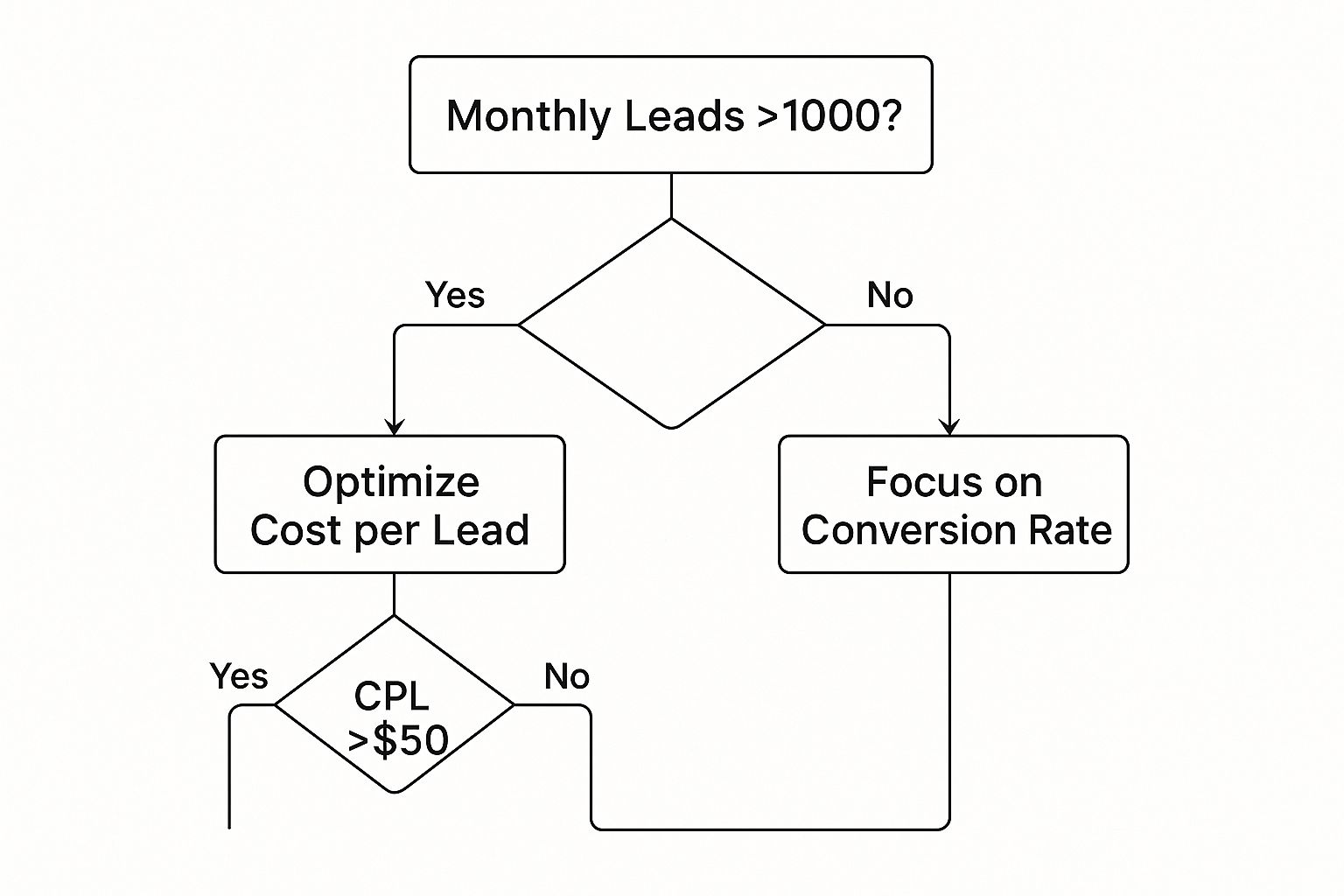
As you can see, if you've got a high volume of leads, your biggest win is in optimising your conversion rate. If your lead volume is low, you first need to tackle either your lead costs or figure out how to scale your campaigns effectively.
Proven Industry Specialisation
First things first: look for an agency that has direct, verifiable experience in your specific industry. A team that already knows the lingo, the pain points, and the buying habits of your target market has a massive head start.
They won't waste your time (and money) learning the ropes of your business. They can hit the ground running with strategies that are already proven to work for businesses just like yours. Ask them for concrete examples of campaigns they've run for other companies in your sector.
Compelling Case Studies and Testimonials
Don't just take their word for it—demand proof. Any agency worth its salt will have a portfolio of case studies that detail their work and the results they've achieved for past clients.
These shouldn't be fluffy success stories. You're looking for hard data:
- What was the client's initial problem?
- What specific strategies did the agency put in place?
- What were the measurable outcomes (e.g., increase in qualified leads, lower cost per lead, growth in sales revenue)?
Client testimonials are great for getting a feel for their service, but it's the case studies with cold, hard numbers that provide the evidence you need to make a smart decision.
Transparent Reporting and KPIs
Clarity is non-negotiable. Before you even think about signing a contract, you must have a crystal-clear understanding of how they measure and report on performance. A good partner will be completely open about the key performance indicators (KPIs) they track.
Ask to see what their reporting dashboard looks like and find out how often you’ll get updates. They should be able to clearly explain metrics like Marketing Qualified Leads (MQLs), Sales Qualified Leads (SQLs), cost per lead, and conversion rates. If their reporting seems murky or they’re cagey about the details, see it as a major red flag.
Agency Vetting Checklist
To make sure you're covering all your bases, use this checklist to compare potential agencies. It will help you systematically evaluate each one and spot any potential issues before you commit.
| Evaluation Criteria | What to Look For | Red Flags to Avoid |
|---|---|---|
| Industry Experience | Demonstrable success in your niche; understands your audience. | Generic, one-size-fits-all approach; no relevant case studies. |
| Proof of Results | Data-driven case studies with clear ROI and specific metrics. | Vague testimonials; reliance on vanity metrics like clicks or impressions. |
| Transparency | Clear, easy-to-understand reporting; open about their process. | Confusing reports; unwillingness to share KPIs or data access. |
| Strategy & Process | A customised plan tailored to your goals; a clear qualification process. | Boilerplate strategies; no plan for understanding your unique business. |
| Communication | A dedicated point of contact; regular, scheduled check-ins. | Poor response times; unclear communication channels. |
| Contract Terms | Flexible terms, clear termination clauses, and transparent pricing. | Long, restrictive lock-in contracts; hidden fees or surprise costs. |
Going through these points systematically ensures you don't miss anything critical in your evaluation. It's about finding a true partner, not just a service provider.
The Crucial Questions You Must Ask
Once you’ve got a shortlist, it’s time to dig deeper with some pointed questions. The way they answer will tell you everything you need to know about their expertise, their process, and whether they’ll be a good fit for your team.
Here’s a list to get you started:
- Lead Qualification Process: "Walk me through your exact process for qualifying a lead. What criteria do you use to sort a genuine prospect from a tyre-kicker?"
- Strategy Customisation: "How will you tailor your strategy specifically for our business? What research will you conduct to understand our unique market position and ideal customer?"
- Team and Communication: "Who will be our main point of contact? How often can we expect strategy meetings, and what’s your process for ongoing communication and feedback?"
- Contract Terms: "What are the contract length, termination clauses, and payment terms? Are there any hidden fees or extra costs we need to be aware of?"
Their answers to these questions are incredibly revealing. If they sound generic or vague, it’s likely they rely on a cookie-cutter approach that won't get you the targeted results you need. Finding the right agency is a detailed process, and it helps to understand the bigger picture. If you're weighing up different types of agencies, our guide on what is the best digital marketing company can offer some extra perspective.
Red Flag Alert: Be very wary of any agency that makes outlandish guarantees, like promising a certain number of sales in the first 30 days. Real lead generation is a strategic marathon, not a magic trick, and sustainable results take time.
By following this structured approach—checking their specialisation, demanding proof, insisting on transparency, and asking the tough questions—you can confidently choose a lead generation agency that will become a powerful partner in your growth.
Measuring the True ROI of Your Lead Generation Agency
So, you've partnered with a lead generation agency. It's a big investment, but how do you really know if it’s paying off? The answer isn't buried in fluffy metrics like clicks or impressions. It's all about the bottom line.
Proving your return on investment (ROI) means looking past the quantity of leads and focusing on their quality—and, more importantly, whether they actually become paying customers. To hold your agency accountable, you need to track a few critical numbers that cut through the noise and show you exactly what your marketing dollars are achieving.
Key Metrics That Actually Matter
Don't let yourself get bogged down in complicated reports. A few core metrics will tell you almost everything you need to know about your agency's performance and its real impact on your growth.
Here’s what to focus on:
- Cost Per Lead (CPL): This is the most straightforward one. Simply divide the total cost of your agency's campaign by the number of leads it generated. A low CPL looks great on paper, but it’s completely meaningless if the leads are junk and never convert.
- Customer Acquisition Cost (CAC): Now we're talking. CAC measures the total cost to get a new customer on board, including your agency fees and any internal sales costs. A top-notch lead generation agency should drive your CAC down over time by delivering better-qualified prospects who are easier for your team to close.
- Customer Lifetime Value (CLV): This metric forecasts the total revenue you can expect from a single customer over their entire relationship with your business. The ultimate goal is a CLV that absolutely dwarfs your CAC. When your agency brings in your ideal, high-value clients, your CLV skyrockets, proving the long-term value of their work.
The most crucial relationship to watch is the one between your Customer Acquisition Cost (CAC) and Customer Lifetime Value (CLV). A healthy, sustainable business should have a CLV that is at least 3x greater than its CAC.
Why Your Sales and Marketing Teams Must Be Aligned
Trying to track ROI accurately is impossible if your sales and marketing teams aren't talking to each other. It’s a classic problem. Your agency could be delivering hundreds of perfectly qualified leads, but if your sales team doesn't follow up effectively or give feedback, you'll never see the true value.
Proper alignment creates a seamless handover from marketing to sales and, just as importantly, a feedback loop that helps the agency sharpen its targeting. When both teams share data and communicate openly, you get a crystal-clear picture of your entire pipeline, from first click to final sale. This alignment is foundational, and understanding why it is difficult to measure marketing ROI often comes down to fixing this internal disconnect.
At the end of the day, measuring the real ROI of your lead generation agency means connecting their activities directly to revenue. By zeroing in on CPL, CAC, and CLV, you can move past surface-level stats and have confident, data-driven conversations about what's working—ensuring your investment fuels real, sustainable growth.
Got Questions About Lead Generation Agencies?
Even when you’ve got a clear plan, bringing a lead generation agency on board always comes with a few practical questions. Let's be honest, you need to know about the costs, timelines, and weird acronyms before you sign anything. Getting these answers upfront is the key to setting realistic expectations from day one.
Here are the answers to the questions we hear most often.
How Much Does a Lead Generation Agency Cost in Australia?
The investment can vary wildly, depending on how much work is involved. In Australia, if you're a small business just dipping your toes in, you might find entry-level services starting around $500 to $1,500 per month. For more established companies needing a proper, multi-channel strategy, you're looking at a monthly cost anywhere from $5,000 to $20,000 or more.
Most agencies structure their pricing in one of a few ways:
- Monthly Retainer: A fixed fee you pay each month for ongoing work. This is super common for long-term strategies like content marketing and SEO.
- Pay-Per-Lead: Simple. You pay a set price for every qualified lead they send your way.
- Performance-Based: The agency's fee is tied directly to results, like booked appointments or even closed deals. It's a real "put your money where your mouth is" model.
How Long Until We Actually See Results?
This is the million-dollar question, and the honest answer is: it depends entirely on the strategy.
If you go with outbound tactics like a targeted email campaign or paid ads, you can start seeing the first leads trickle in within a few weeks. But inbound strategies like SEO and content marketing are a slow burn. It often takes a solid three to six months of consistent effort to build up your authority and get a steady flow of organic leads coming in.
Any decent lead generation agency will be straight with you about these timelines. If a provider promises you the world overnight with guaranteed results, run. Sustainable growth takes time to build properly.
What's the Difference Between an MQL and an SQL?
Getting your head around this is crucial. It's how you measure success and make sure your marketing and sales teams are actually talking the same language.
An MQL (Marketing Qualified Lead) is someone who's shown a bit of interest. They might have downloaded your eBook or signed up for a webinar. They're curious, but they’re not ready for a sales call just yet.
An SQL (Sales Qualified Lead) is the real deal. This is a prospect who has been properly vetted and is ready for a direct chat with your sales team. They usually have a clear need, a budget in mind, and the authority to say "yes".
At Homer Digital Marketing, we don't just find leads; we build the systems that turn strangers into sales-qualified opportunities. We fill your pipeline with prospects who are actually ready to talk business.
If you're ready to build a predictable engine for growth, let's connect. Learn how we can help your service-based business scale.
