

At its core, what is local search optimization all about? It’s the art of making your business the first and most obvious choice when local customers search for your services online. Think of it as planting a giant, flashing sign on the digital map of your neighbourhood, ensuring that when someone needs what you offer, you’re the first business they see. This guide promises to show you exactly how to achieve that.
Understanding Local Search Optimisation
Let’s get practical. Imagine a potential customer in your suburb needs a plumber, a great coffee, or a reliable accountant. What do they do? They pull out their phone and type in "plumber near me" or "best café in Bondi."
Local search optimisation is the game plan that gets your business showing up right at the top of those results, especially in that all-important Google 'Map Pack'.
Unlike broad SEO that tries to catch attention from anyone, anywhere, local search optimisation is laser-focused. It’s a specialist strategy for businesses that serve a specific geographic area—whether that’s a single suburb, a city, or an entire region.
The Core Components of Local Search Optimisation
Your main goal is to send strong signals to Google that prove your business is relevant, well-regarded, and physically close to the person searching. This isn’t about one magic trick; it’s about getting several key pieces working together seamlessly.
Here’s a quick look at the essential pillars of any solid local SEO strategy. These are the non-negotiables for getting found by customers in your area.
Core Components of Local Search Optimization
| Component | What It Is | Why It Matters for Your Business |
|---|---|---|
| Google Business Profile (GBP) | Your business's free listing on Google. Think of it as a mini-website that shows your hours, address, services, and photos directly in search results. | This is the heart of your local presence. A well-managed GBP is the single most powerful factor for ranking in the 'Map Pack' and attracting ready-to-buy customers. |
| Local Citations | Mentions of your business's name, address, and phone number (NAP) across the web on directories like Yelp, TrueLocal, and industry-specific sites. | Consistent citations build trust and confirm your location for Google. It's like getting multiple references that vouch for where you are and what you do. |
| Online Reviews | Customer feedback left on platforms like Google, Facebook, and other review sites. | Positive reviews are powerful social proof. They build trust with potential customers and tell Google that your business is a legitimate, high-quality choice. |
| On-Page Local SEO | Optimising your website's content to highlight your location. This includes mentioning suburbs you serve, creating location-specific pages, and using local keywords. | This directly tells search engines where you operate. It connects your website to your physical service area, making it clear who you serve. |
Ultimately, a strong local search strategy answers three critical questions for Google: Is this business relevant to what the user searched for? Is it a prominent and trusted business? And how close is it to the user? Nail these, and you'll win the local game.
Understanding what local search optimisation is truly about is the first step. The next is taking action. Your most critical asset is your digital shopfront, and you can learn exactly how to master it in our guide to the Google Business Profile.
Why Local SEO Is a Game-Changer for Aussie Businesses

It’s one thing to understand how local search works, but it's another to see what it can actually do for your business. For Aussie businesses, a smart local SEO strategy isn’t just another marketing task—it's your most direct path to getting more customers through the door and more enquiries in your inbox.
Think about it. The days of flicking through the Yellow Pages are long gone. When someone in your neighbourhood needs a plumber, a hairdresser, or a cafe, they grab their phone. They need something, and they need it now.
This is exactly where local SEO steps in. It puts your business right in front of those high-intent customers at the precise moment they’re ready to spend money.
Tapping into High-Intent Local Searches
The numbers don't lie. When you show up in local searches, you’re tapping into a massive pool of ready-to-buy customers. Aussies are glued to their phones, with over 92% using smartphones to find local businesses.
This has fuelled a huge 250% growth in “near me” searches since 2023, proving that people are actively looking for services in their immediate area. When you get your local SEO right, you're not just getting seen; you're driving real results. Businesses that nail their local listings and review strategies report conversion rates up to 32% higher.
This is the real power of local optimisation. You’re not just casting a wide net and hoping for the best. You're fishing exactly where the fish are biting, which means a much better return on your marketing dollars.
Building Trust and a Local Connection
Beyond just getting found, local SEO builds genuine trust and cements your place in the community. A well-managed Google Business Profile, filled with recent, positive reviews, is one of the most powerful forms of social proof you can have.
Here’s what that looks like in practice:
- Boosts Your Credibility: A strong local presence tells customers you're a legitimate, established, and trusted part of the neighbourhood.
- Drives Foot Traffic and Calls: Appearing in the 'Map Pack' makes it ridiculously easy for people to get directions or call you with a single tap.
- Gives You a Competitive Edge: So many local businesses are still ignoring their online presence. A focused strategy helps you stand out and grab a bigger slice of the local market.
Ultimately, investing in local visibility is about becoming the first business people think of in your area. To really get a handle on the basics, check out our complete guide on what is local SEO optimisation and see how it can transform your business from just another option to the obvious choice.
Decoding Google's Local Ranking Factors
Ever wondered how Google decides which local business pops up first? It’s not magic. It’s a system built on three core pillars that work together to give the searcher the best possible answer. If you want to climb the local rankings, you need to master these.
Think of it like being a judge at a local talent show. You’re looking for the act that’s most relevant to the category, the most popular with the crowd, and physically closest to the stage. Google does something pretty similar with your business.
This diagram breaks down the fundamental elements that Google’s local search algorithm cares about most.
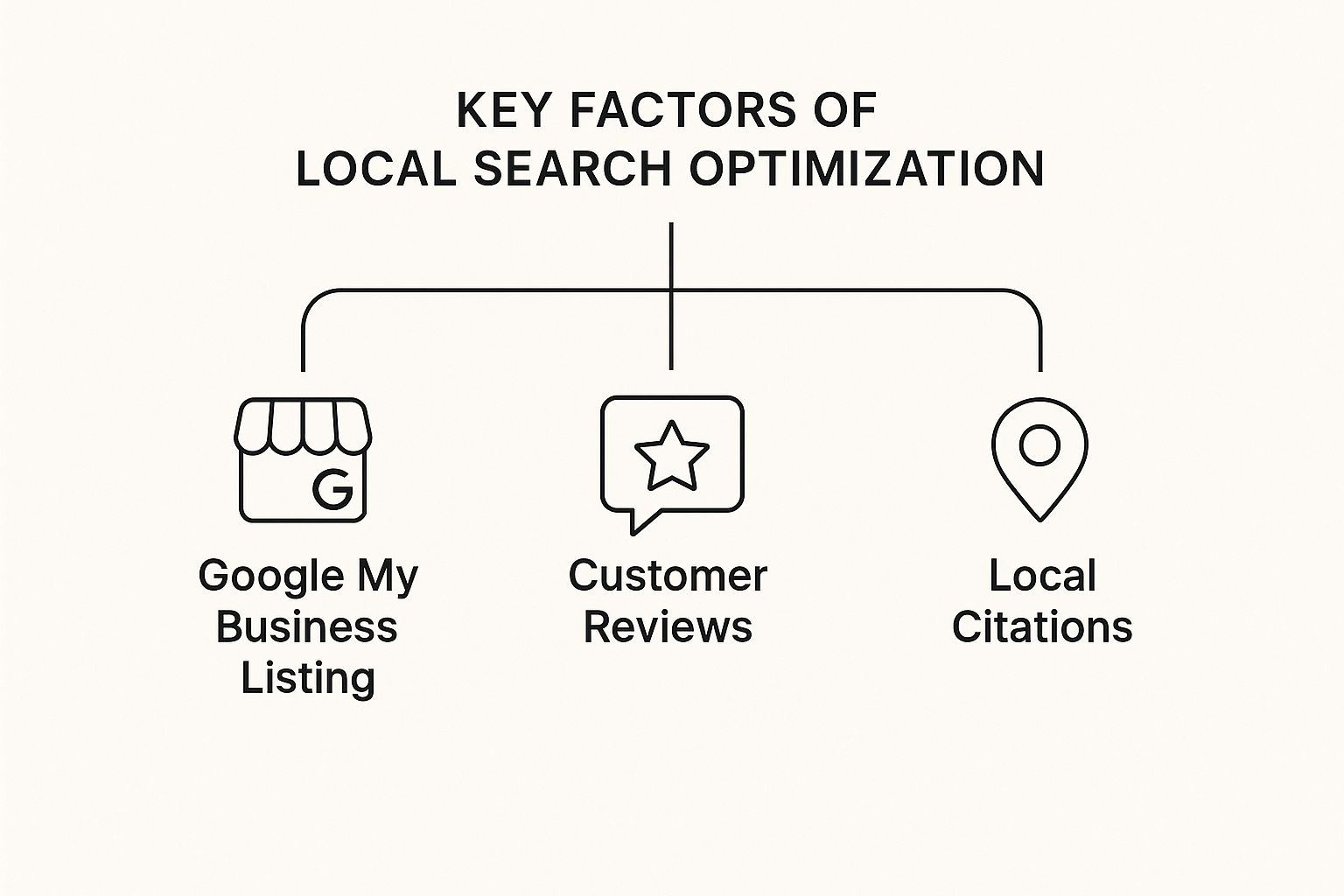
As you can see, a complete and optimised Google Business Profile is the foundation. Back that up with strong customer reviews and consistent local citations, and you’re on your way to local search success.
Relevance: How Well You Match the Search
First up is relevance. This is all about how well your business profile matches what someone is actually searching for.
If someone types in "emergency plumber in Bondi," Google instantly scours its database to find plumbers who have listed "emergency services" and are located in or serve the Bondi area. It's a matching game.
To improve your relevance, you have to be crystal clear about what you do and where you do it. This means filling out your Google Business Profile completely, including:
- Precise business categories: Choose the most accurate primary and secondary categories for your business. Don't guess.
- Detailed service descriptions: List everything you offer using the exact keywords your customers would use.
- High-quality photos: Show, don’t just tell. Add images of your work, your team, and your location to provide vital visual context.
The more detailed and accurate your information is, the more confidently Google can match you to a relevant customer search.
Prominence: How Well-Known Your Business Is
Next is prominence. This is Google’s way of figuring out your business's authority and reputation online. A business that's well-known and respected in the real world should have that same reputation reflected online.
Prominence is essentially your digital street cred. It's built on trust signals that prove your business is a legitimate, active, and respected player in your local market.
The key factors that build your prominence are:
- Customer reviews: The number of Google reviews you have, your average star rating, and how often you get new reviews are massive trust signals.
- Local citations: This is about the consistency and accuracy of your business name, address, and phone number (NAP) across other online directories like Yelp and TrueLocal.
- Backlinks from local sources: Links to your website from local news sites, community blogs, or industry associations act as powerful endorsements.
Proximity: How Close You Are to the Searcher
Finally, we have proximity, which is the most straightforward factor of the three. It simply refers to the physical distance between your business and the person searching.
Google calculates this based on the user’s location if they’ve shared it, or from the location they specify in their search (e.g., "accountant in Parramatta").
While you can't just pick up and move your business, understanding proximity is crucial. It explains why a search for "coffee near me" will show you completely different results depending on which street corner you're standing on. Your goal is to be the best, most relevant, and most prominent option within your service area, so you’re the one who shows up when a nearby customer is ready to buy.
Your Actionable Local SEO Checklist
Right, you’ve got the theory down. Now it’s time to roll up your sleeves and put it into practice. This checklist isn’t just about what local search optimisation is—it’s your step-by-step playbook for actually getting it done and boosting your visibility where it counts.
Claim and Optimise Your Google Business Profile
Let's be clear: Your Google Business Profile (GBP) is the absolute heart of your local SEO strategy. It's non-negotiable. But just claiming it and walking away is like unlocking the door to your shop but never putting anything on the shelves. You have to treat it like a digital storefront that’s always open, accurate, and ready to help.
First things first, fill out every single section. I mean every section. Your business name, address, phone number (we call this NAP), and opening hours need to be perfect. Consistency is king here, because Google cross-references this data all over the web to make sure you’re a legitimate, real-world business.
Once the basics are nailed, it's time to dig into the features that really make a difference:
- Choose Precise Categories: Don't just pick "Tradesperson." If you're a plumber, your primary category should be "Plumber." Then, add all the relevant secondary categories to catch people searching for more specific things like "Hot Water System Repair."
- Write a Compelling Description: This is your mini-sales pitch. Clearly explain what you do, who you help, and what makes you the best choice. Sprinkle in the keywords your customers are actually typing into Google, but keep it natural.
- Add High-Quality Media: Get your phone out and start snapping. People want to see photos of your work, your team, and your van. According to Google, businesses with photos get a whopping 42% more requests for driving directions. That's a lot of potential customers.
A well-oiled GBP does more than just tick boxes for an algorithm. It builds instant trust with potential customers by answering their questions before they even ask. It makes choosing you the easiest decision they'll make all day.
If you want to go deeper, our complete guide on Google Business Profile optimisation covers every feature you need to maximise.
To help you stay on track, here's a quick rundown of the most critical areas to focus on within your GBP.
Google Business Profile Optimization Key Areas
| GBP Section | Optimisation Tip | Impact on Ranking |
|---|---|---|
| Business Name | Ensure it's your exact, real-world business name. No keyword stuffing. | High |
| Categories | Select the most specific primary category, then add all relevant secondary ones. | High |
| Address & Service Areas | Use a real address and define the specific suburbs or regions you serve. | High |
| Phone Number & Website | List your primary business phone number and link directly to your website. | High |
| Photos & Videos | Add new, high-quality images of your work, team, and location weekly. | Medium |
| Business Description | Write a clear, keyword-rich summary of your services and what makes you unique. | Medium |
| Google Reviews | Actively request reviews and respond to every single one—good or bad. | High |
| Google Posts | Share regular updates, offers, and news to show your profile is active. | Medium |
| Q&A Section | Proactively add and answer common questions your customers might have. | Medium |
| Services/Products | List out all your specific services with detailed descriptions and pricing. | Medium |
Making sure these fields are not just filled out, but fully optimised, is what separates the businesses that show up from those that don't.
Build Consistent Local Citations
Think of local citations as online shout-outs for your business. They’re simply mentions of your Name, Address, and Phone number (NAP) on other websites, like Yelp, TrueLocal, or industry-specific directories.
The golden rule here is consistency. Every single citation must match the NAP on your Google Business Profile. Down to the last comma. Even a tiny difference, like "St" instead of "Street," can muddy the waters for search engines and weaken your local authority.
Master Your Online Reputation with Reviews
In today's world, online reviews are the new word-of-mouth. They're massively important for both your customers and for Google. A steady flow of positive reviews is a huge signal that your business is active, trusted, and good at what it does.
You need a simple, repeatable process for asking happy customers to leave you a review. But getting them is only half the battle. You absolutely must respond to every review, both the glowing ones and the not-so-great ones. A thoughtful reply to a negative comment can often turn a bad situation around and shows everyone else that you genuinely care.
Create Locally Focused Website Content
Finally, your own website needs to shout from the rooftops about where you operate. Your content should be drenched in local flavour, reflecting the specific communities you serve. This reinforces all the other signals you're sending from your GBP and citations, telling search engines exactly where you belong.
Here’s how to do it:
- Create Service-Area Pages: If you work across multiple suburbs, give each one its own dedicated page on your site. Talk about the services you offer there, maybe mention a local landmark, and include testimonials from clients in that area.
- Incorporate Local Keywords: Weave location-based phrases naturally into your page titles, headings, and general text. Think "emergency electrician in Parramatta" instead of just "emergency electrician."
- Add a Map: It sounds simple, but embedding a Google Map on your contact page makes it dead easy for customers to find you. Don't make them work for it.
The Future of Local Search in Australia

The world of local search is always moving, and staying ahead of what’s next is what separates the businesses that thrive from those that get left behind. What works today will be standard practice tomorrow. If you can get a handle on the next wave of changes, you can prepare for how customers will find you in the future.
Two huge forces are already reshaping how Aussies discover local services: voice search and artificial intelligence (AI). These aren't just trendy buzzwords; they represent a fundamental shift in how people behave, and that directly impacts your local marketing.
The Rise of Voice and Conversational Search
Just think about how often you hear "Hey Siri" or "Okay Google" in a single day. Searching with your voice, hands-free and in a conversational way, is becoming second nature for millions of us.
People don’t talk to their devices using short, clunky keywords. They ask full questions. Think, "Hey Siri, where's the best flat white near Central Station?" or "Okay Google, which mechanic in Richmond is open on a Saturday?"
This trend means we have to shift our thinking from simple keywords to understanding and answering direct questions.
The core of what local search optimisation is becoming is a focus on conversational intent. Your online content has to directly answer the natural language questions your ideal customers are asking their phones, smart speakers, and car assistants every single day.
The Australian market is adopting this tech fast. A huge chunk of the population now uses voice-activated queries daily, and most of those searches are for local businesses and services. These voice searches are longer and more specific, signalling a clear need for local SEO strategies that can keep up.
AI and Hyper-Personalised Results
Artificial intelligence is the engine driving this entire evolution. AI algorithms are getting incredibly good at understanding not just what someone is searching for, but why. They look at past behaviour, location history, and even the time of day to deliver hyper-personalised results.
This means two people standing side-by-side can search for the exact same thing and get totally different recommendations based on their individual habits and preferences. The era of one-size-fits-all search results is well and truly over.
To stay relevant, your business needs to provide rich, detailed information that AI can easily understand and interpret. This includes things like:
- Detailed Service Menus: Clearly list out every single service you offer.
- Specific Attributes: Highlight features like "wheelchair accessible," "free Wi-Fi," or "outdoor seating."
- Accurate Hours: Keep your opening and closing times meticulously up-to-date across the board.
Investing in local SEO is no longer optional in Australia. Projected spending on SEO is set to hit around AUD 1.5 billion in 2025, driven by this intense need for businesses to connect with nearby customers. Digging into the details, about 33% of Australians now use voice search every day, making it a critical way for people to find you. You can find out more by reviewing these local SEO statistics for Australia on redsearch.com.au.
Adapting your strategy for voice and AI now will make sure your business doesn't just survive this shift—it leads the pack.
Your Top Local SEO Questions, Answered
Even with the best game plan, it's normal to have a few questions buzzing around. Getting your head around what is local search optimisation means digging into the details. Here are the straight-up answers to the questions we hear most from Aussie business owners, so you can move forward without the guesswork.
Think of this as your quick-fire FAQ guide.
How Long Does Local SEO Take to Work?
It's the million-dollar question, and the only honest answer is: it depends. While some tweaks, like getting your Google Business Profile in order, can give you a quick boost within a few weeks, building real local authority is a marathon, not a sprint.
Generally, you can expect to see solid, lasting results within 3 to 6 months. This gives Google enough time to see the compounding effect of consistent citations, a steady flow of happy customer reviews, and locally-focused content. It’s all about building digital trust.
Remember, local SEO isn’t a set-and-forget task. It’s the ongoing work of proving you’re the real deal in your local area. The initial push takes a bit of patience, but the long-term payoff is huge.
Should I Do Local SEO Myself or Hire an Agency?
Trying to decide between DIY and calling in the pros? It really boils down to three things: your time, your confidence, and how tough your competition is.
-
The DIY Route: If you have the time to get your hands dirty and learn the ropes—and you’re not in a hyper-competitive market—managing your own local SEO is totally doable. It’s a brilliant way to understand what makes your business tick online.
-
Hiring an Agency: If you're flat out, not confident with the technical side of things, or you’re up against some heavy hitters in a major city, partnering with an agency is almost always the smarter play. A good team can get you results much faster and navigate all the tricky algorithm stuff for you.
At the end of the day, it's about what makes the most sense for your business right now.
What's the Difference Between SEO and Local SEO?
They both aim to get you seen on Google, but the big difference is geography. Let’s think about it like fishing.
Standard SEO is like casting a massive net into the open ocean. You’re trying to catch anyone, anywhere in the country (or the world) who might be interested in what you offer. It’s a broad-strokes game.
Local SEO, on the other hand, is like fishing in your local, well-stocked lake. You know exactly who you’re trying to catch: customers right in your neighbourhood. Every tactic is hyper-focused on proving your relevance to that local audience, leaning heavily on your Google Business Profile, local directory listings, and your physical proximity to the person searching.
Ready to stop guessing and start getting actual results from your local search strategy? Homer Digital Marketing specialises in helping service-based businesses like yours own their local market. We build proven systems that get you seen, attract the right clients, and put your growth on autopilot.
Book a discovery call today and let's transform your local presence.
