
Let's be honest. You're a gun at what you do, but if your LinkedIn marketing isn't up to scratch, you’re basically the best-kept secret in your industry. It's time to stop seeing it as just another social media chore and start treating it like the main stage for B2B success.
Why LinkedIn Marketing Is Your B2B Superpower
Let’s cut straight to it. LinkedIn is no longer a dusty online CV where you list that job from ten years ago. It’s a bustling digital hub where CEOs, key decision-makers, and your next five clients are actively searching for solutions. If you run a service-based business, this is your turf.
Ignoring LinkedIn is like setting up a brilliant shop on a quiet side street with no sign. You might offer the best service in the world, but nobody knows you exist. To really get this right, you first need an understanding content marketing strategy.
The opportunity here in Australia is massive. The platform’s advertising audience is set to hit 17 million users by early 2025. That’s more than 80% of Australians aged 18 and over, all gathered in one professional space.
This isn’t about collecting connections like they’re Pokémon cards. It’s about building genuine authority and starting real conversations with the people who can actually hire you. It’s about strategic visibility.
From Digital Rolodex to Revenue Engine
The platform has completely changed. It's now a content-driven ecosystem where professionals go to learn, network, and vet potential partners. Your ideal clients aren't just scrolling mindlessly; they're researching. They’re looking for experts who can solve their specific, expensive problems.
This is what a modern professional's feed looks like—a mix of industry insights, personal stories, and business opportunities.

This shows that LinkedIn prioritises content that sparks conversation, not just sterile corporate announcements. By showing up here consistently with valuable insights, you become the first person they think of when they're ready to buy.
"LinkedIn is the only platform where you can filter an entire country by job title, industry, and company size, find the exact person you want to talk to, and send them a message—for free."
This direct access is what makes LinkedIn so potent. It's not about hoping your ideal client stumbles upon your profile; it's about strategically placing yourself right in their path. The numbers don't lie. That client who desperately needs your help is scrolling right now. The only question is, will they find you or your competitor?
Optimising Your Profile to Attract Ideal Clients
Let's get one thing straight. Your LinkedIn profile is not your CV. It’s not a dusty old resume designed to impress recruiters. It's your 24/7, always-on, client-attracting sales page. Most people mess this up spectacularly, turning their profile into a snoozefest of corporate jargon and job duties from 2010.
We’re not doing that. We're turning your profile into a magnet for your ideal clients. When they land on your page, there should be zero doubt in their mind that you are the exact person they’ve been looking for to solve their expensive problem.
Your Headline Is Your Digital Handshake
Your headline is the most important piece of real estate on your entire profile. It follows you everywhere—in comments, connection requests, and search results. It’s your one-line pitch to the world.
A common mistake is using a generic job title like "CEO at XYZ Corp" or "Business Coach". Yawn. Who cares? Your clients don't care about your title; they care about what you can do for them.
A winning headline screams value. It must clearly state:
- Who you help: Be specific. "Accountants" is better than "small businesses".
- The problem you solve: What pain point do you eliminate?
- The result you deliver: What is the dream outcome for your client?
Think of it like this: "I help [Your Ideal Client] achieve [Their Desired Outcome] by [Your Unique Method]". For example, "I Help Real Estate Agents Generate 5-10 Qualified Listings a Month Using Targeted LinkedIn Outreach". See the difference? That's a headline that gets clicks.
I’ve seen this work wonders for my clients. A buyer's agent I worked with started getting four qualified calls in just two weeks after we fixed his headline. It all comes back to a simple system. In fact, a client in the bridal industry saw an 1,164% return on investment because we optimised her entire presence, starting with these fundamentals. Simple systems, when applied consistently, get massive results.
Your Summary Is Your Story
After your headline hooks them, your "About" section needs to reel them in. This is where you ditch the third-person corporate speak and tell a compelling story. People connect with people, not faceless corporations.
Use this section to show your personality, share your "why," and prove you understand their struggles. It’s a space to build trust and rapport before you’ve even spoken. You can get a much deeper dive into crafting a profile that converts by reading my complete guide to your LinkedIn profile.
Structure it for easy reading with short paragraphs, bullet points, and maybe even an emoji or two. Always end with a clear call to action. Tell them what to do next—whether that's booking a call, visiting your website, or sending you a connection request.
Your profile should answer three questions for a visitor within five seconds: Who are you? Who do you help? And how can you help me? If it doesn’t, you’re losing money.
Showcasing Your Expertise
The rest of your profile elements are there to provide social proof and back up the claims you’ve made in your headline and summary. It's about building a consistent, powerful message across your entire page.
This table breaks down the simple shifts that take a profile from overlooked to overbooked.
Profile Optimization From 'Before' to 'After'
| Profile Element | Common Mistake (The 'Before') | Winning Strategy (The 'After') |
|---|---|---|
| Banner Image | Using the default blue LinkedIn banner or a random stock photo. | A custom-designed banner with a clear value proposition, your logo, and a call to action. |
| Featured Section | Leaving it empty or linking to irrelevant articles. | Pinning your best content: client testimonials, case studies, lead magnets, or a link to your calendar. |
| Experience | Listing job duties like a traditional CV. | Framing each role as a mini-case study. Focus on achievements and results, not responsibilities. |
| Skills & Endorsements | Listing dozens of generic skills like "Microsoft Word". | Highlighting your top 3-5 core skills that are directly relevant to your ideal client's needs. |
Optimising your profile isn't a one-and-done task; it’s the foundation of your entire LinkedIn marketing strategy. If you're serious about this, you'll need the right assets. Steal my 50 best LinkedIn headlines — proven to attract clicks and clients.
Get this foundation right, and every other effort you make on the platform—from content creation to outreach—becomes ten times more effective. Now, go make your profile work for you, not the other way around.
Comparing Organic and Paid LinkedIn Strategies
https://www.youtube.com/embed/MwdRm4tiAWI
Alright, let's get into tactics. When it comes to LinkedIn marketing, you have two main tools in your kit: organic content and paid advertising. Think of them as your left jab and your right hook. Most business owners either go all-in on one or just dabble with both, usually ending up with a lighter wallet and a whole lot of frustration.
So, what's the actual difference? Let's cut the fluff.
Organic is the long game. It's your slow-burn, authority-building engine. This is where you show up consistently, share genuine value, and build real, human relationships. It’s the digital version of going to the same networking event every week until everyone knows your name and what you do. It costs you time and mental energy, but not a cent in ad spend.
Paid is the turbo-boost. It’s your shortcut to the front of the queue, letting you put a specific message right in front of your ideal buyers. You can be incredibly precise with your targeting—think job title, company size, industry, you name it. It costs money, of course, but it buys you speed and precision that organic simply can't match.
When to Go Organic
Organic is your foundation. It’s non-negotiable. You need a solid organic presence before you even think about putting a dollar into ads. Why? Because when people see your ad, the very first thing they’ll do is click on your profile to see if you’re legit.
If they land on a ghost town with no recent posts and a weak headline, they’ll hit the back button faster than you can say "wasted ad spend".
Your organic strategy should focus on:
- Building trust: Consistently sharing valuable insights proves you know your stuff.
- Creating community: Engaging in comments and conversations turns followers into fans.
- Establishing authority: Becoming the go-to person in your niche makes you the only logical choice for clients.
When to Fire Up the Ad Cannon
Paid advertising is brilliant for specific, time-sensitive goals. It’s not for building a brand from scratch; it’s for amplifying a message that already works.
This is when you should consider paying to play:
- Promoting a webinar or event: You need to reach a lot of the right people, fast.
- Launching a new service: Get your offer in front of a targeted audience immediately.
- Driving traffic to a lead magnet: A well-targeted ad can fill your pipeline with qualified leads.
"Think of organic as building the restaurant and the menu. Paid ads are the flyers you hand out to get people in the door. If the restaurant is a mess and the food is terrible, the flyers are useless."
This decision tree shows how to think about your goals before you even touch your profile.
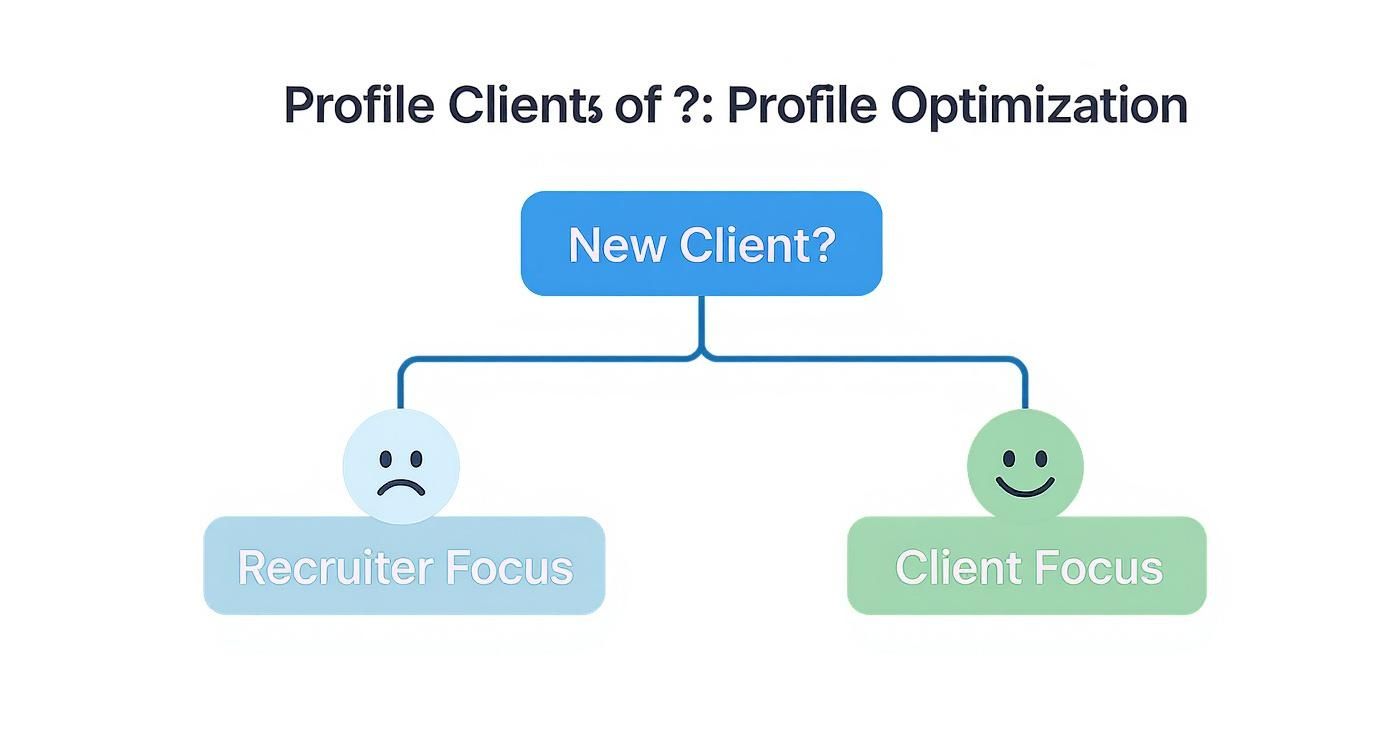
This visual guide simplifies the core question: are you trying to attract clients or recruiters? Your answer changes everything.
The Integrated Approach The Pros Use
The smartest play? Not choosing one or the other, but making them work together. This is where the magic happens. You use your killer organic content to build an engaged audience and test your messaging. When a post performs exceptionally well, that’s your signal. That's the message, the hook, and the angle that resonates with your market.
Now, you take that proven winner and put a bit of ad budget behind it. You’re not guessing what will work; you’re pouring fuel on a fire that’s already burning.
I've seen this first-hand with clients. For instance, I had an IT firm client who generated a $180K pipeline in just 90 days. We didn't just throw money at ads. We first built his authority with consistent, high-value organic content. Once we had proof of what worked, we used targeted ads to amplify his best stuff. This is what a real system looks like—it’s not random acts of marketing.
If you want a deeper understanding of the mechanics, you can learn more about how LinkedIn ads can work for your specific business.
The real secret is that organic makes your paid ads cheaper and more effective, and paid ads give you data to make your organic content sharper. They’re a perfect team.
So, stop thinking "either/or" and start thinking "both/and". Build your foundation with solid, consistent organic content. And when you've got something that truly works, don't be afraid to hit the accelerator with a targeted ad campaign.
Now that’s a knockout combination.
Creating Content That Builds Authority and Converts
Content is the heart and soul of your LinkedIn marketing. But let's be brutally honest—posting random quotes or generic articles for the sake of it is a one-way ticket to the digital graveyard. It’s just noise, and your ideal clients are experts at ignoring noise.
This is your playbook for creating content that doesn't just rack up a few vanity likes but actually starts real conversations and brings in clients.
Let's dissect the types of content that actually work on this platform. It’s a mix of personal stories, hard-won industry insights, simple text-only posts that spark debate, and engaging polls that get people clicking. It’s not about having a Hollywood production budget; it’s about being real.
Developing Your Content Framework
A solid content plan is what separates the pros from the amateurs. You need a framework that positions you as the undisputed go-to expert in your field, without chaining you to your desk 24/7.
Here’s a simple mix to aim for:
- Teach Something: Share a specific tip, a how-to guide, or a common mistake you see people making in your industry. This builds your authority.
- Tell a Story: People connect with stories, not sales pitches. Share a client win, a lesson you learned the hard way, or a personal insight that relates to your work.
- Start a Conversation: Ask a provocative question or run a poll on a hot-button topic. The goal here is pure engagement.
- Show, Don't Just Tell: Post a behind-the-scenes photo, a short video, or a testimonial. This builds trust and adds a human element to your brand.
The magic ingredient is consistency. Showing up regularly builds trust faster than any flashy, one-off campaign ever could. Remember when I was building my commercial cleaning business from nothing? I was literally cleaning offices at 1 am, absolutely knackered, but I knew that relentless execution was the only path forward. That's the same energy your content needs.
It’s not about perfection; it’s about taking massive, consistent action.
Crafting Posts That Actually Get Read
You have about two seconds to stop someone from scrolling past your post. That’s it. Your opening line—your hook—is everything. It needs to be punchy, intriguing, or relatable.
Once you’ve hooked them, you need to structure your post for maximum readability. Nobody wants to read a giant wall of text.
Think of your LinkedIn post like a conversation. You wouldn't ramble on without taking a breath. Use short sentences, plenty of white space, and break up your points with bullet points or emojis to guide the reader’s eye.
Always, always, always end with a call-to-action (CTA). Don't just let your post fizzle out. Tell people what you want them to do next. Ask a question, invite them to share their thoughts, or point them to a resource.
To truly build authority, consider publishing thought leadership pieces; learn how to post an article on LinkedIn to share your expertise in more depth.
Here’s a look at LinkedIn's Post Inspector tool, which helps you check how your links will appear when shared.

This tool is a lifesaver for ensuring your shared articles have a compelling image and headline, which drastically increases click-through rates.
Struggling for ideas is a common roadblock, but it doesn't have to be yours. Need a kickstart? Grab your free 30-Day LinkedIn Content Playbook and never run out of post ideas again.
Now, stop overthinking it. Pick one idea, write a post, and hit publish. Your next client is waiting.
A Practical System for Generating Leads on LinkedIn
Right, let's get down to business.
A slick profile and killer content are fantastic, but they don’t pay the bills. This is where the rubber meets the road—turning all that activity into actual, paying clients. You need a system.
Without a repeatable process, you’re just throwing spaghetti at the wall and hoping something sticks. This isn’t about sending a thousand generic, spammy messages that make people want to block you. It’s about strategic, proactive outreach that builds real relationships and generates leads.
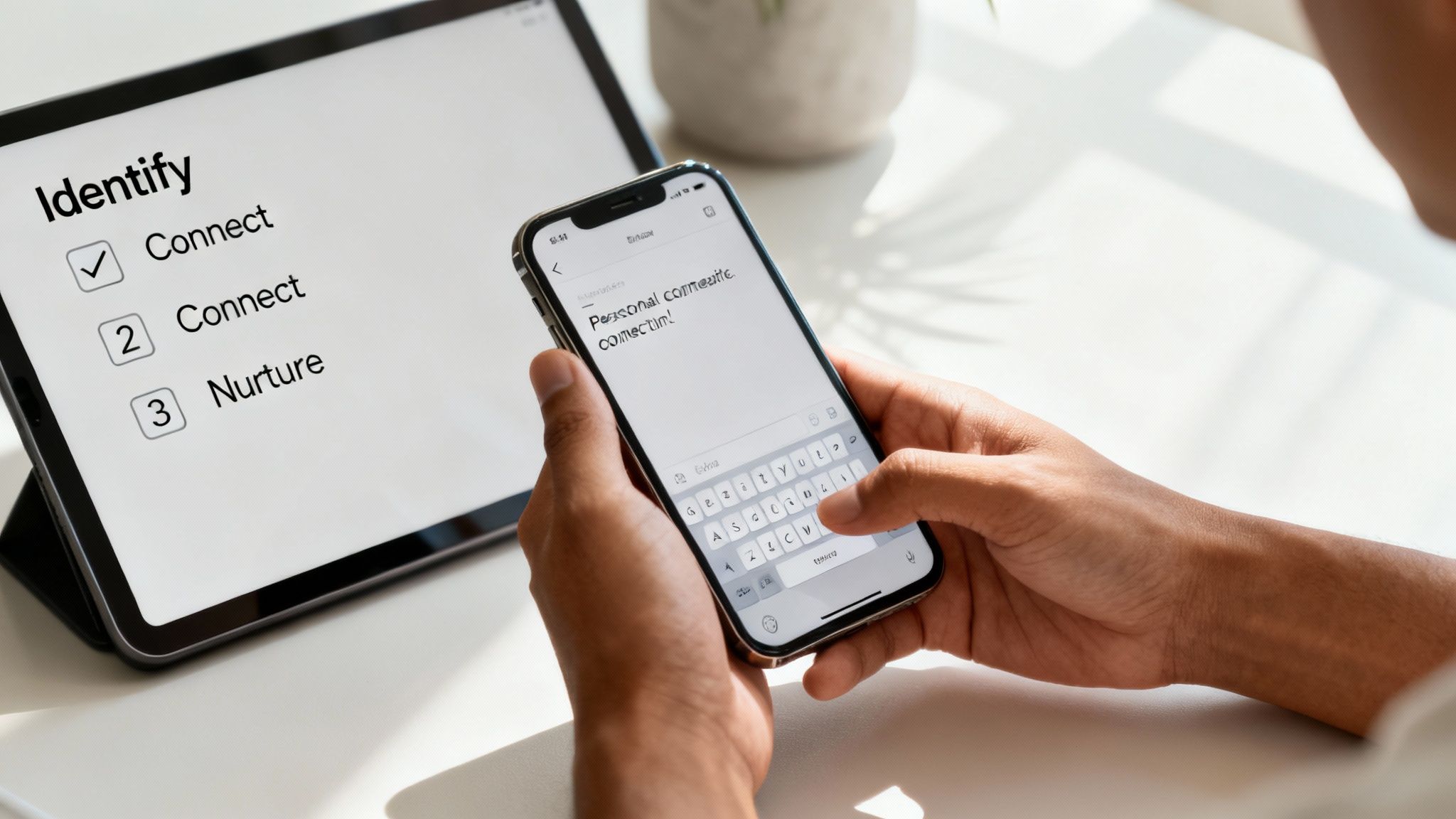
Identifying and Connecting With Ideal Clients
First things first: you need to know exactly who you're looking for. Vague targets like "small business owners" won't cut it. Get granular. What’s their job title? What industry are they in? How big is their company?
Once you have that clarity, you can use LinkedIn’s search filters to build a highly targeted list of prospects. For those serious about scaling, this is where you should explore our guide on using Sales Navigator to really drill down on your ideal client profile. That tool helps you find the right people with stunning precision.
The next step is the connection request. Please, for the love of all that is good, personalise it. A generic request is a wasted opportunity.
A simple, effective template looks like this:
- Mention something specific: "Hi [Name], I saw your recent post about [Topic] and loved your take on it."
- Find common ground: "I noticed we're both in the [Industry] space in [City]."
- State your intention (gently): "I'm always looking to connect with other leaders in our field. Would be great to connect."
That’s it. No pitch. No sleaze. Just a genuine, human-to-human connection.
Nurturing New Connections Authentically
Once someone accepts your request, the real work begins. This is the nurturing phase, and it’s where most people drop the ball. Don't immediately slide into their DMs with a sales pitch. That’s the digital equivalent of proposing on the first date—creepy and desperate.
Instead, play the long game. The goal is to move from a cold connection to a warm conversation.
Your outreach system shouldn't feel like a transaction. It should feel like you're building a professional friendship. Value first, always.
A simple nurturing sequence could be:
- Day 1 (Post-Connection): Send a quick "Thanks for connecting" message. Ask them a question about their work or a piece of content they shared.
- Week 1: Engage with one of their posts. Leave a thoughtful comment that adds to the conversation.
- Week 2: If the conversation flows, offer a relevant piece of value—a link to an article, a helpful tool, or an introduction.
This patient, value-first approach is incredibly effective. I once coached an IT firm that generated a $180K pipeline in just 90 days. We didn't do it with spammy bots; we did it by creating a system built on genuine authority and consistent, human outreach.
In Australia, LinkedIn is the undisputed king of B2B, accounting for 80% of all B2B leads from social media. This isn't a fluke; it's because this is where Aussie professionals come to do business. If you're not using it with a proper system, you're leaving a massive pile of cash on the table.
This all sounds like a lot of work, right? It can be, but a system makes it manageable.
Now stop just collecting connections and start building relationships. That’s how you win.
Measuring Your LinkedIn Marketing Efforts Without Losing Your Mind
Right, so you're putting in the time on LinkedIn. But is it actually working? If you're flying blind, you're making a rookie mistake. And let's be clear: if you can't measure it, you can't improve it.
Forget the fluff. Likes are nice, and a growing follower count feels good, but they don't pay the bills. We need to move past these vanity metrics and focus on the numbers that actually move the needle in your business.
Key Metrics That Actually Matter
These are the numbers that translate directly to business growth. You should be tracking them weekly, without fail.
- Who's Viewed Your Profile: This is a direct measure of your visibility. Are the right people checking you out? If so, your content and engagement are hitting the mark.
- Inbound Connection Requests: When your ideal clients start sending you requests, you’ve officially shifted from hunter to hunted. It's a game-changer.
- Conversations Started in DMs: This is the big one. How many new, meaningful conversations did you kick off this week? This is where your leads are born.
"Treating your LinkedIn activity like a business means tracking your data. Don't just post and pray; track and tweak. That's the difference between a hobby and a high-performing lead generation machine."
Sidestepping the Classic Blunders
Now, let's talk about the common traps people fall into on their way to LinkedIn success. I've seen them all, and they're painfully easy to get caught in.
The biggest one? Inconsistent posting. Showing up in fits and starts is like trying to boil a kettle by flicking it on and off. You need sustained heat to build momentum and trust. I learned this the hard way building my first business from a measly $300. We had no ad budget, so all we had was creativity and relentless consistency. It's about using what you have, every single day.
Another classic is the "All About Me" profile. Your profile isn't your life story; it's a sales page for your ideal client. If every sentence starts with "I," you’re doing it wrong. Flip it around. Make it all about their problems and the results they want.
And don't forget mobile. Australian marketers are finally catching on to the fact that 57% of LinkedIn members use the platform on their phones. As you can read more about these mobile trends, it's crystal clear: if your content isn't easy to read on a small screen, you're losing over half your audience.
Feeling a bit overwhelmed? Don't be. A solid system is your best mate here. To get you started on the right foot, why not Download the Free LinkedIn Guide — it’s the exact playbook to get seen, build trust, and win clients.
Now, stop reading and start doing. The only thing holding you back is you.
Got Questions About LinkedIn Marketing? Let's Get Them Answered
Right, let's cut through the noise and tackle the questions that always come up when business owners decide to get serious about LinkedIn marketing. No fluff, just straight answers to get you moving.
How Often Should I Post on LinkedIn?
Consistency beats frequency, every single time. Aiming for 3-5 times per week is a great goal—it keeps you top-of-mind without leading to burnout. The real win is posting quality, valuable content regularly, not just churning out rubbish for the sake of it.
Find a rhythm you can actually maintain for the long haul. This is a marathon, not a sprint, so don't go so hard you're out of steam in two weeks.
Is LinkedIn Premium Worth It for Marketing?
Look, it really boils down to your strategy. For most service-based business owners I work with, the free version of LinkedIn is more than powerful enough to build a solid brand and bring in consistent leads.
Sales Navigator becomes a game-changer when you're ready for high-volume, hyper-targeted prospecting and need those advanced search filters. My advice? Master the fundamentals on the free version first. Only upgrade when you've genuinely maxed out its potential and need more firepower.
What Is the Biggest Mistake People Make on LinkedIn?
The single biggest mistake is treating LinkedIn like a megaphone. People post their content and then disappear, or they send a connection request immediately followed by a cringey, copy-pasted sales pitch. It’s just awful.
I remember when I wrote my book, Lockdown Took My Income, in 24 hours. The goal wasn’t perfection; it was about taking messy, fast action and connecting with people. That’s the mindset you need—it’s about connection, not just broadcasting.
LinkedIn is a social platform built on relationships. The goal is to start conversations, provide value, and build trust. Engage with others, comment thoughtfully, and treat every interaction like you would at a real-world networking event—without the bad coffee.
So, stop shouting into the void. The real gold is in the give-and-take of genuine conversation. It's the simple stuff that everyone seems to ignore, but it's what actually works.
Still got questions or feel like your content well is running dry? Grab your free 30-Day LinkedIn Content Playbook and you'll never be stuck for post ideas again.
Now, stop second-guessing. Get out there and start a conversation. You've got this.
