

A high-performing lead generation service is more than a company that just sells you a list of names. Think of them as a strategic growth partner, an expert agency that designs and executes a complete system to bring a steady stream of ideal customers directly to your door. Their entire purpose is to build a predictable, reliable flow of qualified clients for your business.
What Is a Lead Generation Service, Really?

Let's cut through the jargon. A professional lead generation service is like a specialist fishing guide for your business. They know precisely where your ideal clients congregate, what "bait" they're biting on, and the proven techniques to reel them in consistently.
They construct a reliable system that shifts your business away from the anxiety of "hope marketing" and toward a predictable methodology for acquiring new clients. This article is your guide to understanding how they achieve this.
Moving Beyond Inconsistent Growth
For many Australian service businesses, the client pipeline is a rollercoaster. One month you're swamped with work, the next you're anxiously wondering where the next job is coming from. This feast-or-famine cycle makes it impossible to plan for growth, hire staff, or invest in your business with any real confidence.
A great lead generation partner solves this core problem. They don't just run a few ads; they build a complete, end-to-end process designed to create a steady, sustainable flow of qualified opportunities.
A lead generation service delivers more than just names on a list; it delivers qualified conversations. The ultimate goal is to connect you with people who are genuinely interested, understand your value, and are ready to talk business.
The Core Components of an Effective Service
A quality service will always bring three critical elements together to build your client pipeline:
- Customised Strategy: It begins with them getting to know your business inside and out—your ideal client, your unique value proposition, and your growth goals. There’s no one-size-fits-all template; the strategy must be built specifically for you.
- Channel Mastery: They know exactly where to find your audience. That could mean mastering LinkedIn for B2B professionals, dominating local Google searches for trades, or using hyper-targeted ads to reach people ready to buy. You can learn more about the link between digital marketing and lead generation in our detailed guide.
- Technology and Automation: Modern lead generation leverages technology like AI and marketing automation to follow up with leads at precisely the right time. This ensures no one falls through the cracks and frees you from the manual grind of chasing people who aren't ready.
Ultimately, a lead generation service is an investment in predictability. It lets you focus on what you do best—delivering exceptional work for your clients—while they build the engine that fuels your growth.
Comparing the Top Lead Generation Channels
Choosing where to invest your time and money is one of the biggest challenges for any service business owner. With countless platforms all claiming to be the silver bullet, it’s easy to get analysis paralysis.
For Australian businesses, the choice usually boils down to three powerhouses that deliver consistent, high-quality results time and time again.
Let's break down the main players—LinkedIn, Google, and AI-powered automation—to see where they fit within a modern lead generation service strategy.
LinkedIn: The B2B Client Magnet
If you’re a service business targeting other professionals—think consultants, accountants, or recruitment agencies—LinkedIn isn’t just another social network. It's the premium marketplace for acquiring high-value clients.
Unlike other platforms, users are on LinkedIn with a business mindset, making them far more receptive to professional offers and partnerships. It's where you can connect directly with decision-makers, completely bypassing traditional gatekeepers.
The platform’s real power is its precision targeting. An IT consultant in Sydney, for instance, can build a specific list of every Chief Technology Officer in the city and initiate a conversation with content that speaks directly to their pain points. That direct access is unmatched.
In fact, in the competitive Australian B2B landscape, LinkedIn is the undisputed king. It accounts for a massive 80% of all B2B leads generated from social media. It’s no surprise that 40% of Aussie marketers ranked it as their most effective channel for finding top-tier leads, according to recent Australian marketing statistics on eloquent.com.au.
Google: Capturing Customers with Urgent Needs
While LinkedIn is about finding specific people, Google is about being found by people with a specific, urgent problem.
When someone types "emergency plumber in Melbourne" or "best financial advisor near me" into Google, they have an immediate need. This is what we call high-intent traffic, and capturing their attention is the fastest way to make your phone ring.
You have two main ways to play the Google game:
- Google Ads (Paid Search): This is your express lane to the top of the search results. You pay to have your ad shown to people actively searching for your keywords. It’s perfect for getting immediate visibility, testing a new offer, or simply getting leads in the door quickly.
- Search Engine Optimisation (SEO): This is the long game. By optimising your website and creating genuinely helpful content, you can earn a top spot in the search results without paying for every single click. It takes time, but solid SEO builds a sustainable asset that generates free, high-quality leads for years.
A local tradie, for example, can use SEO to own the top spot in their suburb, ensuring they’re the first business people see when a pipe bursts.
Key Takeaway: Think of it this way: LinkedIn helps you hunt for your ideal clients, while Google helps you be hunted by them. A powerful lead generation service strategically uses both.
AI Automation: The Engine Connecting It All
AI-powered automation isn't a separate channel like LinkedIn or Google. Instead, it’s the central nervous system that makes everything else work better, faster, and smarter. It’s your 24/7 assistant working tirelessly in the background to make sure no lead ever slips through the cracks.
Our guide on lead generation strategies explores how these systems work together in more detail.
Imagine this scenario: a potential client finds your website via Google and downloads a free guide. Here's what AI automation can do next:
- Instantly send them a personalised thank-you email.
- Schedule a series of follow-up emails with valuable tips over the next few weeks.
- Notify your sales team the moment that person revisits your pricing page, flagging them as a "hot" lead.
This automated nurturing process builds trust and keeps your business top-of-mind without you lifting a finger. It allows you to manage hundreds of potential clients simultaneously, giving each one a personalised experience that gently guides them toward becoming a paying customer.
Lead Generation Channel Comparison for Australian Service Businesses
So, where should you focus your energy? It all depends on who you're targeting and how quickly you need results. This table breaks it down to help you decide.
| Channel | Best For | Primary Tactic | Key Benefit |
|---|---|---|---|
| B2B service businesses targeting specific job titles, industries, or company sizes (e.g., consultants, agencies, corporate trainers). | Direct outreach, content marketing, and building professional authority. | Unmatched precision for reaching high-value decision-makers directly. | |
| Google (SEO & Ads) | B2C or B2B businesses solving an immediate problem (e.g., trades, lawyers, local service providers). | Ranking for specific keywords through paid ads (fast) or organic SEO (long-term). | Capturing "hand-raisers"—people actively searching for a solution right now. |
| AI Automation | All service businesses looking to scale their efforts and improve efficiency across other channels. | Automated email sequences, lead scoring, and CRM integration. | Works 24/7 to nurture leads, save time, and ensure no opportunities are missed. |
Ultimately, the smartest strategies don't rely on just one channel. They blend the precision of LinkedIn, the high intent of Google, and the efficiency of AI automation to create a reliable system for attracting new clients.
How AI Is Your Unfair Advantage in Lead Generation
Artificial Intelligence isn't some futuristic fantasy reserved for mega-corporations. For Australian service businesses, it’s a practical, powerful tool you can use right now to gain a serious competitive edge. It takes the old-school, manual grind of lead generation and transforms it into a smart, automated system that works for you.
Think of AI as a team of hyper-efficient assistants working around the clock. They don't need sleep, they never forget to follow up, and they can process data on a scale no human team could ever manage. This is fundamentally changing how businesses find and qualify new clients.
Automating the Repetitive Work
One of the first benefits you'll notice with AI is its ability to take over the repetitive, low-value tasks that consume your day. Forget manually sorting through contact lists or sending out generic follow-up emails one by one. AI handles it all.
This frees you and your team to focus on what actually moves the needle: building relationships, closing deals, and delivering brilliant service. All the while, the AI engine is in the background, doing the heavy lifting.
This visual shows how AI integrates with other key lead channels, creating a powerful, unified system.
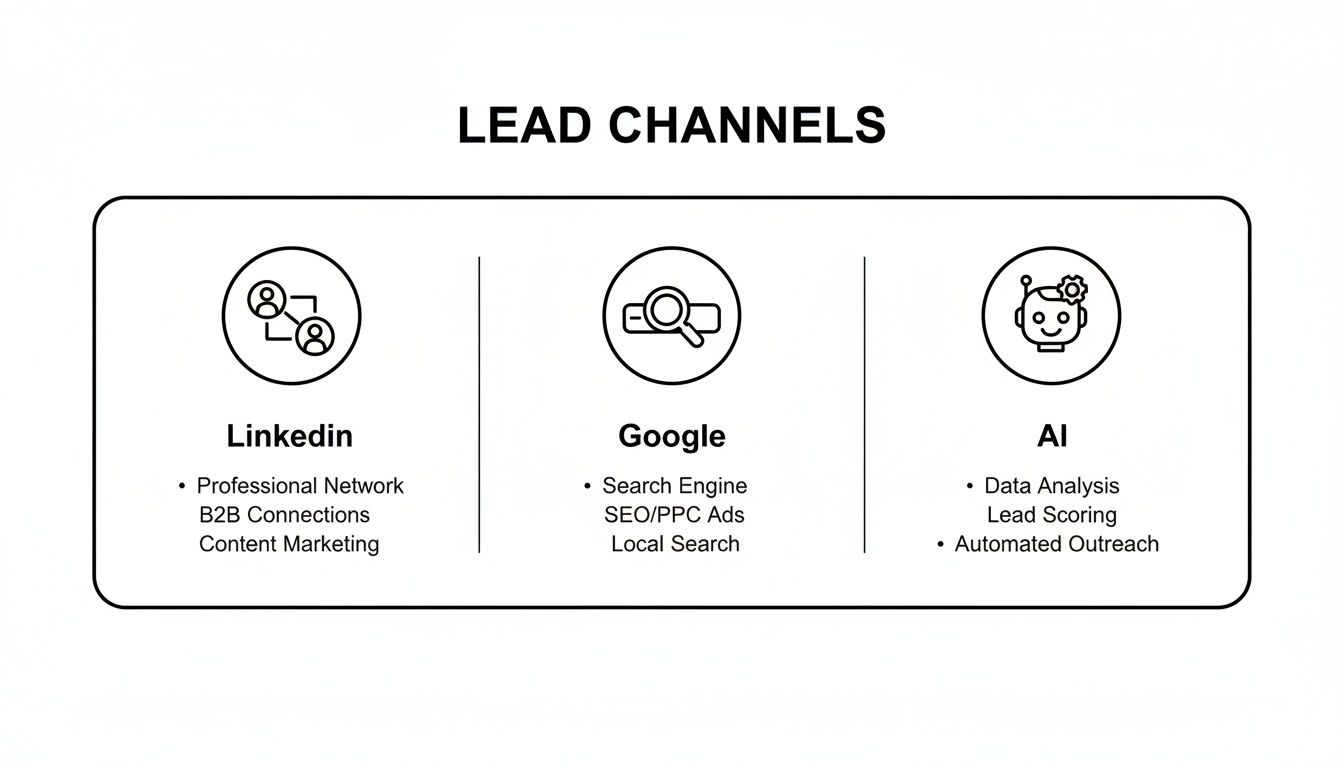
The main takeaway here is that AI acts as the central brain, making both your LinkedIn and Google strategies smarter and more efficient.
Identifying Your Hottest Prospects Instantly
How do you know which lead to call first? In the past, it was often a guessing game. Not anymore.
Today, AI-powered lead scoring provides the answer. It tracks a prospect's behavior—like which pages they visited on your website or how many emails they opened—and assigns a score. This system automatically flags the most engaged, sales-ready prospects for you. It tells you exactly who is showing buying intent, so your team can focus their energy where it matters most and dramatically lift conversion rates.
AI doesn't just find more leads; it finds the right leads at the right time. It turns your client pipeline from a random collection of names into a prioritised list of genuine opportunities.
Personalising Communication at Scale
Let’s be honest: generic, one-size-fits-all marketing messages are dead. Your customers expect you to understand their specific needs. AI makes this level of personalisation possible, even when you're communicating with hundreds or thousands of leads.
AI tools can automatically tweak email campaigns based on how a user has interacted with you before. For example, if a prospect downloaded your guide on property investment, the system can send them follow-up content specifically about that topic, building a much stronger connection. You can learn more about this on our blog covering how AI is being used for content creation in small to medium businesses.
Capturing Leads 24/7 with Intelligent Chatbots
What happens when a potential client lands on your website at 10 PM on a Saturday? Without AI, that lead is probably lost forever.
Intelligent chatbots can jump in and engage with visitors in real-time, any time of day. They can answer common questions, qualify prospects based on what they're looking for, and even book appointments directly into your calendar.
For example, a local law firm can use a chatbot to handle after-hours inquiries. The bot can ask a few qualifying questions and book initial consultations for high-value prospects, capturing leads that would have otherwise clicked away. For a deeper dive into these strategies, check out these insights on AI-Powered Lead Generation. This simple tool transforms your website into a 24/7 lead generation machine.
Turning Prospects Into Paying Clients

Getting potential clients to raise their hand is a great first step, but it's only half the battle. The real profit is made in the follow-up, turning a list of names into a pipeline of actual, paying clients. This is where strategic lead nurturing becomes the engine room of your growth.
Too many businesses treat a new lead like a guaranteed sale. They jump straight into a hard pitch, which often scares off prospects who are still in the early stages of their buying journey.
Effective lead nurturing is different. Think of it less like a sales pitch and more like building a professional relationship.
Building Trust Before the Sale
Lead nurturing is all about building trust and rapport with potential clients over time. You achieve this by providing consistent value and personalised communication, gently guiding them from "just looking" to "ready to buy."
It's a bit like dating. You wouldn't propose on the first date, would you? Of course not. You build a connection through conversation, shared experiences, and showing you actually understand the other person. The same principle applies here.
This approach is especially powerful for Australian businesses. In fact, local B2B companies with a mature lead nurturing process generate 50% more sales-ready leads at a 33% lower cost. For a service business, that’s not just a nice bonus; it’s the bridge from prospect to profit. You can dig into more of these trends and B2B marketing statistics via leadagency.com.au.
The Critical Role of Automation
Let's be realistic: manually tracking and following up with every single lead is impossible once your business starts growing. Important opportunities will inevitably slip through the cracks, and that costs you revenue.
This is where automation becomes your secret weapon. A modern lead generation service uses smart systems to ensure every prospect gets the right message at the right time—without you lifting a finger.
Here’s how that works in practice:
- Instant Follow-Up: The moment someone shows interest, the system can send a personalised welcome email.
- Drip Campaigns: Prospects receive a series of pre-written emails over days or weeks, with each one offering valuable advice or insights related to their problem.
- Behavioural Triggers: If a lead visits your pricing page, the system can automatically ping your sales team, letting them know it’s an ideal time for a personal call.
This automated process works 24/7 in the background, keeping your brand top-of-mind and building your credibility with every single interaction.
A top-tier lead generation service doesn't just deliver a list of contacts. It delivers a calendar full of qualified appointments with people who already understand your value and are keen to discuss how you can help them.
From Lukewarm Interest to Sales-Ready Conversations
The entire point of this nurturing process is to warm up your leads. You want to move them from being "problem aware" (they know they have an issue) to "solution aware" (they see you as the answer).
By the time a nurtured lead gets on a call with you, the conversation is completely different.
- They already know who you are.
- They understand what you do.
- They trust your expertise because you’ve already provided them with value.
This changes the entire dynamic. You’re no longer a stranger trying to sell something; you’re a trusted advisor discussing a solution. This saves you from wasting hours on discovery calls with unqualified prospects, letting you focus your energy on closing deals with those who are genuinely ready to move forward.
How to Choose the Right Lead Generation Partner
Picking a lead generation service isn’t just about outsourcing a task—it's about finding a partner to help you grow. But with so many agencies making big promises, it’s tough to sort the real experts from the slick salespeople. You need someone who’s genuinely invested in your success, not just in cashing your cheque.
Making the right call comes down to having a clear framework. By asking the right questions and knowing what to look for, you can vet potential partners and find one that truly aligns with your long-term goals.
Look for Proven Industry Experience
The very first question you should ask is: “Have you worked with businesses like mine before?” Generic strategies just don’t cut it. An agency with experience in your industry, whether you're a mortgage broker or an IT consultant, understands the unique challenges you face.
They’ll know what keeps your target audience up at night, the best channels to reach them, and the kind of messaging that actually gets a response.
Ask them for specific, verifiable proof:
- Industry-Specific Case Studies: Request detailed case studies from past clients in your sector. Look for real, measurable results, like an increase in qualified leads or a decrease in Cost Per Lead.
- Client Testimonials and References: A reputable agency will be more than happy to share testimonials or even connect you with a current client for a quick chat.
Scrutinise Their Strategy and Process
A top-tier lead generation service will never push a one-size-fits-all package. They should begin by conducting a deep dive into your business to build a strategy that’s tailor-made for you.
Their process should be transparent and logical, clearly explaining how they plan to attract, engage, and nurture leads. If an agency can’t explain their plan beyond “we’ll get you more leads,” that’s a massive red flag.
A partner sells you a strategic outcome; a vendor sells you a list of tasks. Make sure you’re hiring a partner who can explain the "why" behind every action, from the channels they choose to how they follow up.
Demand Transparency in Reporting
Vague promises are worthless. Real results are found in the data. A trustworthy partner will be an open book with their reporting and focus on the numbers that actually impact your bottom line.
They should provide regular, easy-to-understand reports that track key performance indicators (KPIs) like:
- Cost Per Lead (CPL): How much you're actually paying for each new prospect.
- Lead-to-Client Conversion Rate: The percentage of leads that become paying customers.
- Sales Qualified Leads (SQLs) Generated: The number of prospects who are genuinely ready to discuss business.
If an agency seems hesitant to discuss these metrics or only talks about vanity numbers like impressions or clicks, be cautious. True partners hold themselves accountable for delivering a real return on your investment and are eager to show you the numbers to prove it.
This checklist is a simple guide to use when you're evaluating potential partners.
Vendor Evaluation Checklist
| Evaluation Criterion | What to Look For | Red Flag to Avoid |
|---|---|---|
| Industry Expertise | Demonstrable experience and case studies in your specific niche or a closely related one. | Vague claims of success without any industry-specific proof or relevant examples. |
| Customised Strategy | A detailed proposal that is tailored to your unique business goals, target audience, and market. | A generic, pre-packaged solution that they offer to every client regardless of their needs. |
| Reporting & Metrics | A clear focus on business-critical metrics like CPL and conversion rates, with transparent reporting. | An emphasis on vanity metrics like "reach" or "impressions" without connecting them to revenue. |
| Guarantees | A focus on process, strategy, and delivering qualified opportunities over a set period. | Unrealistic promises of a specific number of leads, which often prioritises quantity over quality. |
Use these points to cut through the sales pitches and find a lead generation agency that will act as a true extension of your team.
Building Your Predictable Client Pipeline

Tired of the feast-or-famine cycle? Transitioning your business from an unpredictable client flow to a state of steady, reliable growth isn't a mythical quest. It’s about building a system—a clear, step-by-step roadmap that turns abstract strategy into concrete action.
The goal is to give you back control and confidence, knowing that a pipeline full of your ideal clients is not just possible, but predictable. With the right plan, you can build an automated engine that consistently brings new business through the door.
Step 1: Define Your Ideal Client Profile
Everything starts here. If you don't know exactly who you're targeting, you're just shouting into the void. A vague target like "small businesses" simply won't cut it. You need to get specific and build a detailed Ideal Client Profile (ICP).
This means digging into their industry, job title, company size, and—most importantly—their pain points. What problems are keeping them up at night? What are they trying to achieve that you can help with? The clearer this picture is, the more your marketing will resonate. A sharp ICP is the bedrock of any successful lead generation campaign.
Step 2: Select Your Core Acquisition Channel
Don't try to be everywhere at once. Spreading your team (and your budget) too thin is a classic mistake that guarantees mediocre results across the board. The smarter move is to focus your energy on mastering the one or two channels where your ideal clients actually spend their time.
- For B2B professionals? LinkedIn is almost always the undisputed champion, thanks to its powerful targeting options.
- For local services? Dominating Google with targeted SEO and Ads is your best bet for capturing customers who are ready to buy.
Pick your main channel based on where your ICP lives online. Once you've established a consistent flow of leads from that primary source, then you can consider expanding. This focused approach ensures you get the best possible return from the start.
Building a predictable pipeline isn’t about chasing every possible lead; it’s about systematically attracting the right ones. This shift from quantity to quality is what separates struggling businesses from those that scale with ease.
Step 3: Deploy an Automated Nurturing System
So, a lead shows interest. What happens next is critical. This is where automation becomes your secret weapon, ensuring no opportunity ever falls through the cracks again. A well-built nurturing system works around the clock to build relationships for you.
This system can send out personalised email sequences, deliver helpful content, and track engagement to flag the hottest prospects for you. To make this work, you'll need the right tech, including the best data enrichment tools for scalable growth. It ensures your follow-up is not just consistent, but genuinely relevant and helpful.
Step 4: Measure, Analyse, and Optimise for Growth
Your lead generation system isn't a "set and forget" machine. Think of it as a high-performance engine that needs regular monitoring and fine-tuning to run at its best. This means you must get comfortable with the numbers.
Keep a close eye on key metrics like your Cost Per Lead (CPL) and your lead-to-client conversion rate. This data tells you exactly what’s working and what’s not. By constantly analysing your performance, you can make smart, data-driven decisions to tweak your campaigns, sharpen your messaging, and ultimately, reduce your client acquisition costs while boosting revenue.
Got Questions About Lead Generation Services? We Have Answers.
If you’re considering bringing in a professional service to handle your lead generation, you’re bound to have some questions. It’s a big decision, and getting straight, honest answers is the only way to move forward with confidence.
Let's unpack some of the most common queries we hear from Australian business owners.
What's the Real Cost of a Lead Generation Service?
This is usually the first question on everyone's mind, and the honest answer is: it varies. A lead generation service isn’t a fixed cost like your internet bill; it's a direct investment into your business’s revenue engine. The pricing is almost always tied to the results and value you receive.
Here are the typical models you'll encounter:
- Monthly Retainer: A set fee each month for ongoing work like strategy, SEO, content, and campaign management. This is ideal for a long-term, comprehensive approach.
- Performance-Based: You pay per qualified lead, per booked appointment, or even a percentage of the revenue generated. This model means the agency only wins when you do.
- Hybrid Model: A mix of both—usually a smaller retainer to cover foundational work, plus performance bonuses for hitting specific targets.
A realistic budget can start from a few thousand dollars a month for a tightly focused campaign and can increase significantly for a competitive national market across multiple channels. The key is to shift your mindset from seeing it as an expense to seeing it as the fuel for predictable, scalable growth.
How Fast Will I Actually See Results?
The timeline depends heavily on the chosen strategy. It’s crucial to set the right expectations from the start because different channels are built for different speeds.
Analogy: Think of it like planting a garden. Paid ads are like fast-growing annuals that can produce flowers (leads) almost immediately. Organic strategies like SEO and LinkedIn authority-building are like planting fruit trees—they take time to grow strong roots but deliver compounding returns for years to come.
Paid advertising, like Google Ads, can have traffic and enquiries flowing within a matter of days. But for a truly sustainable pipeline that works for you 24/7, organic channels are the way to go. An SEO campaign might take three to six months to start gaining significant traction, but the high-quality, 'free' leads it generates long-term are invaluable.
Should I Do This In-House or Just Hire Someone?
Ah, the classic "build versus buy" dilemma. While keeping lead generation in-house is an option, it's a massive commitment that many business owners underestimate.
Going the DIY route means you need to find:
- Time: This isn't a set-and-forget task. It requires daily effort to manage campaigns, create content, and follow up with leads.
- Expertise: You'll need to become a jack-of-all-trades, mastering everything from copywriting and SEO to ad management and marketing automation. It’s a steep learning curve.
- Tools: The professional software needed for analytics, outreach, and automation comes with hefty subscription fees.
Hiring a specialised lead generation service is about getting results faster and more efficiently. You get to skip the trial-and-error phase and avoid the costly mistakes that come with learning on the job. A good partner brings proven systems, deep industry knowledge, and a focused team, freeing you up to do what you do best—serving the new clients they bring through your door.
Ready to build a predictable client pipeline without the guesswork? Homer Digital Marketing uses proven LinkedIn, Google, and AI-driven strategies to help service businesses scale. Book a no-obligation strategy call with us today and let's talk about fuelling your growth.
