

Lead generation is the process of finding and attracting potential customers for your business. It’s the very first step in building a relationship that can turn a complete stranger into a loyal, paying customer. It's the engine that fuels your entire sales process from start to finish.
What Is Lead Generation and Why It Matters
Imagine your business is a fishing boat. You could have the best gear and a top-of-the-line vessel, but if you don’t know where the fish are biting, you’ll come home empty-handed.
Lead generation is how you find those hot fishing spots. Without a steady stream of new leads, a business simply can’t grow. It’s the lifeblood that keeps your sales pipeline full, making sure that as you close deals with current prospects, new ones are always ready and waiting. For Australian service businesses, getting this right isn’t just a nice-to-have; it's essential for survival and sustainable growth.
The Difference Between Leads and Prospects
It’s easy to throw the words "lead" and "prospect" around interchangeably, but they mean two different things. Nailing this distinction is key to keeping your sales efforts organised and effective.
-
A lead is someone who has shown some initial interest in your business. Maybe they downloaded a free guide or signed up for your newsletter. They've handed over their contact details, but you haven't yet figured out if they're a good fit for what you offer.
-
A prospect is a lead who has been qualified. Your team has done the homework and confirmed they match your Ideal Customer Profile (ICP), have a genuine need for your service, and have the authority to actually make a buying decision.
Basically, every prospect starts out as a lead, but not every lead will become a prospect. Your real goal is to attract high-quality leads who have a strong chance of converting into prospects and, eventually, happy customers.
How Lead Generation Fuels the Sales Funnel
The sales funnel is a way to visualise the journey a potential customer takes, from the moment they first hear about you to when they finally make a purchase. Lead generation is what gets the whole thing started by feeding the very top of this funnel.
This infographic breaks down the standard sales funnel, showing exactly where lead generation fits in. It’s the bridge between someone being vaguely aware of you and actively showing interest.
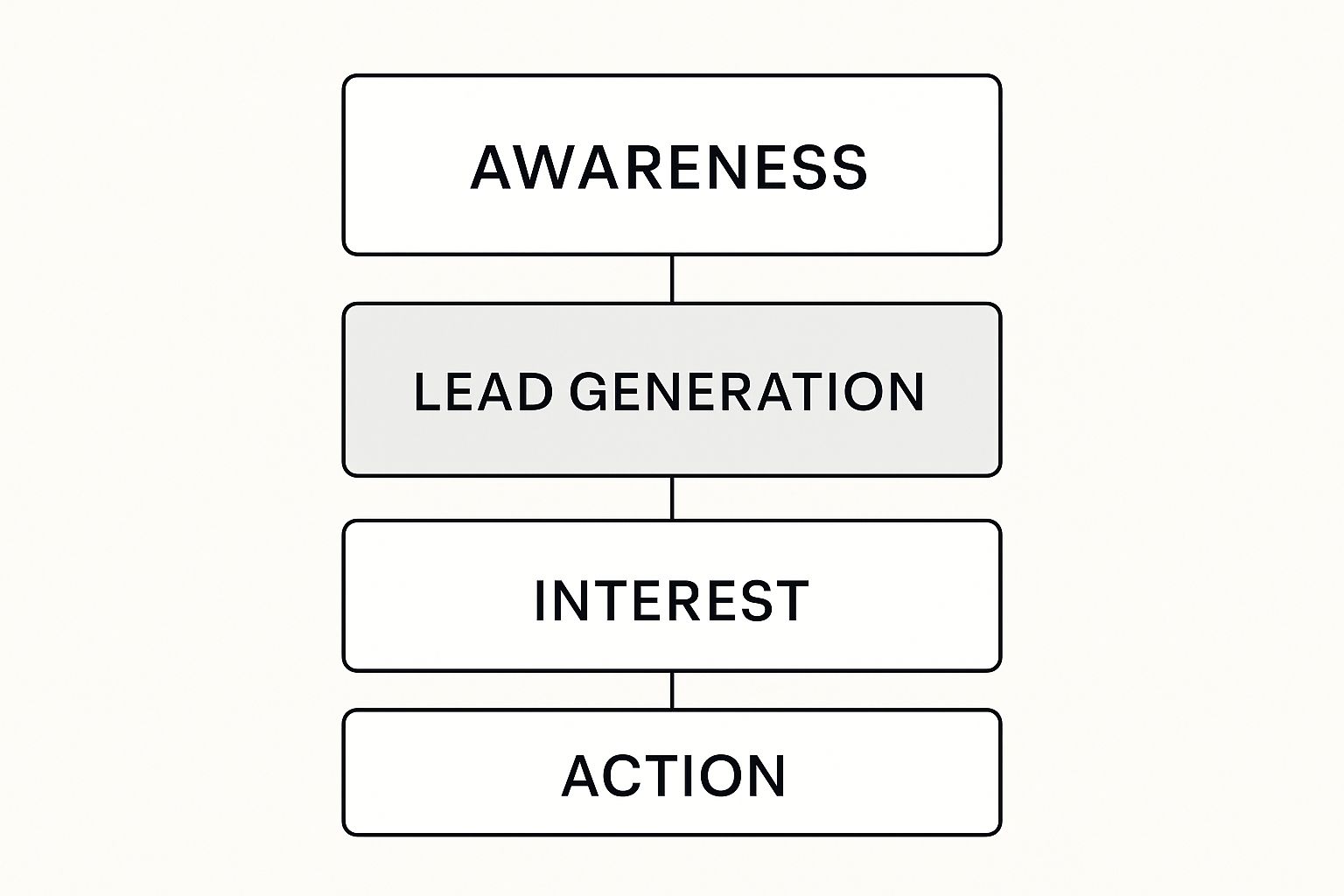
As you can see, lead generation grabs the attention of people in the 'Awareness' stage and pulls them down into the 'Interest' stage, officially bringing them into your world.
By focusing on attracting the right people at the top, you build a much more efficient and profitable system. A strong lead generation strategy means your sales team spends its valuable time talking to qualified people who are genuinely interested, instead of wasting hours chasing cold contacts with zero potential. This strategic focus is what separates businesses that struggle from those that scale.
Building a Modern Lead Generation Framework
Great lead generation never happens by accident. It's the result of a smart, well-designed framework that lines up your marketing with what your ideal clients actually need. The old way of just collecting a list of contacts is dead. Success today demands a strategic blueprint.
Think of this framework as the operating system for your business growth. It ensures every blog post, every ad, and every conversation has a clear purpose. It shifts you from random tactics to a cohesive system that consistently attracts, nurtures, and converts the right people for your service business.
The first, most critical step? Defining exactly who you’re trying to attract. Without this clarity, you're just throwing money and time into a void, marketing to people who will never buy from you.
1. Define Your Ideal Customer Profile
Your Ideal Customer Profile (ICP) is a sharp, detailed description of the perfect client for your business. This is way more than basic demographics like age or city. A strong ICP paints a crystal-clear picture of the organisations you’re built to serve.
So, what makes a client the perfect fit? Think about specific attributes like their industry, company size, annual revenue, and the common headaches they face every day. A well-defined ICP is the bedrock of your entire lead generation strategy.
To get started on your ICP, ask yourself these questions:
- What industry are my best clients in? (e.g., real estate, allied health, recruitment)
- What's their typical business size or revenue? This helps you qualify leads on a financial level.
- What specific problems does my service solve for them? Your messaging has to hit these pain points directly.
- Where do they hang out online for information? (e.g., LinkedIn, industry blogs, Google searches)
Answering these questions ensures you put your resources where they’ll have the biggest impact, attracting leads who aren't just curious, but are a perfect match for what you do.
2. Map the Customer Journey
Once you know who you're targeting, you need to understand how they think and make decisions. Mapping the customer journey is all about outlining every single touchpoint a potential client has with your brand, from the moment they first hear about you to the day they sign on.
This journey is never a straight line; it's a winding path with multiple stages and channels. A prospect might find you through a Google search, follow your business on LinkedIn, and then join a webinar before they even think about speaking to your team. Understanding this path is crucial for saying the right thing at the right time. A solid framework needs core components, and you can learn more with this complete guide to marketing funnels.
By mapping out this process, you can spot key moments to engage with prospects and gently guide them toward becoming a paying client.
3. Create Irresistible Lead Magnets
A lead magnet is a valuable piece of content you give away for free in exchange for an email address or phone number. It’s the heart of inbound lead generation. But let’s be honest—a generic "free guide" just doesn't cut through the noise anymore.
Your lead magnet has to solve a specific, urgent problem for your ICP. The more relevant and genuinely helpful it is, the more likely your ideal customers are to hand over their details for it.
A great lead magnet doesn’t just generate a contact; it pre-qualifies them. By offering a solution to a specific problem, you attract individuals who are already signalling their need for your expertise, making them warmer and more convertible leads.
Think about creating lead magnets like these:
- A detailed checklist for a complex process in their industry.
- An exclusive case study showing real, tangible results for a similar business.
- A free tool or template that makes a daily task easier.
- An on-demand webinar that teaches a valuable skill they can use immediately.
4. Embrace Data-Driven Strategies
The lead generation landscape is always changing, especially here in Australia. Relying on gut feelings is a recipe for disaster. A modern framework is built on data, letting you make smart decisions and constantly fine-tune your approach. In the Australian market, strategies have moved on from old-school methods like cold calling. By 2025, companies are leaning into AI-powered lead scoring and omnichannel engagement.
This means using tools to track where your best leads come from, using AI to score them based on how they interact with you, and collecting your own first-party data to build deeper relationships. By analysing what actually works, you can double down on the channels that deliver and stop guessing with your marketing budget.
Exploring High-Impact Lead Generation Channels
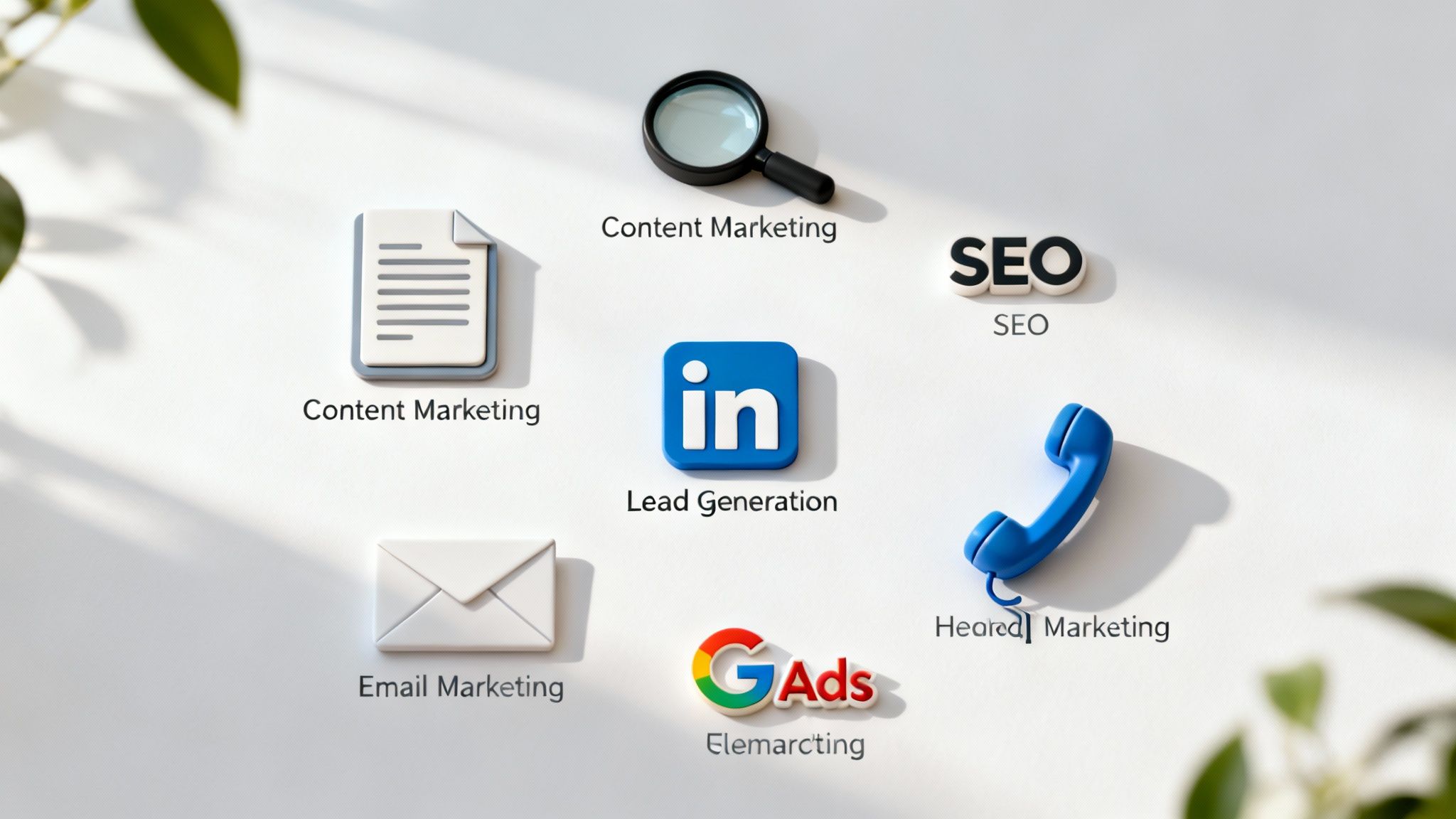
Once your framework is sorted, the next big question is: where do you actually find your ideal customers? This is where channels come in, and not all lead generation channels are created equal.
Think of it like fishing. You wouldn't cast a net in a tiny pond hoping to catch a marlin. The best channels are simply the places where your Ideal Customer Profile (ICP) already hangs out.
The goal isn’t to be everywhere. It's to choose a smart mix of inbound and outbound methods that work in harmony, creating a steady stream of qualified leads for your business.
5. Inbound Channels That Draw Customers In
Inbound is all about attraction. Instead of chasing people down, you create valuable, helpful content that naturally pulls your target audience toward you. It positions your business as the go-to expert, the one they trust before they’re even ready to buy.
Content Marketing and SEO
Content is the engine of any good inbound strategy. This means creating articles, guides, and videos that directly answer the questions your ideal clients are punching into Google every single day.
When you pair great content with Search Engine Optimisation (SEO), it becomes a magnet for organic traffic. By targeting the right keywords, you make sure your business pops up the very moment someone needs what you offer. To really get this right, you need solid strategies for increasing organic website traffic.
Social Media Marketing
Social media isn’t just for posting updates—it’s where you build communities and relationships that turn into real business. For Australian service-based businesses, LinkedIn is an absolute powerhouse.
It’s the number one platform for B2B professionals to find decision-makers, share valuable insights, and establish genuine authority. A strong, consistent presence here will lead directly to high-quality sales conversations. If you want to get this right, our in-depth guide to optimising your LinkedIn lead generation strategy is a must-read.
Of course, other platforms have their place. Instagram and Facebook can be brilliant for B2C services or visually-driven industries like design, wellness, or real estate.
6. Outbound Channels for Proactive Growth
While inbound marketing pulls leads in, outbound is about proactively reaching out. When done right, it's not pushy—it’s a direct and highly effective way to fill your pipeline with ideal prospects.
Paid Advertising
Platforms like Google Ads and Meta Ads (Facebook/Instagram) let you put your message right in front of a laser-targeted audience. You can dial in on people based on their location, interests, online habits, and even the exact terms they’re searching for.
This makes paid ads one of the fastest ways to get leads in the door. You drive traffic to a specific landing page with a clear offer, capturing details from people who are actively looking for a solution like yours. It’s fast, scalable, and you can measure every dollar.
Strategic Email Marketing
Email is still one of the most reliable channels out there. Once someone gives you their email address (usually in exchange for a helpful guide or checklist), you can use automated sequences to build trust and guide them toward a sale.
This isn’t about spam. It’s about delivering value at the right time, solving their problems, and keeping your business top-of-mind. A smart email strategy can warm up cool leads until they’re ready to have a conversation.
Comparing Lead Generation Channels
To make sense of it all, it helps to see how these channels stack up against each other. Each has its own strengths when it comes to cost, effort, and the type of results you can expect.
| Channel | Primary Use Case | Cost Level | Time to Results |
|---|---|---|---|
| SEO & Content | Building long-term authority and organic traffic | Medium | Slow (6-12 months) |
| Social Media | Community building and brand awareness | Low to Medium | Medium (3-6 months) |
| Paid Ads | Generating immediate, targeted leads | High | Fast (Days/Weeks) |
| Email Marketing | Nurturing existing leads into customers | Low | Medium (1-3 months) |
Ultimately, the best approach is rarely just one of these. A powerful strategy combines the long-term asset building of SEO with the immediate impact of paid ads, all supported by strong social media and email nurturing.
7. Choosing Your Essential Technology Stack
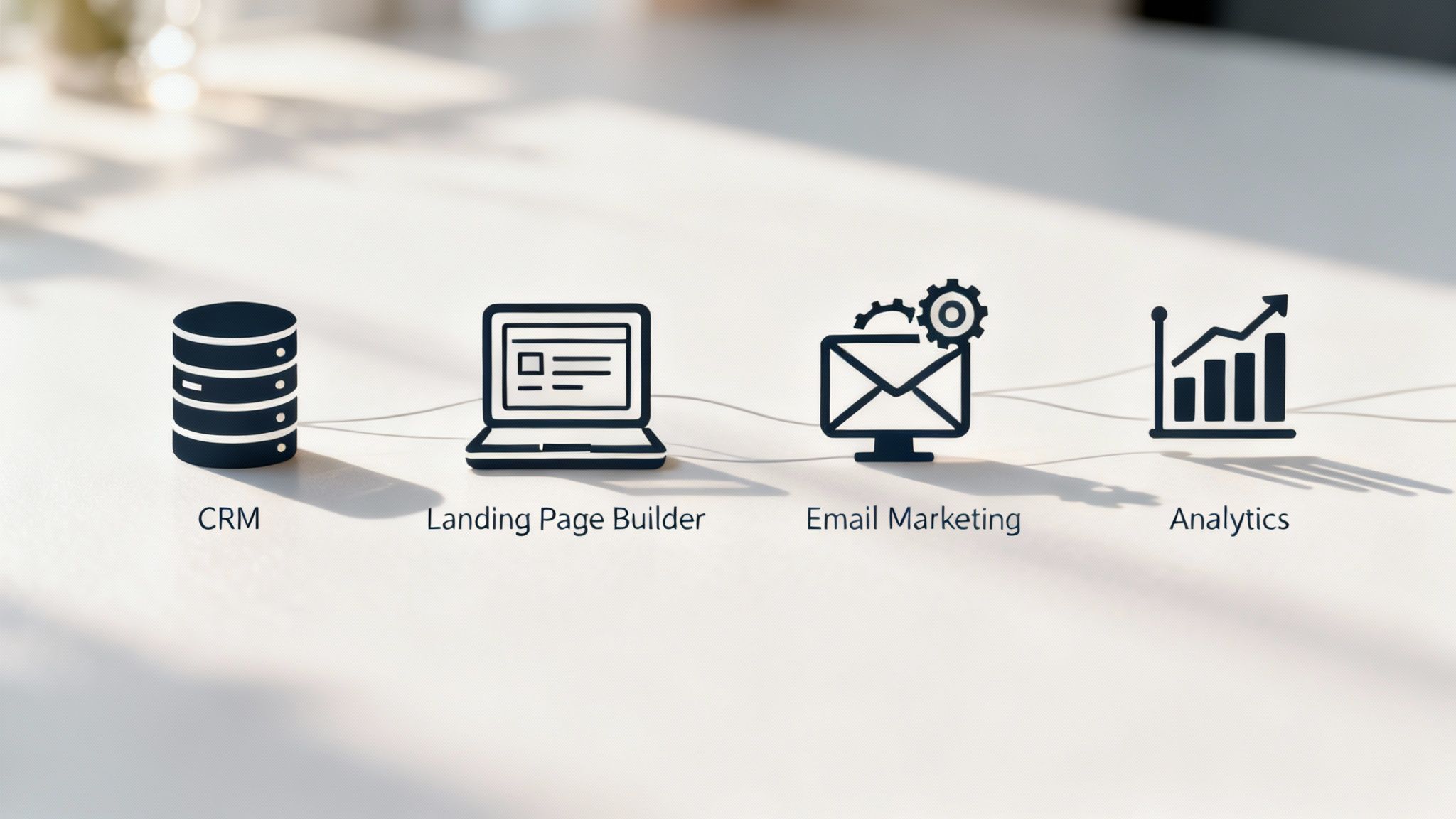
A solid lead generation framework is powerful, but without the right tools, it’s like trying to build a house with your bare hands. The right technology stack doesn’t just make your job easier; it’s a force multiplier that automates the grunt work and gives you the data you need to make smarter decisions.
Think of your tech stack as the central nervous system of your marketing. It connects every touchpoint, from the first time someone lands on your website to the moment they sign on as a client. The good news? Building this system doesn't have to be complicated or break the bank.
The trick is to pick tools that play well together, serve a clear purpose, and can grow with your business. Let’s break down the must-have categories every Australian service business should have in their toolkit.
Customer Relationship Management (CRM) Systems
Your Customer Relationship Management (CRM) system is the heart of your entire lead generation operation. It’s so much more than a digital address book—it's a central database that tracks every single interaction you have with a prospect or client.
A good CRM logs emails, phone calls, website visits, and downloads, giving you a complete 360-degree view of each contact. For marketing and sales teams, that kind of insight is pure gold.
Popular options include:
- HubSpot: Known for its user-friendly interface and a powerful free version that makes it a great starting point for small businesses.
- Salesforce: A highly customisable and scalable platform, perfect for larger businesses with more complex sales processes.
Ultimately, a CRM stops high-value leads from falling through the cracks and makes the handover from marketing to sales completely seamless.
Landing Page and Conversion Tools
When you run an ad campaign, you need a dedicated place to send all that traffic. That’s where a landing page comes in. It's a standalone web page designed with a single goal in mind: conversion. It strips away distractions like site navigation to focus a visitor's attention on one specific call to action.
Tools in this category make it ridiculously simple to build, test, and launch high-converting pages without needing a developer on standby.
Effective landing pages are non-negotiable for paid campaigns. They ensure your ad spend is directed towards an experience optimised for one thing—capturing lead information. This focus dramatically increases your conversion rates.
Check out platforms like:
- Leadpages: Offers a huge library of proven templates that you can customise in minutes.
- Instapage: Provides more advanced features for personalisation and A/B testing to really dial in your performance.
These tools are built to turn clicks into qualified leads far more effectively than a standard page on your website ever could.
Email Marketing and Automation Platforms
Once you’ve captured a lead, the real work begins. Email marketing is your primary channel for nurturing that new relationship, building trust, and guiding the prospect toward a sale. Automation platforms take this to the next level.
They let you create "drip campaigns" or automated sequences that send the right message to the right person at exactly the right time, triggered by their actions. For instance, if someone downloads a guide about a specific service, you can automatically send them a series of emails with related case studies and tips. This level of personalisation is a game-changer. For an in-depth look, explore our guide on marketing automation for small business.
Top contenders here are Mailchimp and ActiveCampaign. Both offer powerful automation features that help you nurture leads on autopilot, freeing you up to focus on closing deals.
Solving Common Lead Generation Challenges
Let's be honest. Even the slickest lead generation strategy hits a wall eventually. The theory is great, but the reality of attracting clients who are actually a good fit? That’s a whole different ball game. These roadblocks aren't a sign you’ve failed; they’re just part of the process.
For most Australian service businesses, the headaches are pretty much the same. You might be getting plenty of leads, but none of them are the right kind. Or maybe your data is a complete mess, your marketing campaigns are falling flat, and there’s a massive disconnect between what marketing promises and what the sales team hears on the phone.
This isn’t about theory anymore. This is a practical, no-fluff guide to fixing what’s broken.
8. Tackling Low-Quality Leads
This is probably the most common complaint we hear: a pipeline crammed with tyre-kickers. These are the people who download your freebie but have zero budget, no decision-making power, or are just a terrible match for what you do. It almost always comes down to a mismatch between your marketing message and your Ideal Customer Profile (ICP).
The fix? Get tighter with your targeting and qualify leads before they ever get near your sales team.
- Refine Your ICP: Seriously, go back and look at your Ideal Customer Profile. Is it truly specific? Your ads, your content, and your website copy need to speak directly to the real-world pains of that one person.
- Strengthen Your Lead Magnets: Stop offering generic checklists that appeal to everyone. Create a resource that solves a very specific, high-value problem. A guide on a niche industry challenge will attract serious prospects, not just freebie hunters.
- Improve Your Forms: Add one or two qualifying questions to your forms. Simply asking for "Company Size" or "Biggest Business Challenge" is an easy way to automatically filter out the people who aren’t a good fit from the start.
9. Bridging the Marketing and Sales Gap
Ah, the classic tug-of-war between marketing and sales. Marketing is celebrating 100 new leads, while the sales team is grumbling that 95 of them were useless. This friction doesn't just waste money and time; it creates a toxic internal culture.
The solution is surprisingly simple: get both teams to agree on the rules of the game.
The most powerful way to align your teams is with a Service Level Agreement (SLA). Think of it as a formal peace treaty. It clearly defines what a "qualified lead" actually is and who is responsible for what. It turns subjective finger-pointing into an objective, data-backed conversation.
A good SLA needs to spell out three things:
- The exact criteria a lead must meet before being handed over to sales.
- The timeframe sales has to follow up with that qualified lead.
- How sales will give feedback to marketing on lead quality (so marketing can improve).
This one document builds accountability and turns lead generation into a team sport instead of a blame game.
10. Overcoming Inaccurate Data
Bad data is the silent killer of any lead generation campaign. You can have the best strategy in the world, but if you’re working with wrong phone numbers, old email addresses, and duplicate contacts, you’re just shouting into the void. It’s a huge problem in the Australian B2B space.
Keeping your data clean isn’t just a nice idea; it’s fundamental to a healthy pipeline. Regularly cleaning and updating your database means your emails actually land in the right inbox and your sales team isn't wasting hours on dead ends.
One Australian business saw a staggering 35% conversion rate from appointment to proposal, simply by using professional telemarketers who were armed with accurate, verified data. It allowed them to get straight to the key decision-makers. You can dive deeper into how targeted tactics deliver results and get more insights from Telemarketing Professionals' lead generation research.
How to Measure and Optimise Your Strategy
Running a lead generation campaign without measuring it is like driving with your eyes closed. You might be moving, sure, but are you even on the right road? To see any kind of real return on your investment (ROI), you have to treat your strategy like a living thing—something that needs constant attention and tweaks.
This isn’t about chasing vanity metrics. It's about focusing on the numbers that actually hit your bottom line. Tracking your performance is the only way you can make smart, data-backed decisions instead of just guessing what works.
11. Define Your Key Performance Indicators
To know if you’re winning, you need to define the scoreboard. That’s where Key Performance Indicators (KPIs) come in. These are the core numbers that give you a clear, honest picture of your campaign’s health.
For a service business, these three are non-negotiable:
- Cost Per Lead (CPL): This tells you exactly how much you're spending to get a single new lead in the door. It’s your first checkpoint for financial efficiency across different channels.
- Customer Acquisition Cost (CAC): This is the big one—the total cost to turn a lead into a paying customer. It gives you the full picture of your sales and marketing engine's performance.
- Lead-to-Customer Conversion Rate: This percentage shows how many of your leads actually sign on the dotted line. It’s a direct measure of your lead quality and how effective your sales process is.
Knowing these numbers is one thing, but making sense of them can get tricky. We break down the challenges and solutions in our guide on why it is difficult to measure marketing ROI.
Your goal isn’t just to track these KPIs, but to understand the story they tell. A high CPL from one channel might be acceptable if those leads have a much higher conversion rate, resulting in a lower overall CAC.
12. Implement A/B Testing for Continuous Improvement
Once you have your data flowing, you can start making things better. A/B testing, sometimes called split testing, is a powerfully simple way to improve every piece of your campaign.
The idea is to create two versions of one thing—a landing page headline, an email subject line, or a button colour—and test them against each other to see which one gets better results.
This approach takes the guesswork out of the equation. It allows you to make tiny, incremental improvements that add up to massive gains over time. The key takeaway here is that lead generation is never "set and forget." It’s a constant cycle of testing, learning, and refining to get consistently better results.
Frequently Asked Questions About Lead Generation
Alright, let's wrap this up by tackling some of the most common questions service-based businesses ask when they're ready to get serious about lead generation. Getting your head around these points will help you set realistic expectations and put your money where it matters most.
How Long Does It Take to See Results?
This is the million-dollar question, and the honest answer is: it really depends on the channels you choose. The timeline for seeing a return can vary wildly.
-
Paid Advertising (Google Ads, Social Media Ads): This is the fast lane. You can see new leads trickle in within days—sometimes even hours—of launching a campaign. You're paying for immediate visibility in front of your target audience.
-
Content Marketing & SEO: This is a long-term play. It generally takes a solid 6 to 12 months of consistent work to build authority, earn trust, and start ranking for the keywords that bring in high-value clients. The payoff? The leads you generate are often far better quality and cheaper in the long run.
Think of it this way: paid ads are like renting a house, while SEO is like buying one. Renting gives you a roof over your head tonight, but buying builds an asset that pays dividends for years to come.
What Is the Difference Between Inbound and Outbound Lead Generation?
Understanding this is crucial for building a strategy that actually works. The main difference comes down to who starts the conversation.
Inbound lead generation is all about attracting customers to you. You create valuable content and experiences they're already looking for, which pulls them into your world. Outbound lead generation is when you proactively reach out to potential customers, pushing your message out to them.
Inbound tactics are things like SEO, blogging, and creating helpful social media content that naturally draws people in. Outbound tactics include paid ads, direct email outreach, or even cold calling—anything where you make the first move. A strong, modern strategy mixes both to keep the pipeline full.
How Much Should a Small Business Budget for Lead Generation?
There’s no magic number here, but a good rule of thumb for an established business is to set aside 5-10% of total revenue for your marketing budget. A big chunk of that will naturally go towards lead generation.
For a new business or one that’s really pushing for growth, that figure might need to be higher—think closer to 12-20%—to get some initial traction and carve out a space in the market.
The key is to start small, measure everything, and then double down on what’s actually working. Instead of spreading your budget thin across a dozen different platforms, prioritise the one or two channels that are proven to deliver the highest-quality leads for your specific industry.
Ready to stop guessing and start growing? Homer Digital Marketing builds proven, AI-powered marketing systems that attract your ideal clients on autopilot. We combine LinkedIn optimisation, Google visibility, and expert content strategies to deliver real, measurable results for service-based businesses.
