
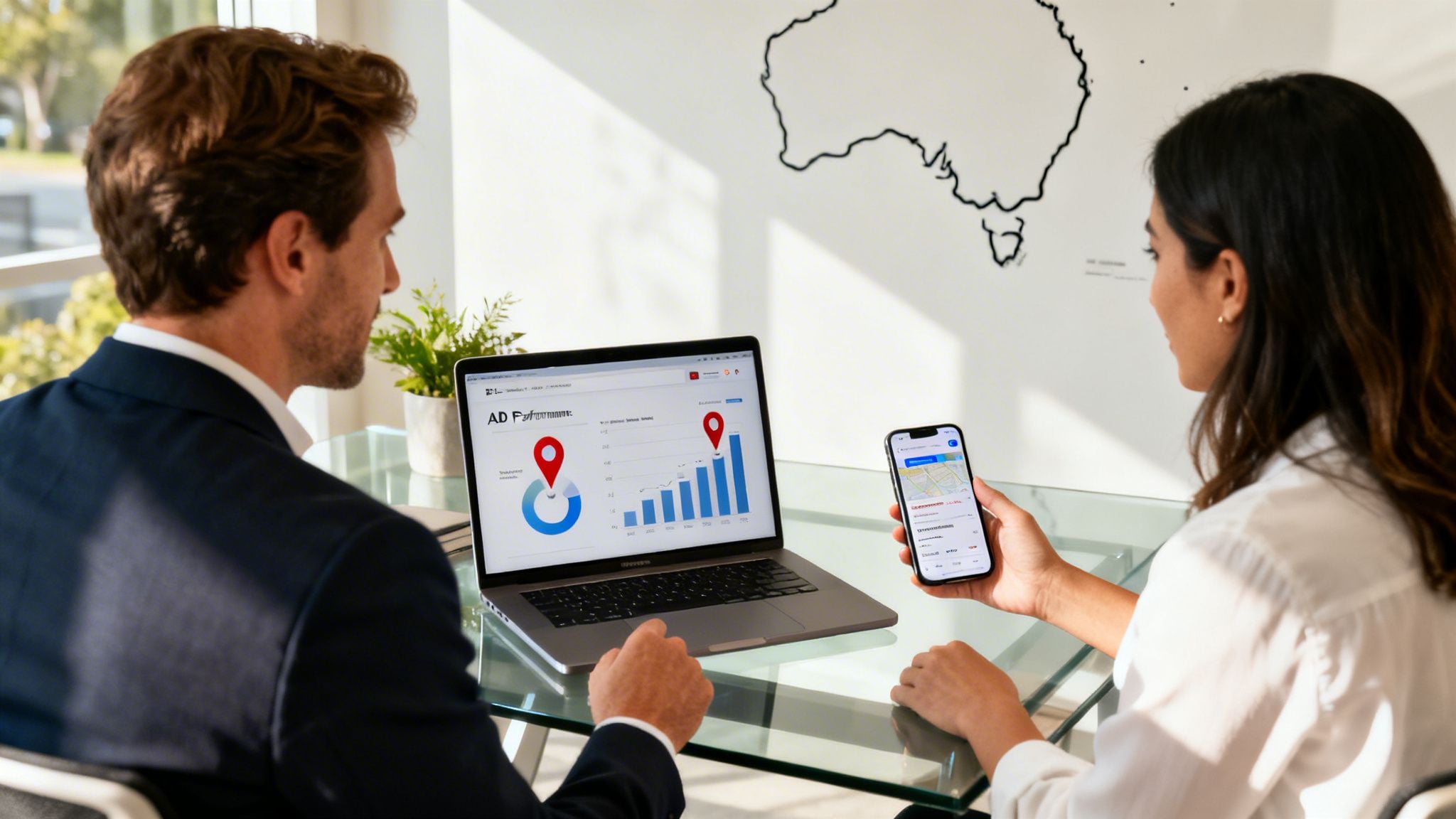
When you search for a “Google Ads agency near me,” you’re not just looking for a service provider down the road. You’re seeking a strategic partner with a home-ground advantage. A local Australian agency understands the nuances of your specific market, from Melbourne's bustling café scene to Brisbane's competitive tradie landscape, and can turn that local knowledge into a powerful asset for your campaigns.
This guide provides a research-driven framework for Australian businesses to identify, vet, and partner with a top-tier local Google Ads agency. We will analyze the key criteria, pricing models, and questions you need to ask to find a partner that delivers a tangible return on investment.
Why Local Google Ads Expertise Matters in Australia

For a service business in Australia, success with Google Ads isn’t just about bidding on the right keywords. It’s about connecting with your local community in a way that feels authentic and relevant.
An agency that’s part of your community inherently understands the market because they operate within it. This firsthand insight leads to smarter, more effective campaign strategies. A local partner knows the seasonal trends, the main competitors, and the geographic opportunities a remote agency would likely overlook.
For example, an agency in Perth instinctively knows how summer heatwaves drive demand for air conditioning repairs. A Sydney-based team understands which suburbs are hotspots for professional services. This is contextual knowledge that can't be gleaned from data alone.
Let's break down the key differences between partnering with a local expert versus a remote or overseas agency.
Local vs. Remote Google Ads Agency: An Analytical Comparison
The decision between a local and a remote agency hinges on your business priorities. This table provides a clear snapshot of the trade-offs.
| Factor | Local Agency ('Near Me') | Remote/Overseas Agency |
|---|---|---|
| Market Knowledge | Deep understanding of local culture, terminology, and seasonality. | General knowledge; may miss crucial local nuances. |
| Competitor Insight | Knows the local players and their real-world tactics. | Relies on software and data, which can lack real-world context. |
| Time Zone | Operates in your time zone (AEST/AWST, etc.) for real-time collaboration. | Can cause significant delays in communication and campaign adjustments. |
| Communication | Facilitates face-to-face meetings and clear, direct communication. | Primarily email or scheduled video calls, with potential for language barriers. |
| Cost | Generally higher due to local operating costs and GST. | Often cheaper, but may result in lower quality service or results. |
| Accountability | High accountability; their local business reputation is at stake. | Can be more difficult to hold accountable if issues arise. |
While a remote agency might appear more cost-effective initially, the value derived from genuine local insight often delivers a superior return on investment, particularly for service-based businesses.
The Power of Hyper-Local Targeting
One of the most significant advantages of a local agency is its mastery of hyper-local targeting. This is essential if your business serves a specific geographic area, such as:
- Dentists in Adelaide
- Lawyers in Melbourne's CBD
- Plumbers covering Sydney's North Shore
- Real estate agents on the Gold Coast
An agency with local insight can craft ad copy that speaks directly to the community, referencing local landmarks, events, or terminology to create an immediate connection. This builds a level of trust and relevance that a generic, nationwide campaign can never achieve.
Data consistently shows that hyper-local targeting can drive significantly higher conversion rates compared to broad national campaigns.
By understanding the unique character of your city or region, a local agency can transform your Google Ads from a simple online advertisement into a powerful tool for community engagement and customer acquisition.
Nuanced Market Insights and Competitor Awareness
Beyond geography, a local agency possesses a deeper understanding of the competitive landscape. They are aware of other players in your field, their marketing strategies, and existing market gaps.
This allows them to be more agile. For example, they might observe a local competitor focusing heavily on one service and advise you to pivot, targeting an underserved niche or emphasizing your unique selling proposition in your ads.
This level of tactical awareness is difficult to achieve without a presence on the ground. It also directly contributes to strengthening your entire digital footprint, especially your Google Business Profile.
Ultimately, searching for a "Google Ads agency near me" is about finding a partner who not only understands Google Ads but also understands your specific market. This combination is what consistently turns clicks into customers.
Your Vetting Checklist: How to Find a True Partner
Once you have a shortlist of agencies, the critical evaluation process begins. It's time to move beyond slick presentations and dig into their actual capabilities and performance history.
This isn’t about being cynical; it’s about conducting thorough due diligence. A reputable agency will welcome your questions, confident that their results and processes speak for themselves.
Look Beyond the Google Partner Badge
The Google Partner badge is often a prominent feature, and while it indicates a baseline of competency, it shouldn't be the sole deciding factor.
The badge confirms an agency has met Google’s minimum requirements for certifications, ad spend, and campaign performance. However, it doesn’t tell you if they have deep experience in your specific industry, if they are effective communicators, or if they will act as a true strategic partner.
Think of the Google Partner badge as a driver's licence. It proves they know the basic rules of the road, but it doesn't mean they're a Formula 1 champion.
Analyse Their Case Studies and Results
Case studies offer the best insight into an agency's real-world performance. Don't just skim them for impressive numbers; you need to read between the lines.
Here’s what to look for:
- Industry Relevance: Have they delivered results for businesses similar to yours? An agency that excels with e-commerce may not be the right fit for a local service-based business.
- The "Before" Picture: Do they clearly articulate the problem they were hired to solve? Look for specific details like a high cost-per-acquisition (CPA), low-quality leads, or a poor return on ad spend (ROAS).
- The "How": What did they actually do? Vague statements like "we optimised the campaigns" are a red flag. A strong case study will detail specifics like keyword strategy, ad copy A/B testing, landing page improvements, and audience targeting adjustments.
- The "After": The results should be tied to tangible business goals, not just vanity metrics. An increase in qualified leads, a lower CPA, or a specific ROAS are the numbers that matter.
This level of detail demonstrates a structured process and proves they can connect daily activities with your business's growth.
Evaluate Their Communication and Transparency
The initial conversations with a potential agency are highly revealing. Pay close attention to their communication style. Are they asking insightful questions about your business, your customers, and your long-term goals?
Or are they simply launching into a sales pitch? A genuine partner will spend more time listening than talking, especially at the beginning of the relationship.
Transparency is non-negotiable. The right agency will be upfront about their pricing, reporting dashboards, and operational processes. If you sense they are avoiding questions or being deliberately vague, it's a warning sign. When vetting, look for an agency that demonstrates expertise in data analysis and fluency in tools for tracking and optimisation, like those discussed in Mastering Google Analytics.
Assess Their Technical Acumen
A top-tier agency does more than just manage bids; they possess significant technical and strategic depth. Historical data shows that Google Ads agencies in Australia have been pivotal in scaling businesses since the platform first launched.
An industry benchmark analysis in 2026 revealed that agency-optimised campaigns produced a 29% average Click-Through Rate (CTR) improvement for service businesses—a figure that significantly outperforms national averages.
That kind of result isn’t an accident; it stems from genuine expertise. You can gauge this by asking about their approach to conversion tracking setup, campaign structure, and landing page optimisation. A confident agency will explain its methods clearly and without resorting to jargon. This is also the right time to ask how they’d integrate a dedicated Google Ads specialist for a highly complex account, should the need arise.
Using this checklist helps you cut through the marketing noise and evaluate potential partners based on what actually drives results, giving you the confidence to select an agency genuinely committed to your success.
Critical Questions to Ask Before You Sign Anything

You've shortlisted a few agencies. Now comes the moment of truth: separating the sales pitch from the substance. Asking the right questions upfront is the single most effective way to prevent future complications.
A reputable agency will appreciate tough questions. It signals that you are a serious client, and they will be eager to demonstrate the robustness of their processes. Vague answers or a defensive tone should be considered a red flag.
Approach this as a strategic discussion, not an interrogation. You are looking for a partner to help grow your business. When searching for a "google ads agency near me," you need one that not only answers these questions but also demonstrates a deep understanding of your local market.
Questions About Strategy and Process
First, you need to understand how they work. This is where you determine if they are true strategists or simply technicians.
Start with these fundamental questions:
- How will you approach keyword research for our specific industry and local area? A strong answer goes beyond simply using a tool. They should discuss competitor analysis, identifying long-tail keywords specific to your services (e.g., "emergency plumber in Fitzroy after hours"), and understanding the user's intent behind the search.
- What is your process for creating and testing ad copy and creatives? Look for a structured approach. A great agency will talk about A/B testing headlines, using ad customizers to make copy hyper-relevant, and ensuring the ad's promise aligns with the landing page content.
- How do you handle landing page optimisation? An agency that stops at the ad is only doing half the job. You want to hear them discuss conversion rate optimisation (CRO), analyzing user behavior on your pages, and recommending improvements to your calls-to-action (CTAs) to generate more leads.
A top-tier agency views Google Ads as part of a complete customer journey, not just an isolated channel. Their answers should consistently connect ad performance to your website experience and business goals.
Unpacking Account Structure and Ownership
This part may seem technical, but it is absolutely critical. The setup of your Google Ads account can determine your long-term success and data security. Do not hesitate to get into the details here.
The key issue is ownership.
Account Ownership and Access
- Will we own the Google Ads account? The only acceptable answer is an unequivocal yes. If an agency builds the account in their name, you risk losing years of valuable campaign data and history if you ever decide to part ways. This is a major red flag.
- What level of access will we have? You must have full administrative access from day one. This is non-negotiable. You should be able to log in and see exactly what is happening in your account at any time.
If you encounter any resistance on these two points, it is a deal-breaker. A true partner wants you to feel empowered and in control, not locked out of your own assets.
Questions About Reporting and Communication
Finally, you need crystal-clear expectations regarding how success will be measured and what the day-to-day partnership will look like. Excellent communication and transparent reporting are the bedrock of any successful agency relationship.
Get specific about their operational rhythm and processes:
- What metrics will you focus on, and why? Clicks and impressions are vanity metrics. You want to hear them talk about what truly matters to your bottom line: Cost Per Lead (CPL), Return On Ad Spend (ROAS), and lead quality.
- What does your reporting look like, and how often will we receive it? Ask for a sample report. Is it a raw data dump, or a clear, easy-to-understand summary of performance against your goals? Monthly reporting is standard, but they should also have a process for urgent updates.
- Who is our main point of contact, and what is your expected response time? Knowing exactly who you're dealing with and having a clear service level agreement (SLA) on communication can prevent significant frustration later on.
Receiving straight, confident answers to these questions will give you a comprehensive understanding of an agency's competence, transparency, and suitability as a long-term partner.
Navigating Google Ads Agency Pricing and Contracts
Before committing to an agency, you must have complete clarity on the financial aspects. As you search for a "Google Ads agency near me," you will find that there is no single pricing standard. Australian agencies employ several common pricing models, and the most suitable one depends on your business, budget, and growth objectives.
Let’s break down how these fees are structured and what you must look for in a contract to protect your investment and set the partnership up for success.
Common Pricing Models in the Australian Market
Most Google Ads agencies in Australia structure their fees in one of three ways. There isn't a universally "best" model; the right fit for a local tradie will differ from that of a national e-commerce brand.
The choice largely depends on your monthly ad spend, account complexity, and goals.
- Percentage of Ad Spend: This is a very common model where the agency charges a fee that is a percentage of your monthly ad budget, typically between 10% and 20%. It's straightforward and incentivizes the agency to scale your campaigns, as their fee increases with your ad spend.
- Flat-Rate Retainer: This model offers predictability. You pay a fixed fee each month, regardless of your ad spend. This is ideal for businesses that require stable marketing costs. The fee is determined by the amount of work needed to manage the account effectively.
- Performance-Based Fees: In this model, the agency's fee is directly tied to results, such as a specific number of leads or a target Cost Per Acquisition (CPA). While appealing, it requires robust tracking and a very clear agreement on what constitutes a "qualified lead" to be effective for both parties.
Understanding the factors that contribute to your total investment is vital. For a more detailed analysis of how these costs are calculated, it's worth reviewing information on the Google paid search cost.
Australian Google Ads Agency Pricing Models Explained (2026 Benchmarks)
So, what should you actually budget for management fees? While costs vary based on an agency's size and location (e.g., Sydney vs. Perth), the table below provides a realistic starting point for a service-based business in Australia in 2026.
| Pricing Model | Typical Cost (AUD/Month) | Best For | Potential Drawback |
|---|---|---|---|
| Percentage of Ad Spend | 10-20% of spend | Businesses with ad budgets over $5,000/month and clear growth goals. | Can create a conflict if the agency focuses on increasing spend over efficiency. |
| Flat-Rate Retainer | $1,500 – $5,000+ | Businesses needing predictable costs and a well-defined scope of work. | Might not scale easily if your ad spend changes dramatically month-to-month. |
| Performance-Based | Hybrid (Base Fee + Bonus) | Businesses with precise, measurable conversion goals and excellent lead tracking systems. | Can be complex to structure and may lead to a focus on lead quantity over quality. |
Do not underestimate the value a great agency provides. According to Kantar Media's AU ad spend analysis, Google Ads drove 44% of new customer acquisitions in the services sector. Even more telling, agencies achieved an average 5.2x Return on Ad Spend (ROAS), while in-house teams only hit 2.1x. As searches for a 'Google Ads agency near me' continue to rise in metro areas, professional management is no longer a luxury—it's a competitive necessity. You can discover more from these PPC agency findings.
Decoding the Fine Print in Your Contract
Your contract is the rulebook for your entire partnership. Before signing, you must read every single line. A good agency will provide a straightforward, easy-to-understand agreement.
A contract shouldn't be a source of confusion. A transparent agency provides a clear, straightforward agreement that protects both parties and sets clear expectations from day one.
Pay close attention to these key areas:
- Term and Termination Policy: How long is the contract term? Most reputable agencies require a minimum of 3-6 months to deliver meaningful results. More importantly, what is the exit process? Look for a 30-day notice period. This is the industry standard and is fair to both parties.
- Service Level Agreements (SLAs): This section defines the agency's commitments. It should specify communication response times, reporting frequency (e.g., weekly check-ins, monthly performance summaries), and who your day-to-day contact will be.
- Scope of Work: The contract must state exactly what is included in your monthly fee. This should cover campaign setup, ongoing management, keyword research, ad copywriting, landing page recommendations, and reporting. It is equally important that it clarifies what is not included to prevent unexpected costs.
What to Expect in Your First 90 Days
So, you've partnered with a Google Ads agency. What happens next?
The first 90 days are the most critical phase of your new partnership. This period is not about immediate, dramatic results; it's a methodical process of discovery, construction, and testing.
Knowing what to expect allows you to hold your agency accountable and identify potential red flags early. A good agency will set the pace, but understanding the roadmap makes you a more informed and effective client.
The First 30 Days: Discovery and Foundation
Month one is dedicated to a deep dive into your business. Your new agency should be asking more questions than they are making changes. This is where they build the foundation for your entire campaign strategy.
Here’s what should happen in the first four weeks:
- Kick-off and Discovery: This is the most important meeting. The agency needs to understand your business goals, ideal customer profile, profit margins, and what constitutes a "good lead." A lack of intense curiosity is a problem.
- Account & Tracking Audit: They will analyze your existing Google Ads account (if applicable) and, most importantly, your conversion tracking. Without robust tracking for calls, form submissions, and sales, performance measurement is just guesswork.
- Initial Keyword & Competitor Research: Using the information gathered, they will begin mapping out initial keyword lists and assessing the competition. This research informs the entire campaign structure.
The first 30 days are about measuring twice and cutting once. Rushing to launch without proper discovery is a recipe for wasted ad spend. This foundational work is essential for long-term success.
Days 31-60: Campaign Build and Launch
With the strategy defined, month two is when implementation begins. Your agency translates the research into live campaigns, showcasing their technical expertise.
Key milestones for this period include:
- Campaign Structure Build: They will construct the campaigns from the ground up, segmenting ad groups by service, theme, and location. This granular approach provides better control and allows for highly relevant ad copy.
- Ad Copy & Creative Development: Your agency will write compelling ads that speak directly to your target customers. You should have the opportunity to review and approve this copy to ensure it aligns with your brand's voice.
- Launch and Initial Monitoring: Once the campaigns go live, the agency should monitor them closely. They will be looking for immediate issues, adjusting bids, and ensuring the budget is allocated correctly. Expect frequent updates during the first week post-launch.
The agreed-upon pricing model will influence the scope of work here. The industry has evolved toward more accountable, results-focused partnerships.

This shift towards performance-based models means your agency's success is directly tied to yours.
Days 61-90: Data Analysis and Optimisation
By month three, there is enough data to make informed decisions. This is where a great agency demonstrates its value, moving from setup to strategic optimisation with the goal of achieving sustained, profitable results.
Here’s what your agency should be focusing on:
- Analysing Performance Data: They will be deep in the search term reports, identifying what is working and what isn't. This involves finding negative keywords to eliminate wasted spend and reallocating budget to high-performing ads.
- A/B Testing and Refinement: Systematic testing should begin. They should be experimenting with different headlines, ad copy, and landing page offers to continuously improve click-through and conversion rates.
- The 90-Day Performance Review: At the end of the quarter, a comprehensive review meeting should take place. Your agency should present the data, the insights they've gathered, and their strategic plan for the next 90 days. This is your first real look at ROI and an opportunity to align on future goals.
This ongoing process of analysis and refinement is the core of effective Google Ads management. It is what distinguishes professional agencies from amateurs.
Answering Your Key Questions About Google Ads Agencies
As you finalize your search for a "Google Ads agency near me," a few last-minute questions inevitably arise. Getting clear answers is essential for making a confident decision and setting proper expectations from day one.
Let’s address the most common questions Australian business owners have before signing a contract.
How Long Until I See Real Results?
This is a frequent and important question. The honest answer is: it depends. However, you should see positive indicators relatively quickly.
While it can take three to six months for a campaign to become a fully optimised, profit-generating asset, you should not be left in the dark during this time.
Within the first 30 to 60 days, any competent agency should be able to demonstrate forward momentum. This doesn't necessarily mean large profits, but crucial markers that indicate the strategy is on the right track:
- Improved Click-Through Rate (CTR): This shows their ads are resonating with your target audience.
- Higher Quality Score: A key metric indicating that Google views your ads as relevant, which helps lower your advertising costs.
- Your First Leads or Sales: Even if the initial cost per lead is not ideal, seeing the first conversions confirms that tracking is working and you are reaching an interested audience.
Think of the first month as laying the foundation. By month two, the framework should be in place. By month three, you should begin to see a tangible return.
What Is a Realistic ROAS for My Business?
Return On Ad Spend (ROAS) varies significantly across industries. An e-commerce business selling low-cost items might aim for a 10x ROAS. However, for a builder, consultant, or high-value service provider, a 3x ROAS can be highly profitable when a single client is worth thousands of dollars.
For service-based businesses in Australia, a mature and well-managed campaign should generally aim for a 3x to 5x ROAS. This means for every $1 invested in Google Ads, you generate $3 to $5 in revenue.
However, don't become solely fixated on ROAS. For many service businesses, Cost Per Qualified Lead (CPL) is a more relevant measure of success. Paying $150 for a lead that results in a $5,000 project is an excellent return.
How Do Google Ads and SEO Work Together?
Google Ads and SEO are a powerful combination. Both target users who are actively searching for your offerings, and a smart digital strategy integrates them to dominate the search engine results page.
A common approach involves using Google Ads for immediate feedback, testing which keywords generate the best leads. Once you have identified your most profitable search terms, you can focus your long-term SEO strategy on ranking organically for them.
The ultimate goal is to appear in both the paid and organic search results. This builds incredible trust and authority, making your business the clear choice for potential customers.
How Involved Do I Need to Be as a Client?
You are hiring an agency to handle the technical execution, not to replace your business expertise. Your input is invaluable, especially in the initial stages.
Expect to be most involved during the first 30 days. This is the discovery and strategy phase where the agency learns the intricacies of your business.
After that, your primary role is to provide feedback on lead quality. A simple weekly communication, such as "Those leads were fantastic" or "These leads were not a good fit, and here’s why," provides your agency with the crucial information needed to refine and improve campaign performance.
Homer Digital Marketing is an independent publishing platform and does not provide marketing services.
Agencies interested in editorial review or inclusion opportunities within our guides can contact our editorial team for more information on our research and analysis process.
What has been your experience finding a Google Ads agency in your local area? Share your insights or questions in the comments below
