
Before you even think about searching for "local SEO agencies near me," you need to define what winning actually looks like for your business. This is the single most important step. Get it right, and you'll build a partnership that drives measurable growth. Skip it, and you’re just throwing money away on vanity metrics.
A clear set of goals is the only way to ensure you hire an agency that’s focused on your definition of success and delivers a tangible return on investment.
Setting Your Goals Before You Hire an Agency
Walking into a meeting with an agency without a clear brief is like starting a road trip with no destination. You might be moving, but are you getting any closer to where you need to be? The best partnerships always start with the business owner knowing exactly what they want to achieve.
Don't overcomplicate it. This is simply about turning your business ambitions into something you can actually measure online. Are you a consultant trying to book more discovery calls? Or a local mechanic who just needs the phone to ring more often?
Translate Business Needs into SEO Metrics
First, nail down your main business goal. Then, work backwards to figure out what online actions get you there. This clarity means you can tell an agency precisely what you need from them, no fluff.
Common goals we see from service-based businesses include:
- More phone calls from genuine local customers.
- An increase in quote requests through the website form.
- More foot traffic coming through the door of your shop or office.
- Higher visibility for high-intent, money-making search terms in your local area.
Once you’ve got that primary goal, you can link it to specific Key Performance Indicators (KPIs). These are the hard numbers an agency will track to show you if things are working.
For example, a real estate agent’s goal of "getting more seller leads" translates directly into KPIs like "increased calls from the Google Business Profile" and "more form submissions on our 'property appraisal' page."
Define Your Key Performance Indicators
Your KPIs are the language of results. When you approach potential local SEO agencies with these already defined, it shows you’re serious about ROI and gives them a clear target to hit.
Here are the essential local SEO KPIs you should be thinking about:
- Google Business Profile (GBP) Calls: How many people rang you directly from your Google listing.
- GBP Website Clicks: The number of users who clicked from your profile through to your website.
- GBP Direction Requests: A direct signal of someone intending to visit you.
- Local Keyword Rankings: Where you show up for terms like "accountant in Melbourne" or "bridal shop Sydney."
- Organic Traffic from Local Areas: Analysing website visitors from your specific service suburbs.
- Conversion Rate on Location Pages: The percentage of visitors who actually take action (like filling out a form) on your suburb-specific pages.
Perform a Quick Self-Audit
Before you hand the keys over to anyone, take a quick look at your own online presence. You don't need to be an SEO guru; just look at things from a customer's point of view. A simple audit gives you a starting point and helps you spot the obvious problems.
Ask yourself these four questions:
- When I search for my main service in my city, where do I show up? Am I even on the first page?
- Is the information on my Google Business Profile 100% accurate and complete?
- Are my customer reviews mostly positive? Am I responding to them?
- Does my website make it dead-simple for customers to see which areas I serve?
This quick check-up gives you valuable context for your first chat with an agency. If you get stuck or this feels like too much, booking a professional digital marketing consultation can give you an expert-led audit to set a clear baseline. It ensures you walk into any partnership with a data-backed understanding of what you need and where the opportunities are.
What a Powerful Local SEO Strategy Looks Like
When you start vetting local SEO agencies, you're going to hear a lot of jargon. Forget the buzzwords. A powerful, results-driven strategy is about a handful of coordinated actions that make your business the obvious choice for local customers.
Knowing what these actions are is your best defence against agencies that talk a big game but don't deliver. A winning local strategy is built on a few core pillars. If an agency you're speaking with isn't an expert in all of them, they're not the right partner to help you own your local market.
Mastering Your Google Business Profile
Think of your Google Business Profile (GBP) as your digital storefront. For many, it's the very first time they'll interact with your business. Real GBP optimisation goes way beyond just listing your hours and address.
A good agency treats your GBP like an active, breathing marketing channel. This means:
- Regularly publishing GBP Posts with updates, offers, and news to keep your profile fresh.
- Uploading high-quality, geotagged photos and videos weekly to showcase your work and team.
- Building out the Q&A section by proactively adding and answering common customer questions.
- Using all relevant features, like booking buttons, product lists, or service menus, to make it dead simple for customers to act.
This isn't a "set and forget" job. It requires consistent effort to signal to Google that you’re active, relevant, and trustworthy.
Building Consistent Local Citations
Local citations are simply mentions of your business's Name, Address, and Phone number (NAP) across the web on directories like Yelp, TrueLocal, and other industry-specific sites. Consistency here is everything.
Mismatched NAP information confuses Google and customers, and it will absolutely kill your local ranking potential. An expert agency will run a full audit of your existing citations, clean up every inconsistency, and build new, high-quality listings to strengthen your digital footprint.
A powerful local SEO strategy isn't just about rankings; it's about building a web of trust signals that tell Google you are the most authoritative and relevant result for a local searcher.
On-Page and Technical Local SEO Foundations
This is where the agency gets its hands dirty on your actual website, making sure it’s perfectly tuned for local search. It’s the technical backbone supporting everything else. Key tasks here include creating location-specific service pages and implementing local business schema markup.
A massive 46% of all Google searches are from people looking for something local. For service businesses in Australia, ignoring these technical elements means leaving a huge amount of money on the table.
Even better, the top local search result grabs a whopping 24.4% of all clicks. Outranking your direct competitor can send nearly a quarter of all potential customers straight to your door instead of theirs. It’s also why a practical guide to track local SERPs is non-negotiable for measuring what’s actually working.
Proactive Review and Reputation Management
Your online reviews are one of the most powerful local ranking signals and a massive driver of customer trust. But just getting reviews isn't enough. You need a proactive system for generating, monitoring, and responding to them.
A switched-on agency will set up a system to encourage your happy customers to leave great feedback. They'll also monitor new reviews across all platforms and help you write professional responses to both the good and the bad, proving your customer service is top-notch.
This continuous management builds social proof and has a direct impact on your visibility in the all-important local map pack.
To get the full picture, check out our guide on what local search optimisation truly involves. Arming yourself with this knowledge will help you ask smarter questions and confidently pick an agency that will deliver real, tangible results.
Your Vetting Checklist for Finding the Right Partner
Choosing the right partner from the dozens of local SEO agencies out there can feel like a huge task. But with a solid plan, you can cut through the noise and make a smart business decision.
It’s not about who has the flashiest website. It’s about finding a team that actually gets what a service-based business needs, speaks your language, and is genuinely invested in seeing you grow. This is your framework for finding them.
Scrutinise Their Track Record and Niche Expertise
The first filter is always relevance. An agency that gets killer results for online T-shirt stores probably doesn’t have a clue how to make the phone ring for a local plumber or a real estate agent. You need proof they understand your world.
When you get them on a call, be direct:
- "Can you show me results you've achieved for other businesses in the [your industry] space?"
- "What's your specific strategy for a [your business type], and how does it differ from other clients?"
- "How do you measure success for a service business like mine, beyond just website traffic?"
If their answers are vague or they pivot to generic marketing speak, that's a major red flag. You want confident answers backed by real, specific examples.
Dive Deep into Case Studies and Testimonials
Case studies are an agency's resume. Don't just skim them; pull them apart. Look for tangible results that match the goals you’ve already set for your business. A good case study goes way beyond vanity metrics like "increased rankings."
Look for the numbers that actually matter to your bottom line, like a 45% increase in qualified phone leads, a 60% rise in booking form completions, or measurable growth in foot traffic via Google Business Profile direction requests.
It's the same deal with their Google reviews and client testimonials. Are the reviews from businesses like yours? Do they mention specific team members by name or highlight how good the agency's communication is? Honest, detailed praise often tells you more about the day-to-day experience than a polished case study ever will.
Assess Communication Style and Reporting Transparency
A great partnership is built on clear communication. Pay close attention to how they interact with you from the very first email. Do they listen more than they talk? Do they ask smart questions about your business, or do they just launch into a generic sales pitch?
Transparency in reporting is completely non-negotiable. Ask for a sample report. Is it easy to understand, or is it a confusing mess of data and jargon? It should clearly connect their activities to your business goals. If you can’t make sense of it, that’s exactly what you’ll be getting every single month.
As you build your checklist, it’s worth your time to delve deeper into digital marketing agencies to get a feel for the different specialisations. You’re not just looking for a provider; you’re looking for a genuine partner.
The Australian market is packed with talent. With over 120 specialised local SEO agencies, particularly in hubs like Melbourne and Sydney, the competition is fierce. This means the top performers are delivering serious, data-driven ROI for service businesses just like yours. Finding a proven partner in this environment is critical.
To help you keep track, here’s a quick-reference checklist you can use while comparing your shortlisted agencies. It's designed to help you spot the green flags and avoid the red ones.
Agency Vetting Quick-Reference Checklist
| Evaluation Area | Key Question to Ask | Green Flag (Positive Sign) | Red Flag (Warning Sign) |
|---|---|---|---|
| Industry Experience | "Can you show me results for businesses similar to mine?" | They provide specific, relevant case studies with real numbers. | They talk about "transferable skills" and have no direct industry proof. |
| Strategy & Goals | "How will you measure success for my business specifically?" | They focus on leads, calls, and bookings—not just rankings. | Their primary KPIs are traffic and keyword rankings (vanity metrics). |
| Communication | "Who will be my main point of contact and how often will we connect?" | A clear contact person and a set schedule for updates/meetings. | Vague answers, or you're passed between multiple salespeople. |
| Reporting | "Could I see a sample of a monthly report you send to clients?" | The report is easy to understand and connects SEO work to business goals. | The report is a data dump filled with jargon and no clear insights. |
| Client Reviews | "What do your current and past clients say about you?" | Reviews are from similar businesses and mention positive results. | Reviews are generic, non-existent, or from unrelated industries. |
| Contract Terms | "What are your contract lengths and cancellation policies?" | They offer flexible terms (e.g., month-to-month, 3-month trial). | They push for a 12-month lock-in contract from day one. |
Use this checklist as you talk to potential agencies. It’ll keep you focused on what really matters and help ensure you find a partner who will truly move the needle for your business.
Understanding Pricing Models and Contract Red Flags
Before you sign on the dotted line, you need to get crystal clear on how a local SEO agency charges. It’s not just about the price tag; it’s about understanding the value you’re getting and making sure the structure of the deal actually works for your business.
You'll usually come across three main ways agencies bill for their time. Knowing the difference is the first step to protecting your marketing budget.
Most good agencies will work on a monthly retainer. This makes perfect sense for local SEO, which is a long game, not a quick fix. It allows the agency to become a genuine partner, constantly tweaking and improving your strategy month after month.
Then there are project-based fees, which are great for one-off jobs like cleaning up your business citations or doing a deep-dive website audit. And finally, you might see hourly rates, though these are less common for a full campaign and better suited for a bit of expert advice or a specific, urgent task.
What Do the Numbers Actually Mean?
When a proposal lands in your inbox, you need to read between the lines. A monthly retainer is almost always the most effective way to go because ranking locally isn't something you can set and forget. It takes consistent work to keep you ahead of the competition.
- Monthly Retainer: In Australia, you can expect this to be anywhere from $1,500 to $5,000+ per month. This should cover the core, ongoing work: managing your Google Business Profile, creating local content, building relevant links, and providing clear reports. Think of it as investing in a continuous growth engine.
- Project-Based Fee: This is a fixed price for a very specific outcome. For example, a full audit and cleanup of all your local business listings might be a one-time cost of $1,000 to $2,500. It’s the perfect option if you have an isolated problem that needs solving, fast.
- Hourly Rate: This can range from $100 to $300+ per hour. It's best used when you need to pick an expert's brain or have them tackle a small, defined task without committing to a whole campaign.
The trick is to match the model to your needs. If you're serious about long-term growth and staying visible, a retainer is the way to go. If you're just putting out a fire, a project fee is a smarter move.
The Big Red Flags to Watch for in a Contract
The contract is where you see an agency's true colours. A good contract is fair, sets clear expectations, and protects both you and them. A bad one is all about locking you in, hiding from accountability, and sometimes, even trying to take control of your business assets.
Be very, very wary of any agency that tries to corner you into a long-term contract right from the start. Confident, experienced agencies know their results will keep you around, so they’ll often offer month-to-month or flexible three-month agreements. A mandatory 12-month lock-in is a huge red flag—it suggests they care more about securing your cash than earning your loyalty.
Here are the deal-breakers you absolutely cannot ignore:
- Fuzzy, Vague Deliverables: If the contract just says "SEO services" or "optimisation work" without spelling out exactly what they’ll be doing, run. You need to see specific, measurable tasks listed, like "4 x GBP posts per month," "20 x citation cleanups," or "1 x new location page created." If it’s not in writing, it doesn’t exist.
- They Want to Own Your Assets: This is non-negotiable. You—and only you—must have full ownership and admin access to your Google Business Profile, your Google Analytics, and your website. An agency that sets these up in their own name is essentially holding your business hostage. You should be granting them access, not handing over the keys.
- No Clear Way Out: A fair contract needs a clear cancellation policy. If the agency isn't delivering what they promised in the scope of work, you should have the right to terminate the agreement with reasonable notice, like 30 days. If there’s no performance clause or easy exit, it’s a sign they don’t plan on being held accountable.
What to Expect After Signing with an Agency
So you’ve signed on the dotted line with a local SEO agency. Great! But this is where the real partnership begins. Don't fall into the trap of thinking it's a 'set and forget' service—the first few weeks are absolutely critical.
A good agency will have a rock-solid onboarding process. It’s your first real glimpse into how they operate, and it sets the tone for everything that follows. This isn't about getting a flood of leads tomorrow; it's about building a foundation for long-term, sustainable growth.
The Onboarding and Discovery Phase
A top-tier agency won’t just take your money and disappear for a month. The first couple of weeks should feel busy and collaborative. This is when they roll up their sleeves and really get to know the ins and outs of your business.
You should expect a few key meetings right out of the gate:
- A Kick-Off Call: This is the official start. You’ll meet the actual team working on your account—not just the salesperson. They’ll run through the goals you discussed and lay out the immediate plan.
- Sorting Out Technical Access: They'll need access to your digital assets to get started. This means your website backend, Google Analytics, Google Search Console, and of course, your Google Business Profile. A pro agency will walk you through how to grant them user-level access securely, without you ever having to hand over your master passwords.
- Deep-Dive Strategy Session: This goes way deeper than the initial sales calls. They should be asking sharp questions about your ideal customers, most profitable services, key service areas, and who your main competitors are. This is all about refining the strategy to make sure it hits the mark.
By the end of this phase, you should feel totally confident that they 'get' your business and have a clear, actionable plan. A huge part of this is nailing your Google Business Profile, which is the cornerstone of local visibility. If you want a checklist of what a properly optimised profile looks like, you can learn more about managing your Google Business Profile here.
Setting Realistic Timelines for Results
This is where so many business owners get tripped up. Local SEO is a marathon, not a sprint. While you can get some quick wins, real, lasting results take time to build, especially in competitive Aussie markets like Sydney or Melbourne.
The biggest mistake I see is business owners expecting a tsunami of leads in the first 30 days. You're building local authority, and that's done through consistent, quality work over months, not days. Any agency promising page-one rankings in a week is selling you snake oil.
The journey unfolds in stages, moving from foundational work to visible growth and finally, to market dominance. The timeline below gives you a clear picture of what that journey typically looks like.
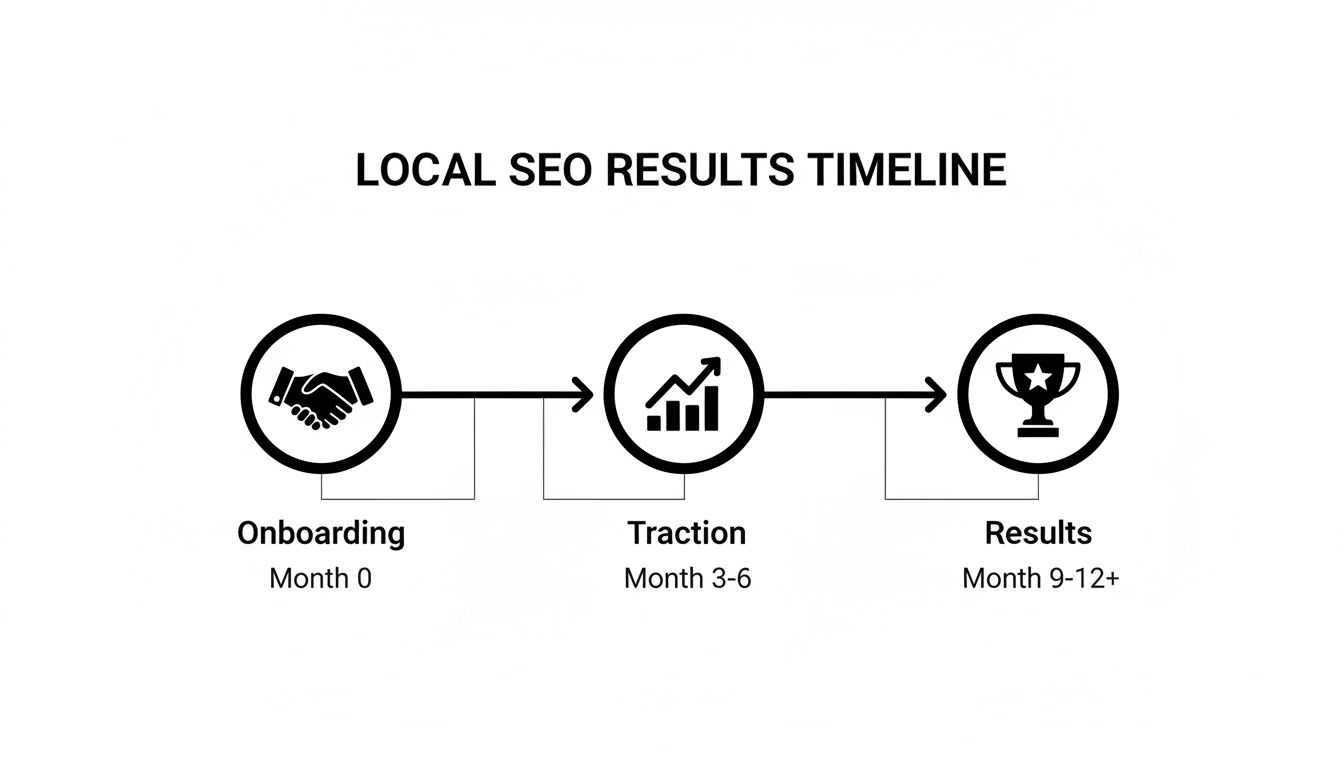
This visual shows that each phase builds on the last, creating momentum that leads to sustainable, long-term success.
Realistic Local SEO Timelines
To give you a clearer idea of what to expect and when, I've broken down the typical journey into a simple table. This helps you track progress and hold your agency accountable to the right milestones at the right time.
| Timeframe | Expected Activities | Typical Results |
|---|---|---|
| Months 1-3 | Technical audits, Google Business Profile optimisation, citation cleanup, foundational on-page SEO. | Early ranking improvements for low-competition keywords, increase in Google Business Profile views and clicks. |
| Months 4-6 | Local content creation (e.g., blog posts, location pages), local link building, proactive review generation. | More consistent map pack visibility, noticeable increase in phone calls and website enquiries. |
| Months 6-12+ | Competitive strategy refinement, targeting higher-value keywords, expanding service area focus. | Strong rankings for competitive local terms, significant ROI, predictable lead flow from organic search. |
Remember, these are general guidelines. A highly competitive industry or a brand-new website might take a little longer to gain traction, but the principles remain the same.
The Multi-Location Accelerator
Now, for businesses that serve multiple suburbs or cities, there’s a way to put this timeline on steroids. Instead of just focusing on one area, a multi-location strategy involves creating dedicated pages and content for each suburb you want to target. It’s like casting a much wider net.
And the results are powerful.
In a detailed 12-month study of 36 Australian businesses, those with a multi-location strategy drove an incredible 557% more organic traffic than their single-location counterparts. That’s an average of 80,022 sessions versus just 12,186.
For a service business in a competitive city, this is a game-changer. Building out dedicated pages for different suburbs is one of the fastest ways to absolutely dominate your local market.
A Few Common Questions We Hear About Local SEO
Deciding to bring in a local SEO agency is a big move. To make sure you're going in with your eyes wide open, we've put together some straight answers to the questions we hear most often from service business owners. Think of this as your no-fluff guide to the investment, the strategy, and what you should actually expect to see happen.
How Much Should I Actually Budget for Local SEO?
It's the first question on everyone's mind, and the honest answer is: it really depends. What you'll need to invest is tied directly to how competitive your industry is, what your specific goals are, and how many locations you’re trying to rank.
For a small service business in a less crowded Australian suburb, a solid local campaign can start at around $1,500 per month. But if you're in a cut-throat market like Sydney or Melbourne, or you're targeting several suburbs, that figure is more likely to be in the $3,000 to $5,000+ range.
A word of caution: be very wary of agencies quoting a few hundred dollars. Proper local SEO takes a serious amount of time, hands-on expertise, and real resources. Rock-bottom prices are almost always a red flag that corners are being cut, which can end up hurting your rankings down the track.
See your budget as an investment in a predictable lead-generating machine, not just another marketing expense. A good agency is obsessed with delivering a positive return on that investment through more phone calls, bookings, and paying customers.
What's the Real Difference Between Local SEO and General SEO?
They're built on the same foundations, but the focus and tactics couldn't be more different. It’s like the difference between your local GP and a heart surgeon—both are doctors, but their expertise is applied in completely different arenas.
General SEO is all about getting a website seen by a national or even global audience. The aim is to rank for broad keywords and pull in traffic from anywhere and everywhere. An online software company, for example, would use general SEO to find customers all over the country.
Local SEO, on the other hand, is geographically pinned down. It’s laser-focused on making your business impossible to miss for customers in your specific service area—the people who are right now searching for what you do, near them. The toolkit is much more specialised:
- Google Business Profile (GBP) Optimisation: This is the absolute cornerstone of local search.
- Local Citations: Getting your business name, address, and phone number listed consistently across local online directories.
- Location-Specific Keywords: Targeting search terms like "plumber Chatswood" or "electrician Northern Beaches."
- Customer Reviews: Proactively getting and managing reviews from local clients.
Basically, general SEO casts a wide net. Local SEO uses a spear. For a local service business, the spear wins every time.
How Do I Know If My Local SEO Is Actually Working?
Measuring the Return on Investment (ROI) from your local SEO isn't just a "nice-to-have"—it's non-negotiable. This is where a great agency proves its worth. You should never be left wondering if your money is actually doing anything.
The trick is to track the metrics that actually hit your bottom line, not just vanity numbers like website visits. Your agency needs to give you simple, clear reports that connect their work to real-world business results.
Here are the main ways you'll measure your ROI:
- Track Inbound Phone Calls: Using call tracking software, you can see exactly how many calls came directly from your Google Business Profile and local search results. It’s a hard number for new leads.
- Monitor Form Submissions: By setting up goal tracking in Google Analytics, you can count how many people fill out your "Request a Quote" form after finding you via a local search.
- Analyse GBP Direction Requests: If you have a physical location, this is gold. A jump in the number of people asking Google for directions to your door is a direct signal of intent.
- Calculate Customer Lifetime Value (CLV): Once you know what a new customer is worth on average, you can put a real dollar figure on the leads SEO brings in. If your campaign generates 10 new clients worth $2,000 each, that’s $20,000 in revenue you can tie directly back to your investment.
A transparent agency will insist on setting up this tracking from day one. They’ll want to prove that every dollar you spend is pulling its weight and growing your business.
Ready to stop guessing and start getting real, measurable results from your local search strategy? Homer Digital Marketing specialises in building powerful Google visibility for service-based businesses like yours. We don't just chase rankings; we drive the calls, leads, and bookings that grow your bottom line.
Book your no-obligation strategy session today and let's build a plan to make you the go-to authority in your local market.
