

SEO for dentists is all about tweaking your practice's website and online profiles so you show up higher in search results. The goal? To attract local patients who are actively searching for the exact dental services you offer, like "emergency dentist near me" or "best cosmetic dentist in Sydney".
A winning strategy focuses on nailing local search visibility, targeting high-intent keywords, and turning those website visitors into actual appointments. It’s a powerful system for consistent, predictable growth.
Why Typical Dental SEO Fails and How Yours Will Succeed
Let's be honest. Many dentists pour money into SEO and get almost nothing back. They receive reports filled with confusing jargon about "traffic increases" and "keyword rankings," but the only metric that really counts—new patients in the chair—barely budges.
This happens all the time, and it comes down to a basic misunderstanding of what successful SEO for dentist practices actually looks like. It isn't just about getting more eyeballs on your website; it's about getting the right ones that are ready to book.
The Critical Gap Between Traffic and Bookings
The real challenge isn't just ranking on the first page of Google. It's turning that visibility into real, measurable growth for your clinic.
Here in Australia, the numbers are pretty stark: most dental websites are leaving a serious amount of money on the table. Dental marketing specialists report that an average dental website converts only 1–2% of its visitors into an actual enquiry. A well-optimised site might hit 10% if it has a solid strategy in place.
Think about that. For every 100 people who land on your site, 95 or more leave without ever picking up the phone or filling out a form.
Imagine a suburban Sydney clinic getting 1,500 organic visitors a month. A 2% conversion rate gets them just 30 enquiries. But by lifting that to just 6% with better local SEO, clear trust signals, and obvious calls-to-action, those enquiries jump to 90. That's a 200% increase in leads without spending a single extra dollar on traffic.
To make sure your practice doesn't become another one of these statistics, it helps to understand comprehensive SEO strategies that tackle the specific challenges and opportunities in the dental industry.
The goal is not to win a vanity contest for the #1 ranking. The goal is to build a predictable system that turns online searches into profitable, long-term patient relationships for your Australian practice.
A Mindset Shift for Sustainable Growth
The first mistake is seeing SEO as just another technical cost. You need to treat it as a strategic asset—a patient acquisition engine that works for you 24/7. This guide gives you that framework. We're moving past generic advice to deliver a hands-on playbook built from real-world experience with practices just like yours.
Here’s what this system involves:
- Dominating Local Search: Turning your Google Business Profile into your most powerful magnet for new patients.
- Targeting High-Value Patients: Creating content that answers the specific questions people have about high-value treatments like dental implants, Invisalign, and cosmetic work.
- Building Trust and Authority: Using technical fixes, schema markup, and smart review strategies to signal expertise to both Google and potential patients.
- Measuring What Matters: Focusing on the KPIs that actually impact your bottom line, like new patient enquiries and cost per acquisition, not just traffic and rankings.
This playbook lays the groundwork for a complete system designed to transform your website from a simple online brochure into your most reliable source of new patients.
Mastering Local Search with Your Google Business Profile

Let's be blunt: your Google Business Profile (GBP) is the new front door to your practice.
For most people searching for a dentist nearby, it’s the very first impression they'll get. Before they even think about clicking through to your website, they've already seen your location, opening hours, and—most critically—your patient reviews. Getting your GBP right isn't just a small part of SEO for dentists; it's the absolute cornerstone of your local strategy.
A well-oiled profile is your ticket into the coveted "Map Pack"—those top three local results that hoover up the majority of clicks. It's free, it's powerful, and it's often the single factor that decides whether a patient in your suburb calls you or the clinic down the road.
Optimising Your Profile for Maximum Impact
An incomplete profile is more than a missed opportunity; it's a red flag to both Google and prospective patients. Every single section is there for a reason, so it's time to get thorough.
First, nail the basics. Your Name, Address, and Phone number (your NAP) must be 100% consistent with what’s on your website and every other directory online. Even tiny differences, like "St." versus "Street," can create confusion for search engines and water down your local authority.
Then, you need to dive into the details that matter:
- Categories: Your primary category should be "Dentist" or a specific specialty like "Orthodontist." But don't stop there. Add secondary categories for everything you offer, such as "Cosmetic Dentist," "Dental Implants Provider," and "Teeth Whitening Service."
- Services: This is where you get granular. Use the 'Services' section to list out every single treatment, from a routine scale and clean to complex oral surgeries. Think like a patient and use the exact terms they would search for.
- Business Description: You have 750 characters to tell your story. Use it to highlight what makes your practice different. Mention key services, your philosophy on patient care, and your connection to the local community.
Your GBP is not a "set it and forget it" task. Treat it like a dynamic social media channel that connects you directly with high-intent patients who are actively looking for a dentist right now.
Leveraging Reviews and Q&A for Trust
In healthcare, social proof is everything. A constant stream of new, positive reviews is probably the single most persuasive factor for both local rankings and patient trust. You have to ask for them. A simple follow-up email or SMS with a direct link to your GBP review page works wonders.
Responding to every single review—good and bad—is non-negotiable. Thanking a patient for their kind words shows you’re engaged. Professionally addressing a negative experience shows transparency and proves you’re committed to patient satisfaction.
The Q&A section is another goldmine that most clinics ignore. Get proactive and populate it yourself. Add and answer the common questions your front desk team fields every day, like "Do you offer payment plans?" or "Is there parking available?" Answering these upfront removes friction and makes it easier for people to choose you.
Advanced Tactics Using Photos and Posts
Visuals and fresh content signal to Google that your practice is active, relevant, and thriving.
Geotagged Photos
Regularly upload high-quality, recent photos of your practice. Show people what to expect.
- Your building exterior and welcoming reception area.
- Your modern treatment rooms and technology.
- Friendly, professional headshots of your dentists and staff.
- Happy patients (always with their permission, of course).
Here's a pro tip: before you upload your images, make sure they are geotagged with your practice's coordinates. It's a small detail that sends another powerful local signal to Google.
Google Posts
Think of Google Posts as free mini-ads that appear directly on your profile. They're perfect for sharing timely updates, special offers, or shining a spotlight on a high-value service. A post is only live for seven days, so it encourages fresh content.
Promote a teeth whitening special, introduce a new hygienist, or share a link to your latest blog post. It keeps your profile from looking stale and grabs the attention of anyone scrolling by. To learn more, check out our complete guide on optimising your Google Business Profile.
Building Digital Authority with Strategic Content and Links
A technically solid website and a perfectly tuned Google Business Profile are your foundations. But to really own the top spots in search, you need to prove your expertise. This is where strategic content and authoritative links come in, turning your website from a simple brochure into a go-to resource for potential patients.
Think of it this way: great content is the engine of any serious SEO for dentist campaign. It shows Google you know your stuff, but more importantly, it gives real value to people making big decisions about their oral health. At the same time, quality links from other reputable local sites are like votes of confidence, signalling that your practice is a trusted authority in the community.
Creating High-Value Service Pages
Forget the generic blog posts about "how to brush your teeth." The real traction comes from creating deep, high-value pages for the services that actually drive revenue—think dental implants, Invisalign, or cosmetic work. These pages need to be the definitive resource for anyone even thinking about these procedures.
Put yourself in the patient's shoes. Someone searching "dental implants Sydney" isn't just looking for a price. They have real questions and anxieties that you are uniquely positioned to answer.
Your service pages should tackle these questions head-on:
- Procedure Details: What’s the step-by-step process? Demystify it for them.
- Patient Suitability: Who is a great candidate for this treatment? And who isn't?
- Costs and Financing: Be upfront about costs and any payment plans you offer.
- Recovery and Aftercare: What should they expect in the days and weeks after?
- Comparisons: How does this stack up against other options, like implants vs. bridges?
By mapping patient-intent keywords directly to these comprehensive pages, you attract high-quality traffic from people who are much closer to making a decision. It’s a core strategy for practices that are serious about growth, and something that specialised content marketing agencies live and breathe.
A Practical Link-Building Strategy for Dentists
Link building for a dental practice isn’t about dodgy, spammy tactics. It's about embedding your clinic into the local digital community. These connections, known as backlinks, are powerful signals of trust. A strong link-building campaign reinforces your local authority and tells Google that you're a recognised and respected part of the neighbourhood.
Building a network of local links is like getting a referral from every respected business owner in your suburb. It’s a powerful endorsement that search engines take very seriously.
Here’s a realistic approach to earning these valuable local links:
- High-Quality Directories: Make sure your practice is listed accurately on trusted Australian directories like Yellow Pages and TrueLocal, plus health-specific sites like Healthdirect.
- Local Community Sponsorships: Sponsoring the local footy team, a school fete, or a charity fundraiser often results in a link from their website. It’s a win-win: you build goodwill and get a highly relevant local backlink.
- Partnerships with Other Businesses: Connect with complementary, non-competing local businesses. A nearby pharmacy, a specialist medical centre, or even a local beauty salon might be happy to link to your site as a trusted provider.
- Local Media and News: Did your practice win an award or invest in groundbreaking new tech? Let your local newspaper or community blog know. A mention in a local news story can deliver a potent, high-authority link.
Of course, this all works best when you’re proactively managing your practice's wider online presence. This great guide on reputation management for dentists offers some sharp insights into maintaining a positive digital footprint. When you combine authoritative content with a strong local link profile, you create long-term digital authority and a reliable stream of new patient enquiries.
Getting Your On-Page and Technical SEO Right
Think of your website's technical health as the foundation of your practice's online presence. If that foundation is cracked, everything you build on top of it—great content, glowing reviews, smart ad campaigns—will eventually crumble. On-page and technical SEO is all about making sure your site is solid, fast, and easy for Google to understand.
These are the behind-the-scenes tweaks that signal to search engines that you're a legitimate, trustworthy local healthcare provider. Get these right, and you'll find it much easier to rank for the services that actually bring patients through your door.
Use Local Business Schema to Stand Out
Schema markup is a bit like adding labels to the back end of your website. It's a type of code that explicitly tells Google, "Hey, this is a dental clinic, here's our address and phone number, these are our opening hours, and here’s what our patients think of us."
This simple act of clarification helps Google serve your information more accurately in search results. The reward? You often get "rich snippets"—those eye-catching extras like star ratings or FAQ dropdowns that appear right under your listing. They make your practice impossible to ignore and can seriously boost the number of people who click through to your site.
For a dental practice, the most critical type is 'LocalBusiness' schema, specifically the 'Dentist' sub-type. Here’s what it needs to do:
- Define your NAP: Clearly state your practice name, address, and phone number in the code to reinforce those crucial local signals.
- Mark up your hours: This allows your opening times to show up directly in search results, answering a key patient question instantly.
- Embed review ratings: Pulling in your aggregate review score displays those valuable star ratings, building immediate trust with potential patients.
Make Your Site Fast and Mobile-Friendly
In Australia, mobile isn't just a trend; it's the primary way potential patients will find you. While desktop users might still convert well, mobile can easily account for 73% of all website traffic for local businesses. If your site is a slow, clunky mess on a phone, you’re turning away the vast majority of your audience.
Google knows this, which is why site speed and mobile-friendliness are direct ranking factors. A slow site leads to frustrated visitors who quickly hit the "back" button, telling Google your website isn't a good answer to their search.
Focus on these essential fixes:
- Compress Your Images: Big, heavy image files are the #1 killer of website speed. Use a tool to shrink them down without losing visual quality.
- Turn on Caching: Browser caching lets a visitor's device "remember" parts of your site, so it loads much faster the next time they visit.
- Use Responsive Design: Your website must automatically adjust its layout to look great on any screen, from a big desktop monitor to the smallest smartphone.
A fast, seamless mobile experience isn't just a technical tick-box; it's a fundamental part of modern patient care. A patient's first interaction with your practice is now digital, and a clunky website creates a poor first impression.
Build a Logical Site Structure
Your website’s layout needs to be dead simple for both people and search engines to navigate. The two key ingredients for this are clean URLs and smart internal linking.
SEO-Friendly URLs
Keep your URLs short, sweet, and descriptive. A messy URL like yourclinic.com.au/p=123?service=implants tells nobody anything.
Instead, aim for something clean and keyword-rich, like this: yourclinic.com.au/dental-implants. This tiny change makes it instantly clear to both users and Google what the page is about.
Strategic Internal Linking
Internal links are just links from one page on your website to another. When done right, they create a logical pathway for users and spread SEO authority throughout your site. For example, if you write a blog post on the "5 Benefits of Teeth Whitening," you should absolutely link from that post directly to your main "Teeth Whitening" service page.
This keeps people on your site longer and helps Google discover all your important service pages. We've seen that Australian dental landing pages that nail this structure can achieve conversion rates well above the median. You can explore more detailed conversion rate statistics by industry to see just how much of a difference it makes in turning traffic into new patient bookings.
Tracking What Matters: Turning SEO into Measurable Growth
Great SEO isn't about chasing vanity metrics like website traffic. For a dental practice, it’s a data-driven process designed to do one thing: put new patients in the chair.
Forget those generic reports filled with confusing jargon. We need to connect your online activity directly to measurable growth for your clinic, so you can see a clear return on every dollar spent.
Setting Up Essential Conversion Tracking
First things first, we need to define what a "win" actually looks like on your website. In the marketing world, these are called conversions, and they’re the bridge between a casual browser and a potential patient. Using a tool like Google Analytics, we can track these actions easily.
For any dental practice, the most important conversions are:
- Appointment Form Submissions: Someone fills out your "Book an Appointment" or "Contact Us" form. This is a direct lead.
- Website Phone Calls: Tracking clicks on your phone number, which is especially critical for mobile visitors looking for urgent care.
- "Book Now" Button Clicks: Monitoring how many people engage with your online scheduling software link.
Setting these up turns abstract data into a clear picture of how many genuine leads your SEO efforts are generating each month. Without this, you're just guessing.
Key Performance Indicators That Actually Matter
Once your tracking is in place, you can ignore the noise and focus on the Key Performance Indicators (KPIs) that directly impact your bottom line. While more traffic is nice, these are the metrics that tell you if your SEO is actually working.
An increase in traffic means nothing if it doesn't lead to more phone calls and booked appointments. The ultimate KPI is your cost per new patient, and every other metric should be viewed through that lens.
Here are the top KPIs I recommend every dental practice watches closely:
- Organic Traffic: The number of visitors finding you through unpaid Google searches. Is it growing month-on-month?
- Local Keyword Rankings: Where do you appear for high-intent searches like "emergency dentist [your suburb]" or "Invisalign [your city]"? These are your money-makers.
- Conversion Rate: The percentage of visitors who take action (call, fill out a form). This number tells you how effective your website is at turning traffic into patients.
- Cost Per Lead/Acquisition: This is the big one. It connects your SEO spend to the number of new patient enquiries, showing your true ROI.
Monitoring these allows you to see what’s working and where to make improvements. Fine-tuning your website to turn more visitors into patients is a science in itself. For a deeper dive, check out our guide on what is conversion rate optimisation.
The image below shows a realistic timeline for seeing results, moving from foundational work to long-term, sustainable growth.
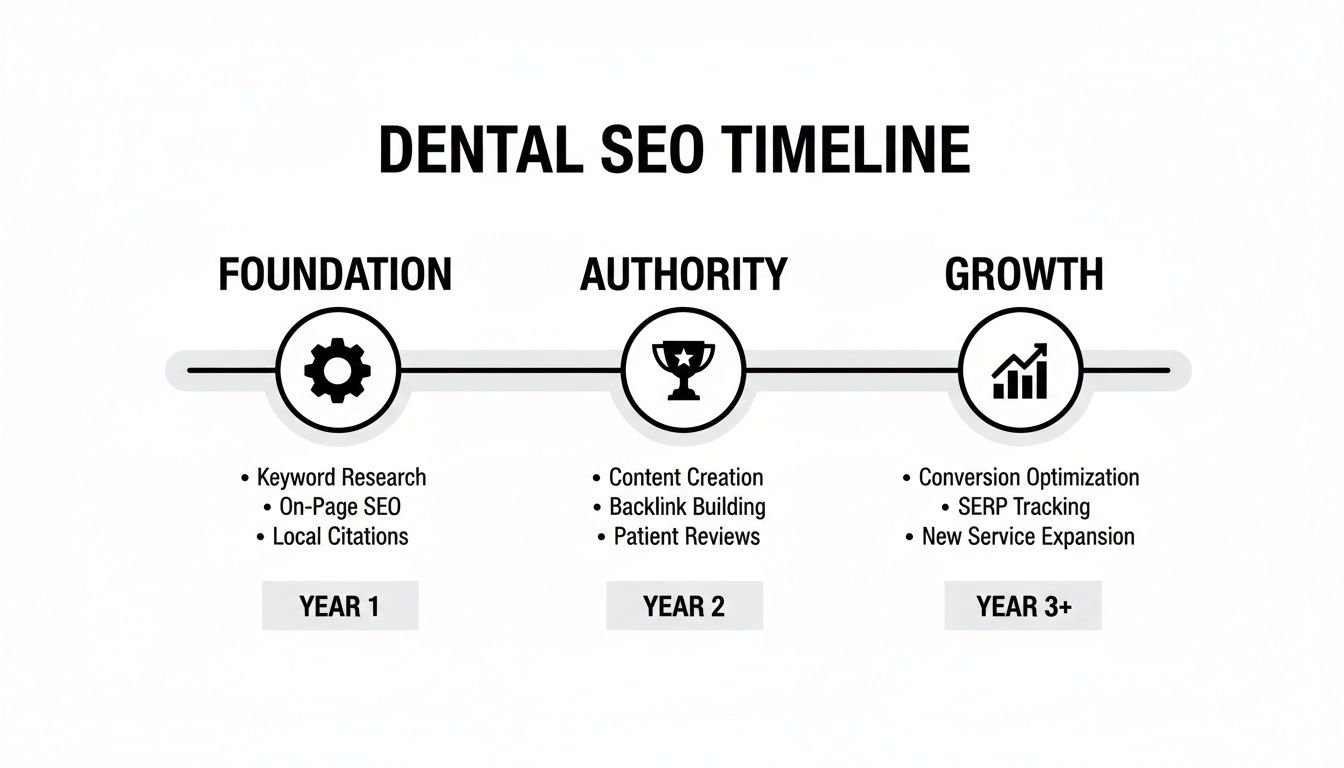
As you can see, SEO is a long game. The groundwork you lay in the first year is what paves the way for serious authority and growth in the years that follow.
Dental SEO Implementation Checklist and Timeline
To make this process tangible, here’s a practical timeline that maps out key SEO activities and what you should expect to see over the first 12 months. This isn't just theory; it's a proven roadmap for turning your website into a patient-generating machine.
| Phase (Timeline) | Key Activities | Primary KPIs to Track | Expected Outcome |
|---|---|---|---|
| Foundation (Months 1-3) | Technical site audit & fixes, GBP optimisation, on-page SEO for core services, keyword mapping, conversion tracking setup. | Website health score, GBP impressions & clicks, ranking for branded terms. | A technically sound website ready to compete, improved local map visibility, and accurate baseline data. |
| Authority Building (Months 4-6) | Create & publish service-specific blog content, build local citations, start a review generation campaign, initial local link building. | Organic traffic growth, increase in non-branded keyword rankings, number of new reviews. | First signs of traffic growth from target keywords and a stronger local reputation signal to Google. |
| Growth & Expansion (Months 7-9) | Expand content to target specific patient problems (e.g., "cost of dental implants"), build links from local community sites, CRO on landing pages. | Conversion rate, keyword rankings for long-tail terms, new patient enquiries (calls & forms). | A noticeable increase in qualified leads and higher rankings for more competitive treatment terms. |
| Optimisation & Dominance (Months 10-12) | Analyse performance data to refine content strategy, build higher-authority links, create video content, refresh old blog posts. | Cost per lead, organic traffic value, rankings for top-tier keywords, total conversions. | Sustainable lead flow, establishing the practice as a local authority, and a positive, predictable ROI. |
By following a structured plan, you move from hoping for results to systematically achieving them. Each phase builds upon the last, creating compounding returns on your investment.
Your Top SEO Questions Answered
Diving into SEO can feel like a minefield of technical terms and conflicting advice. To clear things up, I’ve put together straight answers to the most common questions we hear from Australian dentists. The goal here is simple: give you the clarity you need to make smart decisions for your practice.
How Long Does Dental SEO Actually Take to Work?
This is the big one, and rightly so. Everyone wants to know when they'll see a return.
Think of SEO as a long-term investment, not a quick fix. You’ll often see small, encouraging signs within the first 1-3 months—maybe you start appearing in the map pack for your immediate suburb. That’s a great start.
But for the really valuable keywords, the ones that bring in high-value patients for treatments like "dental implants" or "Invisalign," you need to be patient. Real, page-one traction for competitive terms typically takes a solid 6-12 months of consistent effort. It's all about building momentum.
The first few months are for laying the groundwork. We focus on the quick wins: fixing any technical glitches on your website and getting your Google Business Profile completely dialled in. These steps shore up your foundations and can give you an immediate little lift in local searches.
After that, it's about building authority. This means creating genuinely helpful content that answers the questions your patients are asking and earning quality links from other local websites. This is where the magic happens, creating a compounding effect that turns your online presence into an asset that brings in new patients for years.
SEO is like planting a tree. The work you do in the first year establishes the roots, but the real growth and fruit come in the years that follow. Patience and consistency are your greatest allies.
Should I Focus on Local SEO or General SEO?
For a dental practice with a physical address, local SEO is everything. It’s not just a piece of the puzzle; it’s the entire game. The vast majority of your patients live or work within a pretty tight radius of your clinic.
This means the highest-impact things you can do are optimising your Google Business Profile, consistently getting new patient reviews, and making sure your practice details are correct across the web. These are the signals that get you in front of people searching for a dentist right now, in your specific area.
But that doesn't mean you can ignore general SEO. A strong website with detailed service pages (e.g., "cosmetic dentistry Sydney") acts as the engine powering your local efforts. It helps you capture searches from a slightly wider net, boosts your site's overall authority, and proves your relevance to Google.
They work together. Start with a laser focus on your local community, and build out from there.
Can I Just Do My Own SEO?
Of course. And for some basic tasks, you absolutely should. Things like updating your Google Business Profile with new photos, personally responding to reviews, and double-checking your contact info are simple, effective, and completely within your control.
However, a serious SEO strategy goes much deeper. It involves complex keyword research to understand precisely what potential patients are searching for, technical know-how to make your website fast and easy for Google to read, and constant monitoring of what your competitors are doing.
Honestly, for a busy dentist focused on clinical care, the learning curve is steep and the time required is significant. Working with a specialist agency gives you access to expert knowledge and powerful tools to get results much faster. It almost always delivers a higher return on investment than trying to juggle it all yourself, freeing you up to focus on your patients.
How Much Should a Dentist Budget for SEO in Australia?
The investment can vary quite a bit. It really depends on where your practice is located—a competitive metro area like Melbourne will naturally require a bigger budget than a regional town—and what your growth goals are.
As a ballpark figure, a professional, comprehensive SEO campaign for an Australian dental practice typically falls somewhere between $1,500 and $5,000+ per month.
It’s crucial to stop thinking of this as a "cost" and see it as an "investment." Good SEO isn't an expense; it's the engine that drives your patient acquisition. The whole point is to generate a return that far outweighs the monthly fee by attracting a steady stream of high-value patients for your most profitable services.
When you're talking to potential SEO providers, look past the price tag. Ask about their strategy, demand transparent reporting, and—most importantly—ask to see their track record with other dental practices in Australia.
Ready to turn your website into your most reliable source of new patients? At Homer Digital Marketing, we build proven, AI-powered marketing systems that connect your dental practice with ideal clients. We combine decades of experience with a deep understanding of what it takes to achieve real visibility and growth on Google.
Discover how our tailored SEO strategies can help you scale your practice today.
