

Struggling to turn your website traffic into actual paying clients? Let’s get one thing straight about what conversion rate optimisation (CRO) really is. Think of your website like a physical shop. All the effort you put into SEO and ads? That’s just getting people to walk through the door.
CRO is the art and science of what happens next. It’s the proven, data-backed process for making your website more effective at guiding visitors to do exactly what you want them to do—whether that’s filling out a form, booking a call, or making a purchase. This guide will show you precisely how to make that happen.
Unlocking Hidden Revenue With Conversion Rate Optimisation

So many businesses get stuck on one thing: getting more traffic. They pour thousands into SEO and advertising, chasing higher visitor numbers. And while getting people to your site is the first step, it’s only half the battle.
CRO answers the most important question: “What happens once they arrive?”
For businesses investing heavily in traffic acquisition, understanding how CRO connects with broader digital marketing strategy is critical. Our guide to Brisbane social media marketing for local businesses explores how traffic generation and conversion optimisation work together to drive growth.
It completely shifts the focus from quantity to quality. Instead of constantly chasing more visitors, you start getting more value from the visitors you already have. For any service business serious about efficient, scalable growth, this isn’t just a good idea—it’s non-negotiable.
To make this crystal clear, let’s break down where your marketing focus lies.
Where Your Marketing Focus Lies
| Focus Area | Traffic Generation (SEO & Ads) | Conversion Rate Optimisation (CRO) |
|---|---|---|
| Main Goal | Get more people to the website. | Get more website visitors to take action. |
| Key Question | “How can we increase our traffic?” | “How can we make this page more effective?” |
| Core Activities | Keyword research, ad campaigns, link building. | A/B testing, user feedback, analytics, design tweaks. |
| Measures of Success | Website visitors, keyword rankings, ad impressions. | Conversion rate, leads generated, sales, sign-ups. |
See the difference? Both are essential, but CRO is where you turn raw traffic into real business results.
Why CRO Is A Game-Changer For Service Businesses
The impact of good CRO on your bottom line is massive. This isn’t about guesswork or changing button colours because you feel like it. It’s about digging into user behaviour and systematically removing the points of friction that stop potential clients from taking the next step.
When you nail your CRO strategy, a few things happen:
- You Maximise Your Marketing ROI: Suddenly, you’re getting more leads and clients from the exact same marketing spend. Your cost to acquire a new customer drops, and your profitability climbs.
- You Improve The User Experience: By making your website intuitive and easy to use, you build trust. Visitors stay longer, engage more deeply, and feel more confident in your services.
- You Gain Deeper Customer Insights: The whole process uncovers goldmines of data about what your audience actually wants. These insights can (and should) inform your entire marketing strategy, right down to how you deliver your services.
For a deeper dive into how CRO works as a structured process for growth, check out this practical guide to Shopify Conversion Rate Optimization.
The Financial Impact of Small Improvements
The difference between an average website and a well-optimised one is staggering. According to research published by WordStream, the average conversion rate across industries typically falls between 2% and 5%, highlighting how even small improvements can dramatically increase revenue.
We’re talking about a serious impact on revenue. Bumping up your conversion rate by just 1% could be the difference between $3.12M and $4.68M in annual revenue—without spending a single extra dollar on getting more traffic.
For Australian service providers and established businesses pulling in $10K+ a month, this is a huge opportunity. The gap between where most businesses sit (around 1.78%) and where the top performers are (3-5%) is where the competitive advantage lives. Proper CRO is how you close that gap.
In short, Conversion Rate Optimisation is the most direct way to turn your website from an online brochure into a powerful, automated lead-generation machine. It makes sure every dollar you spend attracting visitors has the best possible chance of delivering a real return.
The Three Pillars Of A Winning CRO Strategy
Effective conversion rate optimisation isn’t about a single tweak or a lucky guess. It’s a structured framework built on three fundamental pillars. Think of them as the legs of a stool—take one away, and the whole thing comes crashing down.
Getting this right means you stop making random changes and start following a systematic process that delivers real, measurable results. A winning strategy requires you to be a detective, an architect, and a scientist, all at once.
Pillar One: User Insight
First up, you need to play detective. The first pillar, User Insight, is all about gathering clues to understand what your website visitors truly want, need, and where they get stuck. This isn’t about what you think they want; it’s about what their actions are telling you.
You can uncover these clues using powerful tools that reveal user behaviour. Analytics platforms show you which pages people visit and where they bail. Heatmaps give you a visual story of exactly where users click, move their mouse, and how far they scroll down a page. This pillar is about getting inside your customer’s head to see your website through their eyes.
To build this pillar, start by asking:
- What’s the first thing visitors see, and does it scream value?
- Where are people dropping off between the landing page and the contact form?
- What questions do visitors seem to have that my content isn’t answering?
Pillar Two: User Experience
Once you have your clues, it’s time to switch hats and become an architect. The second pillar, User Experience (UX), is about designing a clear, intuitive, and frictionless path for your visitors to follow. If User Insight is about understanding the ‘why’, UX is about building the ‘how’.
A great user experience makes it effortless for a potential client to find what they need and take action. This means simplifying your navigation, ensuring your site loads lightning-fast, and making forms dead simple to complete on any device. It’s about removing every tiny obstacle that causes frustration and makes someone click away. To truly design an effective path, you have to understand your customer’s complete journey. You can learn more by exploring our detailed guide on what is customer journey mapping.
Your website’s design should guide visitors, not challenge them. The goal is to make the next step so obvious and easy that they take it without a second thought.
Pillar Three: Continuous Testing
The final pillar is Continuous Testing. This is where you put on your lab coat and become a scientist. After you’ve gathered insights (detective) and improved the experience (architect), you must run controlled experiments to prove what actually works.
Guesswork has no place in CRO. The go-to method here is A/B testing. You create two versions of a page (maybe with different headlines or button colours) and show them to different segments of your audience. By measuring which version gets more conversions, you get undeniable proof of what resonates with your clients.
This scientific approach ensures every change you make is a data-driven improvement, not just a shot in the dark. It’s how you achieve steady, cumulative growth over time.
Key Metrics That Truly Measure CRO Success
You can’t improve what you don’t measure. Once you’ve got a handle on the pillars of a solid CRO strategy, the next step is getting familiar with the numbers that tell you if your efforts are actually working.
Think of these key metrics as the vital signs of your website’s health. They show you exactly where the opportunities are hiding and tell a clear story about how users are behaving. For any service business, tracking these is non-negotiable for turning website clicks into actual leads and clients.
This flowchart shows how user insight, experience, and testing all come together to create a winning strategy.
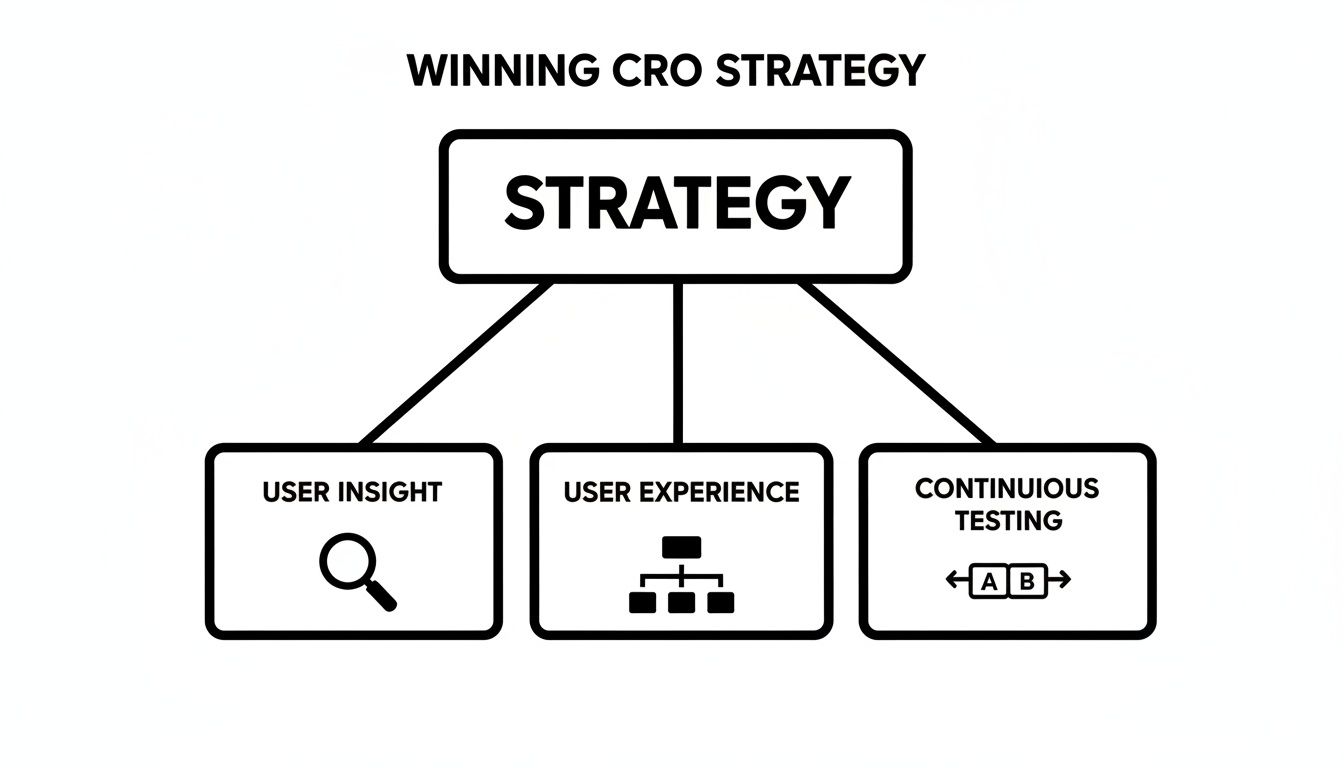
The main takeaway? Successful CRO isn’t a one-trick pony. It’s a balanced approach where real data informs your design choices, and every change is properly tested before you roll it out.
Essential CRO Metrics For Service Businesses
To really understand what’s happening on your website, you need to look at more than just one number. The table below breaks down the must-watch metrics for any service-based business. Each one gives you a different clue about user behaviour.
| Metric | What It Measures | What It Tells Your Business |
|---|---|---|
| Conversion Rate | The percentage of visitors who take a specific, desired action (e.g., submit a form, call you). | This is your bottom line. A low rate is a clear sign that something on your site is creating friction for potential clients. |
| Bounce Rate | The percentage of visitors who land on a page and leave without clicking anything else. | A high bounce rate is like someone walking into your office, taking one look around, and walking straight back out. It often means your page missed the mark. |
| Session Duration | The average amount of time visitors spend on your site during a single visit. | Longer sessions usually mean higher engagement. If people are leaving quickly, your content probably isn’t grabbing their attention. |
| Cost Per Acquisition (CPA) | How much it costs you in marketing spend to get one new client or qualified lead. | This metric connects your marketing spend directly to results. A high CPA means you’re paying too much to win new business. |
| Lead-to-Client Rate | The percentage of leads generated from your website that turn into paying clients. | This tells you about the quality of your leads. A low rate might mean your website is attracting the wrong audience. |
These numbers work together to give you the full picture. A high bounce rate combined with a low session duration on a key service page, for example, screams that there’s a major problem with your messaging or user experience.
Imagine a potential client lands on your “Request a Quote” page. They spend a few seconds there (low session duration), then leave without clicking anything (a bounce). That tells you the page completely failed to convince them.
Was the form too long? Was the value not clear enough? Maybe the page loaded too slowly on their phone. By digging into these numbers, you can pinpoint exactly where people are dropping off and start forming a solid hypothesis on how to fix it. This is fundamental to understanding the ROI of your digital marketing and making smarter decisions.
High-Impact CRO Tactics You Can Implement Today
Theory is great, but action is what gets results. You don’t need a massive budget or a dedicated tech team to start lifting your conversion rate. In fact, some of the most powerful changes are surprisingly simple and can be rolled out in a single afternoon.

Here are four high-impact, quick-win tactics you can use today to turn more of your visitors into genuine leads. Think of this as your practical checklist for immediate improvements.
Tactic 1: Craft Irresistible Calls-to-Action
Your Call-to-Action (CTA) is arguably the most important button on your entire website. It’s the final step a visitor takes before they raise their hand and become a lead. But vague, lazy CTAs like “Submit” or “Click Here” are absolute conversion killers. Why? They create uncertainty and offer zero value.
Instead, switch to benefit-driven, action-oriented language that tells the user exactly what they’ll get. This one small tweak can have a massive impact on your results.
- Before: A button that just says “Submit.” (Submit to what?)
- After: A button that says “Get My Free Proposal.”
See the difference? The “After” version is specific, personal, and puts the focus squarely on the value for the user. It answers their unspoken question: “What’s in it for me?”
Tactic 2: Showcase Powerful Trust Signals
People do business with people they know, like, and trust. For any service business, building that trust is non-negotiable, especially right at the point of conversion—like your contact form. Just as someone is about to hand over their details, you need to squash any last-minute hesitation.
This is where trust signals come in. They are quick visual cues that build credibility and make people feel safe.
- Client Testimonials: Pop a powerful quote from a happy client right beside or below your contact form.
- Industry Awards & Certifications: Display the logos of any awards you’ve won or certifications you hold.
- “As Featured In” Logos: If you’ve been mentioned in reputable publications, show off their logos.
Placing these elements near your CTA reinforces your authority at the most critical moment of decision.
Tactic 3: Simplify Your Contact Forms
Every single field you add to a contact form is another reason for a potential client to give up and leave. Friction is the enemy of conversion, plain and simple. Your goal should be to make getting in touch as effortless as possible.
Go through your forms with a ruthless eye and cut any field that isn’t absolutely essential for that first conversation. You can always gather more details later on in the sales process.
Before: A form asking for Name, Email, Phone, Company, Role, Budget, and a detailed message.
After: A streamlined form asking only for Name, Email, and a brief message.
This change alone can dramatically increase your form submissions by lowering the barrier to entry.
Tactic 4: Prioritise Mobile Usability
With most web traffic now coming from mobile devices, a clunky mobile experience just isn’t an option anymore. A website that’s a nightmare to use on a phone will bleed conversions. Pinching and zooming to read text or fumbling to tap tiny buttons are major sources of user frustration.
Your website must deliver a seamless experience on any device. This means a responsive design where text is readable, buttons are big enough to tap, and forms are a breeze to fill out on a small screen. A great mobile experience is a non-negotiable part of modern web design; a clunky interface will send potential clients running to your competitors. You can discover more about the key elements of modern website design in our detailed guide.
Seeing CRO In Action With Real-World Examples
Theory is great, but seeing how conversion rate optimisation actually works in the real world is where the penny really drops. Let’s walk through a couple of quick case studies for service-based businesses to make it all tangible.
This shows you that CRO isn’t just marketing jargon—it’s a hands-on strategy that delivers a real return. While our focus here is on service providers, this ecommerce conversion rate improvement guide also has some excellent examples if you’re selling products online.
Example 1: The Consulting Firm With a Vague Headline
A business consulting firm was getting decent traffic to its main landing page, but the phone wasn’t ringing. Their headline? “Innovative Business Solutions for a New Era.”
- The Problem: The headline was stuffed with buzzwords but said absolutely nothing. Visitors had no idea what the firm actually did or how it could solve their problems.
- The Hypothesis: If we switch to a benefit-driven headline that nails a specific client pain point, we’ll get more enquiries.
- The Action: They ran a simple A/B test. Version A kept the original headline. Version B went straight for the jugular: “We Help You Add Six Figures in Annual Profit—Without Hiring More Staff.”
- The Result: Version B pulled in a 42% increase in qualified lead form submissions. The new headline instantly connected with the right people, stopping them in their tracks and making them want to know more.
Example 2: The Local Tradie With a Complicated Form
A local plumbing company had a “Request a Free Quote” page that was completely dead in the water. The form was a monster, asking for ten different fields, including detailed job descriptions and property types.
- The Problem: The form was way too long and created a massive roadblock. People in a hurry (like someone with a burst pipe!) just gave up.
- The Hypothesis: Simplifying the form down to the bare essentials will slash the abandonment rate and boost quote requests.
- The Action: They cut the form back to just three crucial fields: Name, Phone Number, and a simple “How can we help?” text box.
- The Result: The business saw a 35% lift in completed quote requests in the first month. By making it dead simple for customers to get in touch, they started capturing high-intent leads that were previously slipping through their fingers.
See? These examples show that CRO isn’t about blowing your budget on a massive website overhaul. It’s about making small, smart, data-backed changes that remove friction and make it easier for customers to say “yes”. It all comes down to clarity, simplicity, and value, every step of the way.
Your CRO Toolkit And When To Call An Expert
Armed with the right strategy, you can start making real improvements to your website’s performance. But you don’t have to do it all manually. A handful of powerful, user-friendly tools can give you the data you need to make smart decisions.
Many of these tools offer free or low-cost plans, making them perfect for getting started without a huge investment. This lets you gather initial insights and build a strong case for more optimisation down the track.
Essential Tools To Get You Started
You don’t need a complicated or expensive software suite to get started with conversion rate optimisation. Just focus on these three core categories to cover the essentials of understanding what your users are doing—and why.
- Analytics (The ‘What’): First, you need to know your numbers. Google Analytics is the industry standard and it’s completely free. It tells you what is happening on your site, like which pages get the most traffic and where visitors are dropping off your site.
- Behavioural Insights (The ‘Why’): To understand why people are behaving a certain way, you need to see your site through their eyes. Tools like Hotjar or the free Microsoft Clarity give you heatmaps and session recordings, showing you exactly where people click, scroll, and get stuck. It’s like looking over their shoulder.
- A/B Testing (The ‘How’): Once you have a theory about what to improve, you need to test it properly. While Google Optimize has been retired, platforms like VWO offer solid A/B testing features to help you prove which changes actually improve your conversions.
When To Hire A CRO Expert
Doing it yourself is a great way to start and can definitely land you some quick wins. But there comes a point where bringing in a specialist or an agency is the smartest move for serious growth.
Hiring an expert isn’t about giving up; it’s about levelling up. A dedicated CRO pro brings deep experience, structured testing methods, and an unbiased perspective that’s hard to get when you’re in-house. They can speed up your results and spot opportunities you might have missed.
Recognising when you’ve hit the limits of your own capacity is key. Bringing in an expert at the right time stops you from wasting traffic and lets you scale your lead generation much more effectively.
So, how do you know it’s time to make the call? Look for these clear signs:
- You Have Significant Traffic But Stagnant Leads: If you’re driving thousands of visitors to your site each month but your lead numbers are flat, it’s a classic sign your website isn’t doing its job. An expert can quickly diagnose the bottlenecks.
- You Lack In-House Expertise or Time: Running a proper CRO program is a real discipline. If you don’t have team members with the skills or dedicated hours to analyse data, form hypotheses, and run clean tests, your efforts are going to fall flat.
- You’ve Hit a Growth Plateau: Maybe you’ve tried the quick fixes and seen some early improvements, but now your growth has stalled. A CRO specialist can bring in more advanced strategies to smash through that plateau and unlock the next level of performance.
Common CRO Questions Answered
To wrap things up, let’s tackle a few of the questions that come up time and time again with conversion rate optimisation. These are the quick, clear answers you need to get past common roadblocks and start making progress.
How Much Traffic Do I Need To Start CRO?
There’s no single magic number here, but a good rule of thumb is to have at least 1,000 unique visitors a month hitting the specific page you want to fix. That’s usually enough data to run a proper A/B test and get results you can actually trust.
But what if your traffic is lower than that? Don’t stress. You can still use CRO principles by focusing on qualitative feedback instead. Tools like user recordings and customer surveys are brilliant for uncovering insights that will help you make smart improvements, even without the big numbers.
What Is A Good Conversion Rate For A Service Business?
Honestly, a “good” conversion rate is all over the place. It changes dramatically depending on your industry, where your traffic is coming from, and what you’re actually measuring as a conversion.
That said, as a general benchmark for lead generation, most Australian service businesses sit somewhere between 2% and 5%.
Instead of getting hung up on an industry average, your real goal should be to consistently beat your own numbers. It’s all about continuous improvement against your baseline. That’s where the real growth happens.
How Long Does It Take To See Results From CRO?
How long is a piece of string? The timeline really depends on two things: how much traffic your website gets and how big of an impact your changes make. Sometimes, a high-impact fix like mending a broken contact form can give you a lift almost overnight.
For a structured A/B test, though, you’ll typically need to let it run for several weeks to gather enough data for a reliable result. Just remember, CRO is a long game built on constant testing and tweaking—it’s not a one-and-done fix for instant success.
Editorial Note
Homer Digital Marketing operates as an independent publishing platform covering marketing strategies, tools, and service providers.
If your organisation would like to enquire about editorial inclusion, research collaboration, or placement opportunities within our guides, please contact the editorial team.
Please note that Homer Digital Marketing does not provide marketing services.
