
Are you tired of the feast-or-famine cycle, struggling to find a consistent stream of high-value clients? For Australian service businesses, mastering marketing for LinkedIn isn't just a good idea—it's the definitive solution. Forget seeing it as just an online resume; it's a powerhouse for connecting directly with decision-makers, building real authority, and driving serious growth.
Why LinkedIn Is a Non-Negotiable for Australian Service Businesses
Here in Australia, LinkedIn has moved well beyond a simple networking site. It’s now a bustling marketplace where business relationships are built and deals get done. For anyone selling a service, getting this platform right means you get a direct line to a highly engaged professional audience actively looking for the solutions you provide.
The numbers don't lie. As of early 2025, LinkedIn has a staggering 17.02 million users in Australia—that's over 61% of the population. These users aren't just scrolling passively. A huge 58% of Australians use social platforms like LinkedIn to research brands before they even think about buying, putting it almost on par with Google. This tells us one critical thing: your professional credibility on LinkedIn directly impacts your bottom line.
This guide is your roadmap. We’re going to break down the two main ways to tackle LinkedIn marketing, helping you figure out which is right for you and when to use them for maximum impact.
Comparing Organic vs Paid Strategies
Choosing between organic and paid marketing on LinkedIn really comes down to where your business is at right now. A new consultant might need to build trust slowly with great content, which costs more time than money. On the other hand, an established firm might need the immediate, predictable lead flow that ads can deliver.
Here’s a quick breakdown to get you started:
| Feature | Organic Marketing (Content & Networking) | Paid Marketing (LinkedIn Ads) |
|---|---|---|
| Primary Goal | Building long-term authority and trust. | Generating immediate, targeted leads. |
| Ideal For | Businesses with more time than budget. | Businesses that need rapid, scalable growth. |
| Key Activities | Consistent content creation and genuine engagement. | Campaign setup, audience targeting, and budget management. |
| Time to Results | Slower and steadier, typically 3-6 months to see real traction. | Much faster—you can see results within days or weeks. |
Optimising Your LinkedIn Presence for Foundational Success
Before you spend a single dollar or minute on LinkedIn marketing, you need to get your digital storefront in order. An unoptimised profile is like inviting potential clients into an empty shop—any traffic you generate will just turn around and walk out. Think of your LinkedIn presence as the foundation for every connection request, post, and campaign you run.
This isn't just about filling in the blanks. It’s about strategically building your personal profile and Company Page into assets that work for you 24/7, generating leads by speaking directly to your ideal clients.
Transforming Your Personal Profile into a Client Magnet
Your personal profile is where the real magic happens in organic marketing. People connect with people, not logos, which makes your profile the number one tool for building trust and establishing yourself as an expert. Every single element needs to be client-focused.
Start with your visuals. A high-quality profile picture is non-negotiable for making a solid first impression, so it’s worth looking into options for professional LinkedIn headshots that help you stand out. Your background photo is prime real estate—use it to show off your value proposition, a glowing client testimonial, or your contact details.
Next up is your headline. Don't just list your job title. Instead of "Business Consultant," try something like, "I Help Australian SaaS Companies Scale with Proven Go-to-Market Strategies." This instantly tells your target audience who you help and how you do it.
Your LinkedIn headline is your digital billboard. It should solve a problem for your ideal client before they even click on your profile.
Your "About" section is basically your sales page. Forget listing accomplishments; tell a story. Address your audience's biggest frustrations and position your services as the clear solution. Use simple, direct language and break up the text with bullet points to highlight the key outcomes you deliver.
Finally, make the most of the "Featured" section. This is your portfolio. Pin your best content, case studies, video testimonials, or a direct link to book a call. It’s instant social proof and gives interested prospects a clear next step. For a deeper look at getting this right, check out our complete guide on building a powerful LinkedIn profile that attracts clients.
Building a Credible and Searchable Company Page
While your personal profile builds relationships, your Company Page builds credibility. It's the official home base for your business and an absolute must if you plan on running paid ads.
Make sure your page's "About" section is packed with relevant keywords—think about what potential clients would actually type into the search bar to find you. Clearly state your unique value proposition and the specific problems you solve.
Use your Company Page to:
- Share official updates: Announce new services, company milestones, or industry news.
- Publish case studies: Showcase client wins in a professional, branded format.
- House evergreen content: Post valuable resources that position your company as a thought leader.
- Run targeted ads: A complete and active Company Page is a prerequisite for launching effective LinkedIn Ad campaigns.
By getting both your personal profile and your Company Page right, you create a powerful, cohesive foundation. This ensures that when your marketing efforts start driving traffic, that traffic lands on a professional presence that’s ready to convert interest into real opportunities.
Organic vs. Paid LinkedIn Marketing: A Strategic Comparison
Figuring out how to approach marketing for LinkedIn feels a bit like choosing between a marathon and a sprint. Both can get you across the finish line, but they require totally different resources, mindsets, and timelines.
The organic route is all about building a solid foundation over time, while paid strategies give you a direct, fast-tracked path to your target audience. For service-based businesses here in Australia, getting the nuances of each right is critical. It’s never about which one is flat-out “better,” but which one actually fits your immediate goals, budget, and patience.
Let's break down these two powerful methods across five key business areas to help you make a smarter choice.
Cost and Resource Allocation
The most obvious difference is what you're spending. Organic marketing's main cost is time and effort. You've got to be consistent with creating valuable content, engaging with your network, and building real relationships. It doesn't cost you a cent in ad spend, but it does demand your dedication. This makes it the perfect starting point for startups or consultants with more time than cash.
Paid marketing, on the other hand, is a direct financial investment. You’re literally paying for eyeballs and laser-focused targeting. While this can bring in leads almost instantly, you need a carefully managed budget to make sure you’re getting a positive return. It’s best for established businesses that have a proven offer and need to generate leads predictably, month after month.
Speed to Generating Results
Need leads now? Paid marketing wins this race, hands down. A well-built LinkedIn Ads campaign can start driving traffic and enquiries within days, sometimes even hours, of going live. You get immediate feedback on your messaging and offers.
Organic growth is a slow burn. It often takes a good three to six months of consistent posting and engagement to build the authority and trust required to attract quality inbound leads. The results are powerful and sustainable, but they definitely don't happen overnight.
Key Insight: Paid marketing buys you speed and data, perfect for rapid testing and lead generation. Organic marketing earns you trust and authority, creating a long-term, self-sustaining lead magnet.
Precision of Audience Targeting
Both methods let you target people, but they work on completely different levels.
With organic, your targeting is mostly manual and relational. You strategically connect with ideal clients, join the right groups, and create content that naturally pulls in the right crowd over time.
LinkedIn Ads, however, gives you ridiculously detailed targeting filters that are impossible to replicate organically at scale. You can pinpoint your ideal clients based on:
- Job Title and Function: Target specific decision-makers like a "Chief Financial Officer" or "Head of HR."
- Company Size and Industry: Focus your ad spend on businesses that fit your client profile, like "IT companies with 50-200 employees."
- Geographic Location: Zero in on prospects within specific Australian cities or regions.
- Seniority Level: Go straight to the top by reaching executives and senior management directly.
This level of precision ensures your marketing budget is only spent reaching the most relevant people, making it incredibly efficient for businesses with a crystal-clear audience.
Deciding where to focus your energy—on your Company Page for ads or your Personal Profile for organic growth—comes down to your primary goal. This quick decision tree clarifies which asset to prioritise.
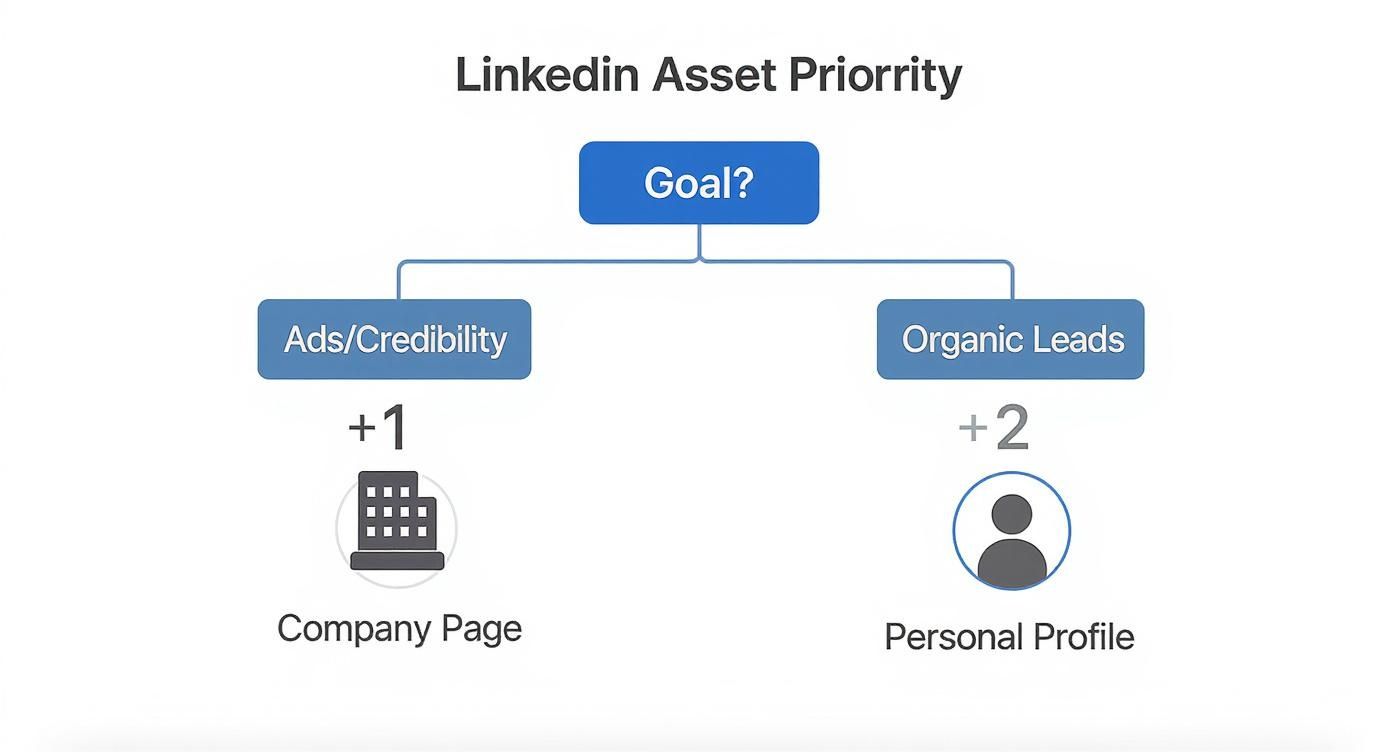
As the chart shows, it's a clear split: if you need credibility for running ads, your Company Page is essential. But if you’re chasing organic leads through relationships, your Personal Profile is the engine room.
Building Trust and Authority
This is where organic marketing truly shines. When you consistently share valuable insights, offer helpful advice, and have genuine conversations, you build real relationships. You become a trusted expert. This "know, like, and trust" factor is absolute gold for service businesses because it warms up potential clients before they even think about reaching out.
Paid ads are great for building brand awareness, but they are inherently transactional. They can drive leads, no question, but they don’t foster that deep level of trust you get from a long-term organic presence. The smartest strategies often use paid ads to amplify the authority you've already built through your organic content.
Scalability and Predictability
Paid marketing is built to scale. Once you crack a campaign that delivers a positive ROI, you can simply increase your budget to generate more leads in a predictable way. For established firms, this makes forecasting revenue and planning growth much, much easier.
Organic marketing is less predictable and harder to scale directly. You can't just double your time and expect to double your inbound leads. Its power lies in creating a consistent, compounding effect over the long haul. Your reach grows, but not always in a straight line.
Organic vs Paid LinkedIn Marketing At a Glance
So, how do these two approaches stack up side-by-side for a service provider? This table cuts straight to the chase.
| Criterion | Organic Marketing (Content & Outreach) | Paid Marketing (LinkedIn Ads) | Recommended For |
|---|---|---|---|
| Cost | Low financial cost, high time investment. | High financial cost, lower time investment. | Organic: Startups, solo consultants. Paid: Established businesses. |
| Speed to Results | Slow and steady (3-6+ months for traction). | Fast (results within days or even hours). | Organic: Long-term brand building. Paid: Immediate lead generation. |
| Trust Building | Excellent for building deep, authentic trust. | Builds brand awareness, but less personal trust. | Organic: High-ticket service providers. Paid: Volume-based offers. |
| Targeting | Relational and manual; connects with individuals. | Highly precise; targets specific demographics. | Organic: Niche relationship selling. Paid: Reaching a broad but specific audience. |
| Scalability | Difficult to scale predictably. | Highly scalable and predictable with budget. | Organic: Foundational growth. Paid: Aggressive growth targets. |
Ultimately, the choice isn't about picking one and ignoring the other. The most powerful LinkedIn strategies blend the long-term authority of organic with the speed and scale of paid ads.
The momentum behind both is undeniable in Australia. A huge 97% of B2B marketers now use LinkedIn in their content strategies, and the platform drives a staggering 80% of all B2B social media leads. These figures prove it’s the undisputed channel for serious lead generation. If you want to dive deeper into the numbers, check out these recent LinkedIn advertising statistics.
The Organic Playbook for Building Authority and Relationships
Organic marketing for LinkedIn is all about the long game. It’s where you swap ad spend for consistency and authenticity, building genuine authority that pulls business opportunities toward you naturally.
This isn't about chasing viral hits. It’s about creating a sustainable system to attract your ideal clients by solving their problems, networking with purpose, and showing up enough to stay on their radar.
Develop a Client-Centric Content Plan
Your content is the engine of your entire organic strategy. The goal here is simple: stop broadcasting sales pitches and start publishing content that cements you as the go-to expert in your niche. That process always starts with knowing your clients' biggest headaches and goals inside out.
To really nail this, understanding how to write engaging LinkedIn posts is non-negotiable. A solid content plan mixes up the formats to keep your audience hooked and caters to how different people like to consume information.
- Text-Only Posts: Perfect for sharing quick insights, asking sharp questions, or telling relatable stories. The LinkedIn algorithm loves these for their simplicity and how easily they spark conversation.
- Image or Carousel Posts: Use carousels (which are just PDF documents) to break down complex ideas into easy-to-digest slides. They work brilliantly for mini-guides, checklists, or walking through a step-by-step process.
- Native Video: Short, authentic videos (1-3 minutes) are great for sharing quick tips, behind-the-scenes content, or client wins. Video builds a much stronger personal connection with your audience.
Key Takeaway: The best organic content doesn't sell—it educates, inspires, or solves a problem. Aim for 80% value and just 20% direct promotion.
Grow Your Network with Strategic Intention
Adding connections at random is a complete waste of time. Your network is your biggest asset on LinkedIn, so you need to curate it as carefully as you would your client list. It's all about quality, not quantity.
Get crystal clear on your Ideal Client Profile (ICP). Who are the decision-makers you need to get in front of? What are their job titles, industries, and company sizes? With that clarity, you can start your outreach.
Your Networking Action Plan:
- Identify Targets: Use LinkedIn’s search filters to find professionals matching your ICP. For a more granular search, a tool like Sales Navigator can seriously level up your targeting. If you want to dig deeper, our guide on how Sales Navigator works is a great place to start.
- Personalise Every Request: Never, ever send a generic connection request. A short, personalised note explaining why you want to connect is essential. Mention a mutual connection, a post they shared, or a common interest.
- Connect with Referral Partners: Don’t just hunt for clients. Build real relationships with other service providers who serve the same audience. A strong referral network can be an incredible source of warm leads.
Create a Consistent Engagement Routine
If you want to be seen on LinkedIn, you have to be active. Consistently. You can't just post content and vanish; you need to be part of the community. A simple daily and weekly routine is the secret to building momentum without getting overwhelmed.
This routine makes sure you’re always interacting with your network, strengthening relationships, and keeping your profile visible in the feed.
Your Daily Engagement Checklist (15-20 Minutes):
- Engage with Your Feed: Spend 10 minutes scrolling your feed. Leave thoughtful comments on at least 3-5 posts from your ideal clients or referral partners. A meaningful comment beats a simple "like" every time.
- Respond to All Comments: Acknowledge every single comment on your own posts. This not only boosts your post's reach but also shows you value your audience’s input.
- Check Your Inbox: Reply to messages and keep conversations going.
Your Weekly Engagement Checklist (30-60 Minutes):
- Publish 2-3 Value Posts: Stick to your content plan and share valuable insights.
- Send 5-10 Personalised Connection Requests: Keep building your network strategically.
- Engage in 1-2 Relevant Groups: Find out where your ideal clients are hanging out and add value to the conversations there.
By sticking to this playbook, you'll turn your LinkedIn profile from a static online resume into a dynamic machine for generating leads built on trust and authority.
The Paid Playbook for Precision Targeting and Rapid Growth
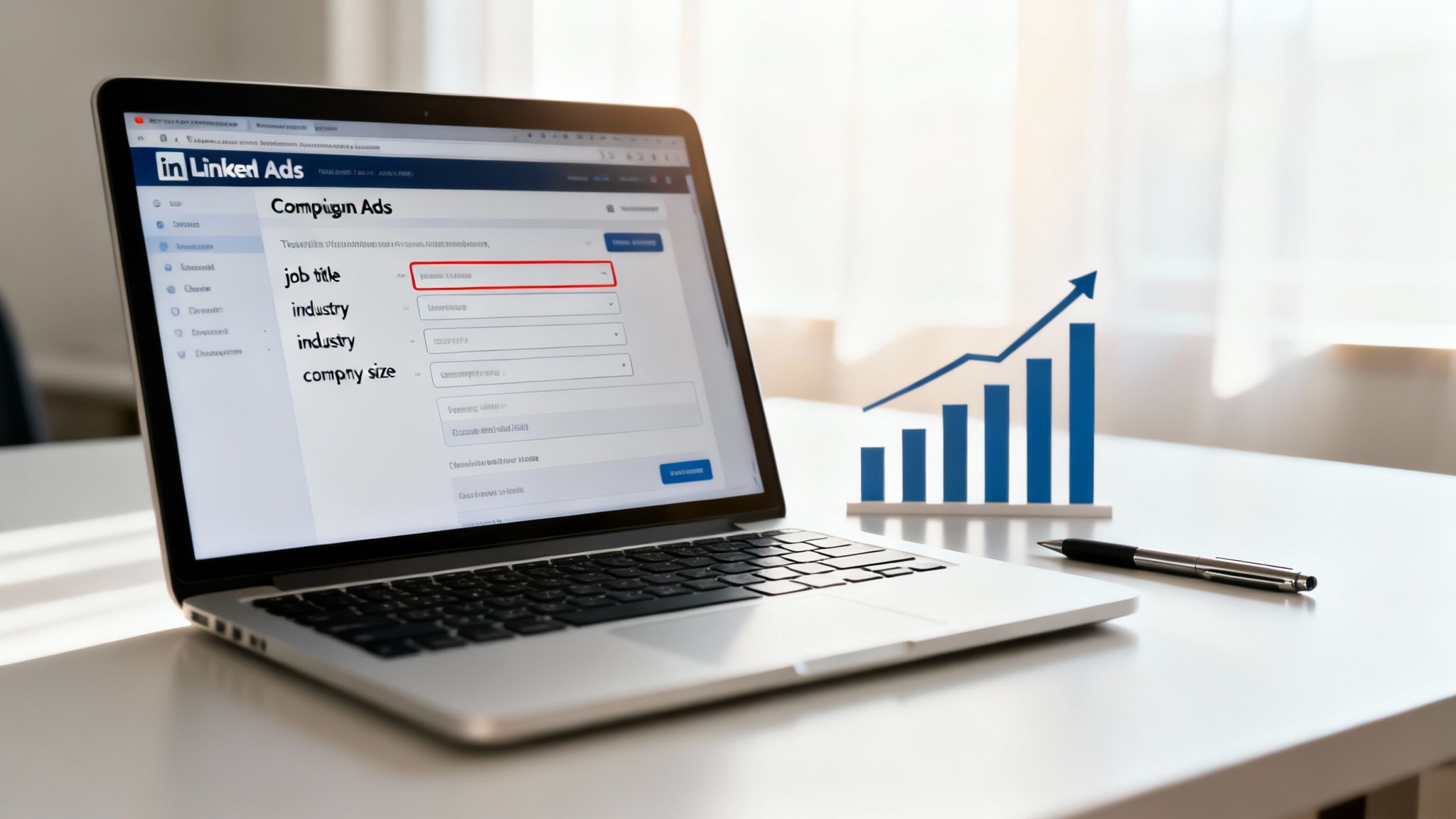
When your service business needs predictable, fast results, paid advertising is the most direct route you can take. The paid approach to marketing for LinkedIn isn't about guesswork; it's a calculated move that puts your message right in front of the decision-makers you need to reach.
While organic methods are great for building authority over the long haul, LinkedIn Ads gives you immediate visibility and a scalable way to generate leads. It lets you skip the slow burn of relationship building and go straight to the people with purchasing power.
Choosing the Right Ad Format for Your Goals
LinkedIn offers a few different ad formats, each built for different business goals. Picking the right one is your first step toward a campaign that actually works. Instead of trying them all, just focus on the formats that make the most sense for a service business.
Key Ad Formats for Service Businesses:
- Sponsored Content (Single Image or Video Ads): These ads pop up right in the LinkedIn feed and look like normal posts. They’re perfect for promoting valuable content like a case study or a webinar invitation, building brand awareness, and getting traffic to your website.
- Message Ads (Formerly Sponsored InMail): This format lets you send a direct message straight to your target audience's inbox. Message Ads are incredibly effective for personalised invitations to book a call or for offers on high-value services because they feel like a one-on-one conversation.
- Lead Gen Forms: You can attach these to Sponsored Content or Message Ads. When someone clicks your call-to-action, a form pre-filled with their LinkedIn profile info appears, making it ridiculously easy for them to become a lead without ever leaving the platform.
For a complete breakdown of campaign types, our guide to LinkedIn advertising gives you a detailed look at how to structure your first campaign for success.
Mastering Precision Audience Targeting
The real magic of LinkedIn Ads is in its targeting. You can go way beyond broad demographics and pinpoint the exact professionals you want to connect with, ensuring your budget is spent wisely.
LinkedIn's targeting filters are the secret sauce to a high-ROI campaign. They let you define your audience by job title, company size, industry, seniority, and even specific skills—making sure your ads only reach qualified prospects.
For example, a business consultant in Sydney can target "CEOs" and "Managing Directors" at "Financial Services" companies with 11-50 employees, located specifically within "New South Wales." You just can't get that level of precision with organic marketing.
Structuring Your First Campaign with Confidence
Launching a paid campaign doesn't have to be intimidating. If you follow a simple framework, you can make sure all your bases are covered, from budgeting to the ad creative itself. A well-structured campaign is just easier to manage, measure, and tweak over time.
A Simple Campaign Framework:
- Define Your Objective: Start with a clear goal. Are you after website traffic, lead generation, or brand awareness? Your choice here will shape the ad formats you use and the metrics you track.
- Set a Realistic Budget: Begin with a small daily or total budget you're comfortable testing with. You can always scale it up once you see what’s working. Even $20-$50 per day can give you enough data to get started.
- Build Your Target Audience: Use the detailed filters to create a super-specific audience. Try not to make it too broad or too narrow; an audience size between 20,000 and 80,000 is usually a good sweet spot for testing.
- Create Compelling Ad Copy and Visuals: Your ad has to grab attention and speak directly to your audience's pain points. Use a strong hook, clearly state the benefit of your service, and include a clear call-to-action (CTA). Pair it with a high-quality, professional image or a short, snappy video.
By combining the right ad format with precise targeting and a structured approach, you can turn LinkedIn Ads into a reliable and scalable engine for getting new clients.
How to Measure Success and Optimise Your Strategy
Posting on LinkedIn and just hoping for the best isn’t a strategy. To make sure your time and money are actually working for you, you need to track the right numbers, understand what they mean, and tweak your approach based on what you learn.
Measuring success looks different for your organic content versus your paid ads. It’s crucial to focus on the numbers that actually move the needle for your business, not just the ones that make you feel good.
Key Metrics for Your Organic Strategy
When it comes to your organic efforts, success isn’t about likes and comments. It’s about the quality of the engagement and the inbound opportunities you’re creating.
Instead of chasing vanity metrics, zoom in on the numbers that show genuine interest and tell you that you're building real momentum.
- Profile Views: A spike in profile views usually means your content is hitting the mark with the right people, making them curious enough to check you out. Keep an eye on this weekly to see which posts are driving the most traffic to your page.
- Connection Request Acceptance Rate: A high acceptance rate (aim for over 50%) is a clear sign that your personalised outreach messages are working and your profile instantly shows your value. If it's low, it's time to rework your connection message or your headline.
- Inbound Messages and Enquiries: This is the big one. This is your ultimate organic KPI. Track how many unsolicited messages you get from ideal prospects asking about what you do. It’s the clearest measure of your content’s power to generate leads.
Essential KPIs for Your Paid Campaigns
With paid advertising, you need to be much more clinical in your analysis because every single click costs money. The goal here is to understand exactly how your campaigns are performing to ensure you're getting a positive return on your investment.
Monitoring your paid campaigns isn't just about tracking your spend. It's about spotting what works so you can double down on your best-performing ads and audiences while cutting the ones that are just eating up your budget.
Here are the key performance indicators (KPIs) you need to watch like a hawk:
- Click-Through Rate (CTR): This tells you how compelling your ad is. A higher CTR (anything above 1% for Sponsored Content is pretty good) means your ad creative and copy are resonating with your target audience.
- Cost Per Lead (CPL): This metric tells you exactly how much you're paying to get a single lead. Keeping your CPL low is what makes your campaigns profitable. If it’s creeping up, you might need to adjust your targeting or sweeten your offer.
- Conversion Rate: This is the percentage of people who click your ad and actually become a lead. It shows you how effective your landing page or Lead Gen Form is at doing its job.
By consistently keeping tabs on these specific metrics for both your organic and paid strategies, you can stop guessing and start building a predictable system for attracting your ideal clients. This data gives you the clear signals you need to optimise your strategy and make sure your LinkedIn marketing delivers real, tangible business results.
Your Top LinkedIn Marketing Questions, Answered
Got questions about using LinkedIn to grow your service business? You're not alone. Here are the straight answers to the questions I hear most often from business owners.
How Much Time Do I Really Need to Spend on LinkedIn Each Week?
Look, it's about consistency, not just cramming it all in on a Sunday night. For a solid organic strategy that actually gets results, aim for 3-5 hours a week.
I’d split that time between creating content (1-2 hours) and the important stuff: strategic networking and actually talking to people (2-3 hours).
If you're running paid ads, it's a bit different. Once your campaigns are live, you can get away with 1-2 hours a week just to check performance, see what’s working, and tweak your ad spend to get better results.
Do I Have to Pay for LinkedIn Premium to Make This Work?
No, it's definitely not essential to get started. You can build a great foundation with the free version. But once you've got your process down, upgrading to a plan like Sales Navigator can seriously speed things up.
Think of Sales Navigator as a superpower. It gives you advanced search filters and lead-building tools that let you find and connect with your ideal clients way more efficiently. My advice? Nail your strategy on the free version first, then upgrade to scale what you know already works.
What's the Biggest Mistake I Could Be Making on LinkedIn?
Easy. Treating it like a billboard. The single biggest mistake is just broadcasting promotional posts and sales pitches. Nobody wants to see that. It pushes people away and does nothing to build the trust you need to sell high-value services.
Success on LinkedIn comes from being seen as the go-to expert. To do that, make sure 80% of your content is focused on helping, educating, and solving problems for your audience. When you do that, clients come to you because they already see your value.
Should I Focus on My Personal Profile or Company Page?
For any service-based business, your personal profile is your number one marketing asset. People do business with people, not logos. Your profile is where you build your personal brand, share what you know, and make real connections.
Your Company Page still has a role to play, though. It's your business's professional home base. You need it to run LinkedIn Ads, and it's the perfect spot for official company news, detailed case studies, and building that overall brand credibility. They work together, but your personal profile always leads the charge.
Ready to stop guessing and turn LinkedIn into a predictable source of leads for your service business? At Homer Digital Marketing, we build smart marketing systems that combine expert content with strategic automation to bring your ideal clients to you.
Book a no-obligation strategy call today and let's talk about how we can help you scale.
