

Picture this: dozens of potential clients in your city are searching online for legal help right now. Where does your firm show up? Law firm search engine optimisation (SEO) is all about making sure your firm is the first one they see. It's the process of boosting your website's visibility so you become the obvious choice for clients looking for a solicitor.
Why Your Firm Needs to Master Search Engine Optimisation
In the Australian legal market, your website is no longer just a digital business card—it's your primary source of new clients. People don't flick through the Yellow Pages anymore. They turn straight to Google to find a conveyancer, a barrister for court representation, or a family lawyer to handle a divorce. If your firm isn't on the first page of those search results, you're effectively invisible.
To get this right, you first need a solid grip on What is Search Engine Optimization (SEO). It’s not about tricking Google's algorithms. It's about building a credible, authoritative, and helpful online presence that genuinely connects people with the legal solutions they desperately need. Think of it as the digital equivalent of earning a rock-solid reputation in your local community.
The Core Pillars of Legal SEO
A winning SEO strategy is built on several key pillars that all work together. If you neglect one, the others will suffer. You need a holistic approach to see sustainable growth and a consistent stream of new client enquiries.
This infographic breaks down the essential parts of a successful law firm SEO strategy, zeroing in on your local presence, your website's performance, and the authority of your content.
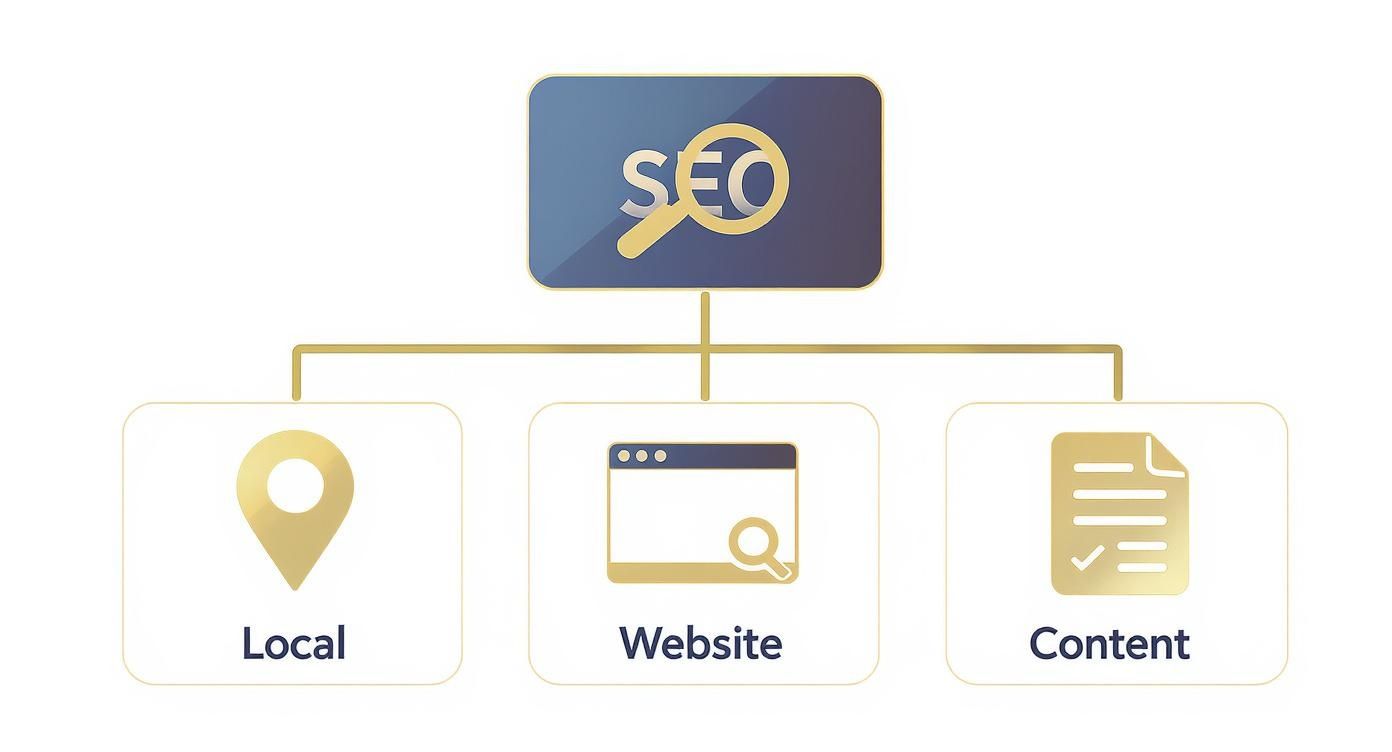
The diagram makes it clear: SEO isn't a single task. It's a multi-faceted discipline where your local visibility, the technical health of your website, and high-value content all have to be optimised to land those top rankings.
By focusing on these core areas, you create a powerful system that attracts, engages, and converts potential clients. This guide will provide a clear roadmap to implementing these strategies, moving your firm from being just another website to a dominant force in your local market. Each section will build upon the last, giving you actionable steps to transform your online presence into a reliable client generation engine.
Winning Locally with a Powerful Digital Footprint
For Australian law firms, the fight for new clients is almost always won on a local battlefield. Forget the Yellow Pages; modern clients turn straight to Google. When someone in your suburb needs legal advice for a property settlement or a will, their first move is an online search.
This is why your law firm search engine optimisation has to start with dominating your local area. It’s not just an add-on; it's the foundation of your entire client acquisition strategy. It’s about building an undeniable digital presence right where your clients live and work.
Your Digital Front Door: Google Business Profile
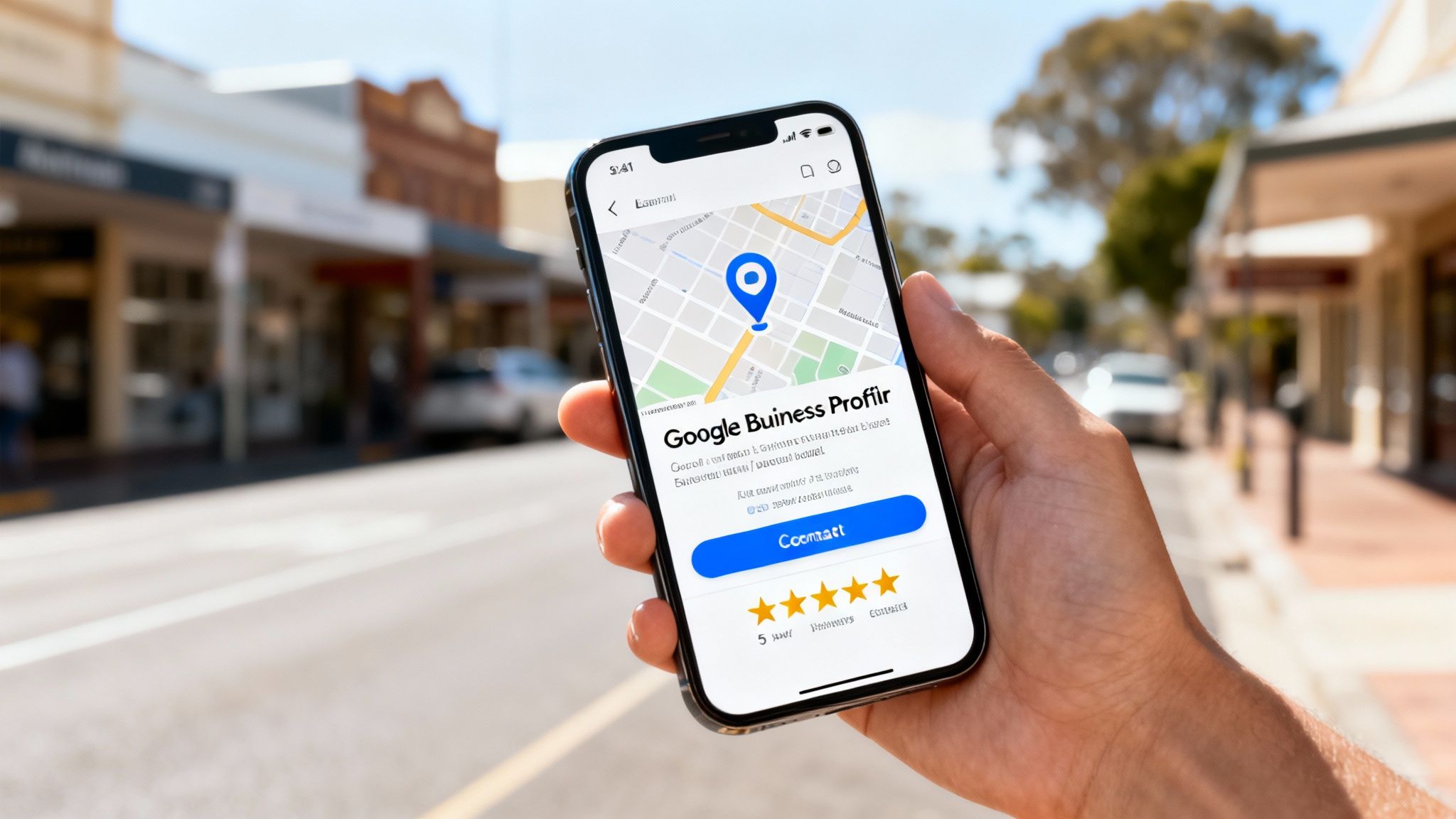
Think of your Google Business Profile (GBP) as the digital front door to your practice. It's often the very first interaction a potential client has with your firm, popping up in Google Search and on Google Maps. A neglected, half-finished profile is like having a messy, unwelcoming reception area—it puts people off immediately.
A well-optimised profile, on the other hand, is a client magnet. It instantly showcases your expertise, builds trust with professional photos and glowing reviews, and gives people every piece of information they need to call or visit you in seconds. You can learn more about building a profile that wins business in our detailed guide to optimising your Google Business Profile.
The Power of Client Reviews and Local Citations
Positive reviews are digital gold. They’re one of the most powerful signals to both prospective clients and Google that your firm is credible and delivers fantastic service. A steady stream of 4- and 5-star reviews can be the single deciding factor that makes a client choose you over a competitor down the road.
Beyond reviews, you need consistent local citations. These are simply mentions of your firm's Name, Address, and Phone number (NAP) on other trusted online directories like Yelp, TrueLocal, or industry-specific legal listings.
Each consistent citation acts like a vote of confidence, telling search engines that your firm is a legitimate and established part of the local business community. Inconsistency, however, can create confusion and harm your rankings.
Creating Hyper-Local Content
To truly own your local market, you need to create content that speaks directly to the legal headaches of your community. This means going deeper than generic articles and targeting the specific questions and concerns of clients in your service areas.
This strategy signals to Google that you aren't just any law firm, but the law firm for a particular location. By answering area-specific legal questions, you forge a powerful connection with your local audience and establish unmatched relevance. Here’s what this looks like in practice:
- Suburb-Specific Service Pages: Instead of a single "Family Law" page, create targeted pages like "Family Lawyers Parramatta" or "Conveyancing Services Geelong." These are designed to capture users searching with clear local intent.
- State-Specific Legal Guides: Develop content around laws and regulations unique to your state, such as "A Guide to NSW Property Settlement" or "Understanding Drink Driving Penalties in Queensland."
- Local Case Studies: Anonymously detail a successful case you handled for a local client, highlighting how you navigated a specific legal challenge within your community.
This is a massive missed opportunity for most firms. While a surprising 74% of Australian law firms have a website, a recent study found only 28% invest in professional SEO to get it seen. Worse, the same audit found that roughly 28% of leading Aussie law firm websites failed Google’s Core Web Vitals tests.
The firms that get ahead are the ones focusing on a sharp local strategy—a polished Google Business Profile, consistent reviews, and hyper-local content. That’s how you land in Google's vital "map pack" and win those valuable local clients.
Here is a simple checklist to get you started on the most important local SEO tasks for your firm.
Your Local SEO Action Plan
| Action Item | Why It Matters | Implementation Tip |
|---|---|---|
| Optimise Google Business Profile | It’s your digital "front door." An incomplete profile costs you clients and hurts your map visibility. | Fill out every section: services, photos, Q&As, and business hours. Post regular updates. |
| Encourage Client Reviews | Reviews build immense trust and are a major ranking factor for local search. | Create a simple email or SMS template to send to clients after their matter is finalised. Make it easy for them. |
| Build Local Citations | Consistent NAP (Name, Address, Phone) details across the web confirm your location and legitimacy to Google. | Start with major directories like TrueLocal and Yelp, then move to legal-specific directories. Ensure 100% consistency. |
| Create Suburb-Specific Pages | This targets high-intent searches like "criminal lawyer Bankstown," capturing clients ready to act. | Dedicate a unique page on your site for each core practice area in each key suburb you serve. |
| Publish Localised Blog Content | Answer the specific legal questions your community is asking. This establishes you as the local authority. | Write about local court procedures, by-laws, or state-specific legal changes that affect residents. |
| Ensure Mobile-Friendliness | The majority of local searches happen on mobile devices. A poor mobile experience sends clients elsewhere. | Use Google's Mobile-Friendly Test tool to check your site and fix any issues immediately. |
Putting this plan into action is the first step toward building a local digital footprint that consistently attracts the right clients to your door.
Building Your Website on a Foundation of Technical SEO
Imagine building a prestigious new office on shaky ground. No matter how impressive the design or how valuable the services offered inside, that faulty foundation puts everything at risk. Your law firm's website is no different, and its foundation is technical search engine optimisation.
Technical SEO is all the behind-the-scenes work that makes sure your site is stable, fast, and easy for search engines like Google to understand. Without a solid technical base, even your most compelling articles and five-star reviews won't deliver their full potential. Why? Because potential clients will abandon a slow or confusing website in seconds, sending all the wrong signals to Google and costing you valuable enquiries.
Why Site Speed Is Non-Negotiable
In today’s world, patience is a very scarce resource. If your website takes more than a few seconds to load, potential clients will hit the back button without a second thought. It's not just about user experience; site speed is a confirmed ranking factor for Google.
A slow website directly hits your bottom line by increasing your bounce rate—the percentage of visitors who leave after seeing just one page. To find and fix what's holding you back, you'll need to run a site audit. The good news is there are plenty of excellent free SEO tools available to help diagnose site speed and other technical gremlins.
A fast, responsive website creates an excellent user experience, and Google rewards that with better visibility. You should be aiming for your pages to load in under three seconds to keep potential clients on your site.
The Mobile-First Imperative
Let's face it: most online searches for legal services now happen on a smartphone. This massive shift led Google to adopt mobile-first indexing, which means it primarily uses the mobile version of your website for ranking. If your site looks fantastic on a desktop but is a nightmare to navigate on a phone, your search rankings will suffer.
A mobile-friendly design isn't just a "nice-to-have" anymore; it's a must. Every single element, from your navigation menus to your contact forms, has to be easy to use on a small screen. This ensures you’re not shutting the door on the huge number of people looking for legal help while they're on the go.
A Logical Site Structure for Users and Bots
A well-organised website is like a well-structured legal argument—it's clear, logical, and easy to follow. A sensible site structure helps both human visitors and search engine crawlers find the information they need without getting lost.
Think of it as creating a clear map of your digital office. Your homepage should link to your main practice area pages (e.g., Family Law, Criminal Defence), which then link to more specific sub-topics (e.g., Divorce, Bail Applications). This hierarchy not only makes navigation intuitive for clients but also helps Google understand the relationship between your pages, distributing authority across your entire site.
Speaking Google’s Language with Schema Markup
Finally, one of the most powerful—and often overlooked—technical SEO tools for law firms is schema markup. This is a special type of code you add to your website that acts as a translator, telling search engines exactly what your content is about in a language they can process instantly.
Instead of just seeing text, Google can understand that you are a law firm, your address is a physical location, and your phone number is a direct contact method. This can lead to what's known as "rich snippets"—enhanced search results that might display your client review ratings or office hours right on the results page. These eye-catching listings can dramatically increase your click-through rate, giving you a serious edge over the competition.
Creating Content That Attracts and Converts Your Ideal Client
Great content is the engine of your entire law firm search engine optimisation strategy. It’s how you show up and provide answers when potential clients are typing their urgent, complex questions into a Google search bar. A winning approach goes far beyond generic blog posts; it’s about building a solid content plan that cements your authority and gets the phone ringing.

This means crafting high-value practice area pages and genuinely helpful articles that speak to clients at every stage of their journey—from the moment they start researching to the point they decide they need a solicitor.
Beyond Keywords to Client Intent
SEO used to be a simple game of matching keywords. Not anymore. Today, it’s all about understanding the intent behind the search. Think about it: someone searching "what happens in a property settlement" is in a completely different headspace to someone searching "best family lawyer in Melbourne."
The first query is informational. The second is transactional—they're ready to hire. Your content has to serve both. By mixing educational articles with service-focused pages, you meet potential clients right where they are. This also means keeping up with how search engines think, which now involves understanding semantic search and context, not just keywords.
Your goal is to become the go-to resource for your practice areas. When your website consistently provides the best, clearest answers, Google notices. It rewards you with higher rankings and establishes your firm as the trusted authority.
Building Foundational Content Pillars
Your website's content needs a strong structure, built around key pillars that represent your core services. These aren’t just single pages. They're interconnected clusters of content that prove you have deep expertise in an area.
For each of your core practice areas, you should have:
- A Cornerstone Practice Area Page: This is your definitive, in-depth page on a primary service like "Personal Injury Claims" or "Commercial Litigation." It’s the central hub for that topic on your site.
- Targeted Sub-Topic Pages: These pages branch off your cornerstone page to cover specific niches. For example, a Personal Injury page should link out to detailed pages on "WorkCover Claims," "Motor Vehicle Accidents," and "Public Liability."
- Helpful Blog Posts and FAQs: These are the articles that answer the specific, long-tail questions your potential clients are actually asking. They build authority and capture search traffic from people who aren’t ready to hire yet, but need solid information.
This structured approach helps search engines recognise your firm as a subject matter expert, which is absolutely critical for ranking for those competitive legal keywords.
Real-World Examples That Win Clients
Let's get practical. Generic content is just noise. What really attracts high-quality leads is specific, localised content that speaks directly to a person's situation.
Here are a few powerful examples tailored for the Australian market:
- "First Steps to Take After a Car Accident in NSW": This article immediately addresses a searcher's panic, giving them actionable advice while positioning the firm as a helpful expert.
- "Understanding Property Division in a Victorian Divorce": This content targets people trying to get clarity on a stressful and complicated process. It builds trust by offering real value upfront.
- "A Guide to Contesting a Will in Queensland": This piece connects with users in the research phase, explaining the legal grounds and processes involved and showcasing deep expertise in a niche area.
This is the kind of specific, helpful content that turns a casual searcher into a qualified lead. The impact is massive. For instance, ranking first for a term like "family lawyer Sydney" (which gets around 1,600 searches a month) could drive about 480 visits to your site every single month. Even with a conservative contact rate, that single keyword could generate over a dozen new clients monthly.
Over time, these efforts compound. One Australian firm generated over 8,600 leads in two years through precisely this kind of targeted SEO, proving the direct financial return of a well-executed content strategy. You can see more details on how SEO drives measurable results for law firms on yomedia.com.au.
Earning Trust Through Digital PR and Link Building
Think of links from other reputable websites as the digital equivalent of a referral from a respected colleague. In the world of law firm search engine optimisation, they are one of the most powerful signals you can send Google, telling them your firm is a credible authority.
Without these crucial "votes of confidence," even the most perfectly written content can get lost in the noise, struggling to rank for the legal terms that matter most.

But this isn't a numbers game. Forget about collecting as many links as you can from any old website. The golden rule is quality over quantity.
A single, relevant link from a major Australian news outlet or a respected legal association is worth infinitely more than a hundred links from dodgy, irrelevant directories. Your goal is to earn high-authority backlinks that build your reputation and actually drive potential clients to your site.
Building Your Digital Reputation
Effective link building for law firms has moved far beyond technical tricks. Today, it’s all about genuine public relations and community engagement. It’s about creating valuable resources and participating in activities that naturally attract attention—and links.
This modern approach doesn't just boost your SEO. It elevates your firm's brand and cements your position as a pillar of the local community. Every insightful article you publish or local event you sponsor becomes a potential link-earning opportunity. The key is to be strategic and proactive in showing off what you know and what you stand for.
A strong backlink profile tells Google that your firm is a trusted source of information. This trust is non-negotiable for ranking for high-stakes legal keywords, as search engines want to send their users to the most reliable experts.
Actionable Link-Building Strategies for Australian Firms
Let's put the outdated, spammy tactics in the bin where they belong. Modern link building is about creating genuine value. Here are a few ethical and highly effective strategies specifically for Australian law firms.
-
Become a Source for Local Media: Journalists are always on a deadline and looking for expert commentary. Position your firm's solicitors as the go-to experts for local news outlets, radio stations, and online publications. When they quote you, they’ll almost always link back to your website.
-
Sponsor Local Community Events: Sponsoring the local footy team, a community fair, or a charity fun run usually gets you a link from the event's website. This builds a fantastic local link and generates massive goodwill and brand visibility where it counts.
-
Offer a Law School Scholarship: Creating a small annual scholarship for students at a local university's law school is a brilliant way to earn a highly authoritative .edu.au backlink. Search engines view these links as top-tier endorsements.
-
Publish Original Research or Data: Don't just write another blog post. Conduct a survey on a local legal issue or analyse public data to create a unique report. For instance, a report on "The Most Dangerous Intersections in Brisbane" is prime bait for links from local news and community blogs. This tactic instantly positions you as an authority.
By focusing on these relationship-driven strategies, you build a sustainable link-building engine that strengthens your SEO, polishes your brand reputation, and directly helps your bottom line.
Measuring SEO Success with Revenue-Driven Metrics
Website traffic is a nice number to look at, but it doesn't pay your firm's bills. The real measure of success for your law firm search engine optimisation is the direct impact it has on your bottom line. It’s time to stop chasing vanity metrics like rankings and impressions and focus on the key performance indicators (KPIs) that actually matter: new client enquiries, signed cases, and revenue.
This means getting past the excitement of watching visitor numbers climb. Instead, you need to track the specific actions that tell you a potential client is ready to talk. Without this focus, you're just flying blind, pouring money and time into a strategy without knowing if it’s delivering a real, tangible return.
From Vanity Metrics to Valuable Actions
The core idea behind revenue-driven SEO is simple: every marketing move you make must be tied to a business goal. Your website isn't just there to attract eyeballs; its main job is to turn those visitors into paying clients. To do that, you need rock-solid conversion tracking.
You have to monitor every possible point where a prospect might reach out. This includes:
- Phone Calls: Tracking calls coming directly from your website or Google Business Profile.
- Form Submissions: Keeping a tally of every "Contact Us" or "Free Consultation" form that gets filled out.
- Live Chat Engagements: Counting how many chat conversations turn into a qualified lead.
- Document Downloads: Seeing who downloads valuable resources, as this signals strong interest.
By tracking these conversions, you can start drawing a straight line from specific SEO activities—like a high-performing blog post—directly to new client enquiries. While knowing which content generates leads is crucial, figuring out the financial return on that investment can get complicated. We break down the challenges and strategies in our guide on why it is difficult to measure marketing ROI.
Aligning SEO with Business Goals
A revenue-focused approach forces you to ask tougher, better questions. Instead of asking, "How much traffic did we get?" you start asking, "How much revenue did that traffic actually generate?" This simple shift aligns your digital marketing directly with the financial health of your practice.
By focusing on revenue, you start making smarter, data-driven decisions. You can confidently double down on strategies proven to attract high-value cases and pull back on activities that only bring in low-quality traffic.
This pivot is becoming non-negotiable as technology reshapes how clients find legal help. In Australia, the evolution of law firm SEO is being driven by tech advances, especially AI and the move towards revenue-focused optimisation. Around 35% of Australian users now turn to AI assistants for legal questions, which means potential clients often get answers without ever visiting a law firm's website. Firms must adapt their SEO for this new world, creating content that not only ranks but captures a user’s intent and guides them through the client journey.
Revenue-driven strategies prioritise conversion optimisation, focusing on metrics like engagement, bounce rates, and form completions instead of just traffic numbers. You can discover more insights about these emerging SEO trends on socialhive.com.au.
Ultimately, when you measure what matters, SEO stops being a marketing expense and becomes what it should be: a predictable and scalable way to acquire new clients.
Your Questions About Law Firm SEO Answered
Trying to get your head around law firm search engine optimisation can feel like wading through legal jargon itself. It often creates more questions than answers. Let's clear up a few of the most common ones so you can move forward with a bit more confidence.
How Long Does SEO Take to Show Results?
Here’s the thing about SEO: it’s a marathon, not a sprint. If you’re looking for a quick hit of visibility, paid ads are your best bet. But if you want to build lasting, organic authority, you need to be patient.
As a general rule, you can expect to see some real movement and early results within three to six months.
But that timeline isn’t set in stone. It depends on:
- Competition: Trying to rank for family law in a major city like Sydney or Melbourne? That’s going to take a lot longer than targeting a niche practice area in a smaller town.
- Website Age: An established website with a bit of history has a head start. A brand-new site is starting from scratch and needs more time to build trust with Google.
- Consistency: SEO thrives on momentum. A steady effort in creating content and earning links will always beat sporadic bursts of activity.
Think of it like building your firm’s reputation in the local community. It doesn’t happen overnight. It takes consistent, high-quality work to become the go-to name people trust.
Do I Need a Blog for My Law Firm Website?
While you can technically do SEO without one, a blog is easily one of the most powerful tools you have. It’s your ticket to targeting long-tail keywords—those specific, detailed questions your potential clients are typing into Google every single day.
A good blog lets you answer questions like, "What are the first steps after a car accident in NSW?" or "How do I apply for probate in Victoria?"
This type of content does two crucial things: it attracts people who have a genuine legal problem, and it builds trust long before they’re ready to pick up the phone and hire a solicitor.
By answering common client questions on your blog, you’re not just creating content—you’re demonstrating your expertise and providing real value. That’s exactly what search engines are designed to reward, and it's a direct line to proving your firm’s E-E-A-T (Experience, Expertise, Authoritativeness, and Trustworthiness).
Can I Do SEO Myself or Should I Hire an Expert?
Going the DIY route can definitely save you money upfront and gives you complete control. But don’t underestimate the time commitment. SEO isn't a "set it and forget it" task; it requires constant learning and execution to stay effective. The rules are always changing, and what worked last year could be useless today.
Hiring an SEO expert or an agency gives you immediate access to specialised skills, industry knowledge, and years of experience. It frees you up to focus on what you do best: practising law and serving your clients. A recent report found that 28% of law firms now bring in a consultant for SEO, a clear sign that the industry recognises just how complex it has become.
A great middle ground? Handle the foundational tasks you know best—like asking clients for reviews or brainstorming blog topics based on the questions you hear daily. Then, outsource the more technical, time-consuming work to a professional. This balanced approach often delivers the best results for your time and money.
Ready to stop guessing and start getting real, measurable results from your online marketing? Homer Digital Marketing specialises in building powerful Google visibility for service-based businesses like yours. We combine proven SEO strategies with AI-powered systems to attract your ideal clients consistently. Book a discovery call today to see how we can help your firm grow.
