

Ever feel like you’re stuck in a learning loop on LinkedIn? You see the ads, you hear people talking about the latest courses, and you think, “Maybe this is the secret sauce to finally landing new clients.”
Here’s the honest truth from someone who lives and breathes this platform: learning LinkedIn and being on LinkedIn are two completely different things. Simply watching LinkedIn Learning courses won’t magically fill your pipeline. True success comes from turning that knowledge into real, human conversations.
I see so many business owners collecting course certificates like they're Pokémon cards, but their bottom line never budges. Why? Because they skip the most critical step: putting what they learn into daily practice. This guide is about closing that gap. We'll explore how to use LinkedIn Learning as a powerful tool, not just a content library, and combine it with a relationship-first approach to transform how you win clients.
What is LinkedIn Learning, Anyway?

Think of LinkedIn Learning as a massive, on-demand digital library built specifically for professionals. It’s a toolkit designed to help you sharpen your skills, from advanced sales tactics to the nitty-gritty of software you use every day. Because it’s owned by LinkedIn, the content is baked right into the professional ecosystem you’re already part of.
For business owners, it’s a direct line to expert-led training. With over 25,000 courses, you can find expert-led instruction on almost any topic imaginable, from “social selling fundamentals” to “LinkedIn for client acquisition.”
Key Features For Business Owners
The platform is much more than just a video player. It's packed with features designed to make learning practical and, most importantly, effective.
- Learning Paths: These are curated playlists of courses that guide you through a broader topic, like becoming a digital marketing specialist.
- Course Recommendations: LinkedIn’s algorithm suggests courses based on your profile, industry, and connections, saving you time.
- Certificates of Completion: Finish a course, and you can add a certificate directly to your LinkedIn profile. It’s a simple but powerful way to show you’re committed to your craft, which is a key point we cover when discussing if your LinkedIn profile really matters.
- Q&A Sections: Many courses have interactive Q&A sections where you can ask instructors questions and learn from other people’s queries.
LinkedIn Learning gives you the "what"—the strategies and the frameworks. But your success hinges on applying it with real human connection. A course can’t teach you empathy, but it can give you a framework to apply it more effectively.
The Gap Between Knowing and Doing

It’s one of the biggest hurdles I see ambitious business owners face. You pour time into a brilliant LinkedIn Learning course, taking pages of notes. You finish feeling pumped, your head buzzing with incredible new strategies. Then… nothing happens.
This is the gap between knowing and doing. We get stuck in ‘analysis paralysis,’ telling ourselves that just one more course will finally give us the confidence to act. But you can’t learn to ride a bike from a book. At some point, you have to start pedalling.
Why Action Always Trumps Theory
Think of it like this: a cookbook can give you a world-class recipe. But until you walk into the kitchen and start chopping, you aren't a chef. LinkedIn is your kitchen. LinkedIn Learning courses are the recipes. The real results only show up when you start cooking.
This means sending that slightly imperfect DM. It means hitting ‘publish’ on that post you’re a bit nervous about. It means leaving an insightful comment on a prospect’s article. Consistent, daily practice is infinitely more powerful than passively watching another tutorial.
“Knowledge is only powerful when it’s applied. A simple, authentic DM sent consistently will always outperform a complex strategy that stays in your notes.” – Maini Homer, Homer Digital Marketing
Real growth on this platform is all about building genuine human relationships. That takes skills you can't just absorb from a screen—like empathy, active listening, and the courage to be a little vulnerable.
Mastering LinkedIn with a Relationship-First Approach
Alright, we’ve covered that just watching LinkedIn Learning courses won't magically land you clients. So let’s get into the practical, day-to-day actions that turn theory into conversations and paying customers.
A relationship-first approach is simple: show up as a human first and a business owner second. It means you stop blasting sales pitches and start getting genuinely curious about people. This is how you build the kind of trust that turns connections into clients.
Crafting DMs That Actually Get a Reply
The DM inbox is where most LinkedIn relationships are either made or broken. Too many people treat it like a cold-calling script. A relationship-first DM does the exact opposite.
- Do your homework: Spend two minutes on their profile. Did they just post an interesting article? Share a personal story? Mention it.
- Lead with a compliment or question: Start with something that shows you’ve paid attention. "Loved your post on AI in real estate. How are you seeing that play out with your clients?" works wonders.
- Keep it short and about them: Your first message should be punchy and focused entirely on them, not what you sell. The goal is just to start a chat.
Leaving Comments That Spark Conversations
Think of your comments as a public portfolio of your expertise. Most people drop generic comments like "Great post!" These do nothing to build a connection. An insightful comment adds to the conversation and invites a response.
"A great comment doesn't just agree with the post; it extends the conversation. It adds a new perspective, asks a thoughtful question, or shares a relevant micro-story. That's how you get noticed by the right people."
Treat every comment as a mini-opportunity to give value. This generous approach builds your authority and makes you memorable. For a deeper dive, check out our guide on creating a standout LinkedIn marketing strategy.
Combining LinkedIn Learning with Real-Life Practice for Faster Results

So, how do you go from passively watching courses to actively building relationships? Stop treating learning and doing as separate things. Use LinkedIn Learning courses as a launchpad for immediate, real-world action. This is what separates the learners from the earners.
An Anecdotal Example of Success
I've heard so many stories like this, but one that stands out is about a business consultant who was struggling to get leads. She took a LinkedIn Learning course on social selling. The course was great—it gave her scripts and a clear process. But she didn't just copy and paste.
Before sending a message, she'd spend five minutes researching each person. She'd find a recent post they shared, then tweak the script from her course to open with a genuine question about it.
The course provided the "what to say," but her authentic application provided the "how to connect." This synergy is the key to turning education into revenue.
Within a week of trying this adapted strategy, she’d landed two high-value clients. The course gave her the foundation, but her personal touch and commitment to real-world practice delivered the results.
Your Blueprint for Application
Ready to build your own learning-and-doing model?
- Isolate One Tactic: When you start a LinkedIn Learning module, look for a single, actionable takeaway.
- Set an Immediate Action Goal: Your goal isn't to "finish the course." It's to "send five personalised DMs using the new approach."
- Review and Refine: At the end of the week, check your results. Adjust your approach based on real feedback, not just what the course told you to do.
This cycle of learning, applying, and refining is how you build true mastery. It turns learning LinkedIn into an active process that speeds up your growth, builds your confidence, and—most importantly—fills your pipeline.
Your Action Plan: What to Do Next
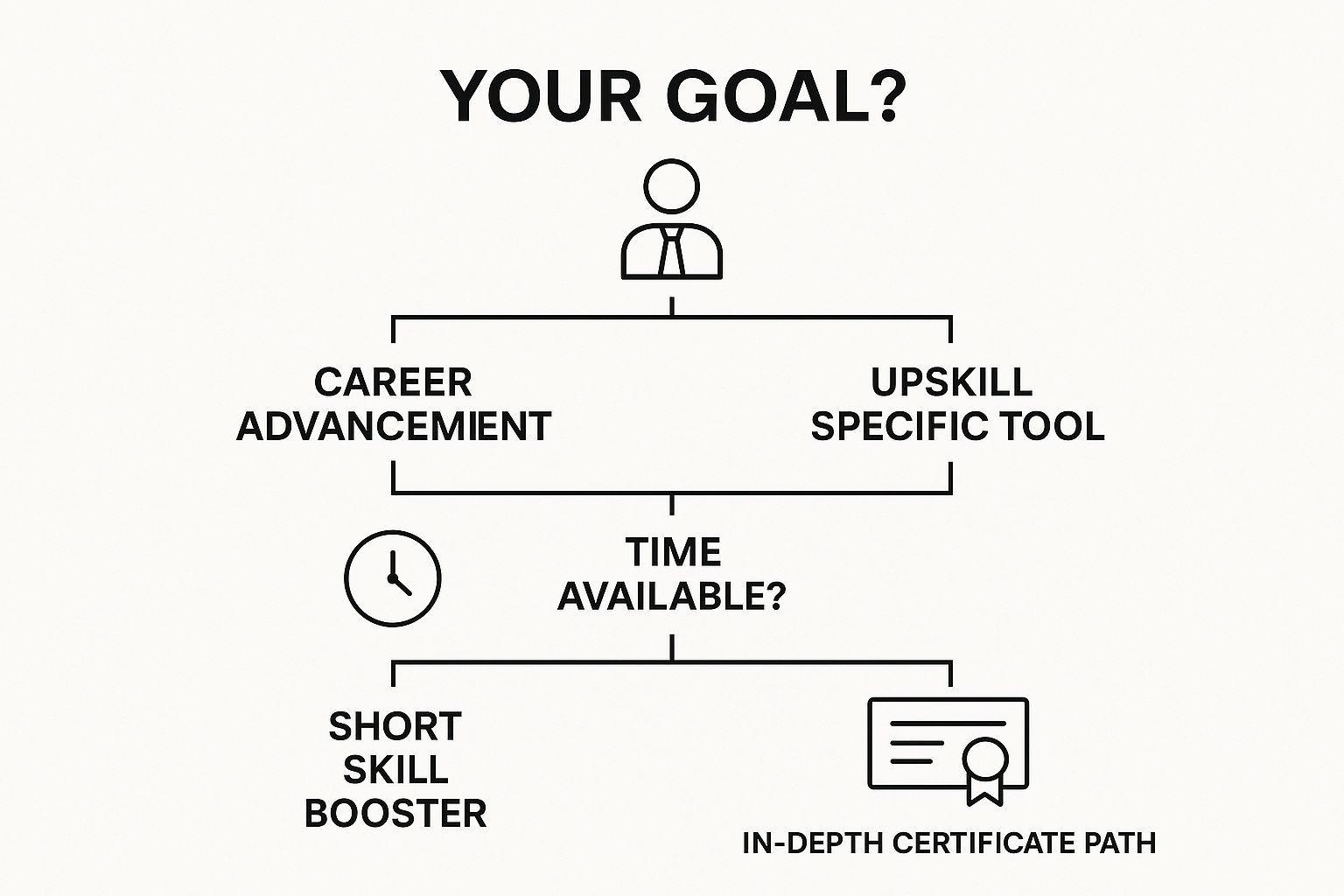
Right, you get that knowing what to do and actually doing it are two very different things. So, what’s the right next step for your business, right now?
When to Take a Course
A LinkedIn Learning course is your best bet when you’re staring at a specific knowledge gap. If you’re brand new to a tool like Sales Navigator or need to learn a skill from the ground up, a structured course gives you a solid foundation.
When to Just Start Applying Tactics
Got notebooks full of strategies but still not seeing results? More learning probably isn’t the answer. Your bottleneck is a lack of consistent action. It’s time to switch from education mode to execution mode and build momentum.
When to Work With a Mentor or Consultant
Sometimes, you need more than just information—you need personalised guidance. Working with a mentor is the way to go when you need accountability, expert feedback, and a strategy that’s built for your business and your blind spots.
Which Path Is Right for You?
This table cuts through the noise and helps you pinpoint exactly what action will give you the most impact right now.
| Your Situation | Recommended Action | Why It Works |
|---|---|---|
| "I don't know the first thing about LinkedIn ads." | Take a Course | You'll get the foundational knowledge and a clear framework to build on. |
| "I know I should post more, but I just… don't." | Apply Tactics | You need to build the habit of consistent action before you can expect to see any results. |
| "My outreach isn't converting, and I have no idea why." | Work with a Mentor | You'll get personalised feedback and a refined strategy to fix what's broken. |
Ultimately, whether it’s a course, daily practice, or expert guidance, the real key is to pick one path and commit to it. And remember to make sure all the right information is on your profile to back up your efforts! You can check out our guide on what you should include in your LinkedIn profile.
I hope this guide has given you the clarity you need to turn LinkedIn into a serious client-generating machine. If you want to learn LinkedIn in a hands-on, authentic way, I’d love to connect. Find me on LinkedIn, and let's have a chat—no pressure, no sales pitch, just a genuine conversation about your business.
