

Tired of marketing strategies that don't deliver? When it comes to generating real, high-value leads for your service business in Australia, lead generation from LinkedIn is in a league of its own. It’s not just a platform for posting job updates; it's a dynamic B2B marketplace waiting for you to tap into it.
The secret is to stop treating it like a resume site and start using it as a strategic tool. This means optimising your presence, sharing content that actually solves problems for your ideal clients, and reaching out to decision-makers without being spammy. This blueprint will show you exactly how to turn those connections into paying clients.
Why LinkedIn Is Your Ultimate B2B Lead Engine
If you're running a service-based business in Australia and not actively using LinkedIn, you are leaving money on the table. Simple as that. It's the undisputed champion for B2B leads because it was built from the ground up for professional engagement.
Forget the broad, scattergun approach you're forced to use on other platforms. LinkedIn's real magic lies in its laser-focused targeting. You get direct access to filter prospects by their industry, company size, job title, and even specific skills they’ve listed. This means every dollar and every minute you spend is aimed squarely at people who can actually become high-value clients.
The Power of Precision Targeting
Let's make this real. Imagine you run an IT consultancy in Sydney, and your sweet spot is working with Chief Information Officers (CIOs) at mid-sized financial services firms. Trying to find these exact people on Facebook or Instagram is a nightmare.
On LinkedIn, you can build that precise list in minutes.
- Geography: Greater Sydney Area
- Industry: Financial Services
- Company Headcount: 51-200 employees
- Job Title: Chief Information Officer
This level of detail is a game-changer. It ensures every message you send and every piece of content you post is hitting the right mark, which massively boosts your chances of starting a real business conversation. You move from hopeful marketing to predictable lead flow.
“LinkedIn isn't just a database of professionals; it’s a living ecosystem of opportunity. The ability to connect directly with a specific role, in a specific industry, in a specific location, is a game-changer for B2B sales.”
The numbers don't lie. For Australian businesses, LinkedIn’s power is clear, with 40% of B2B marketers worldwide calling it their number one source for high-quality leads. Locally, we see small and medium businesses consistently getting better results from LinkedIn than from big-budget Google Ads campaigns, especially for relationship-driven sales.
The conversion rates are just jaw-dropping. Some businesses using LinkedIn's Lead Gen Forms see conversion rates as high as 13%. To put that in perspective, a typical landing page is lucky to get 2.35%. Explore more statistics on LinkedIn's effectiveness if you need more convincing.
This infographic shows you exactly what’s possible when you nail your LinkedIn strategy.
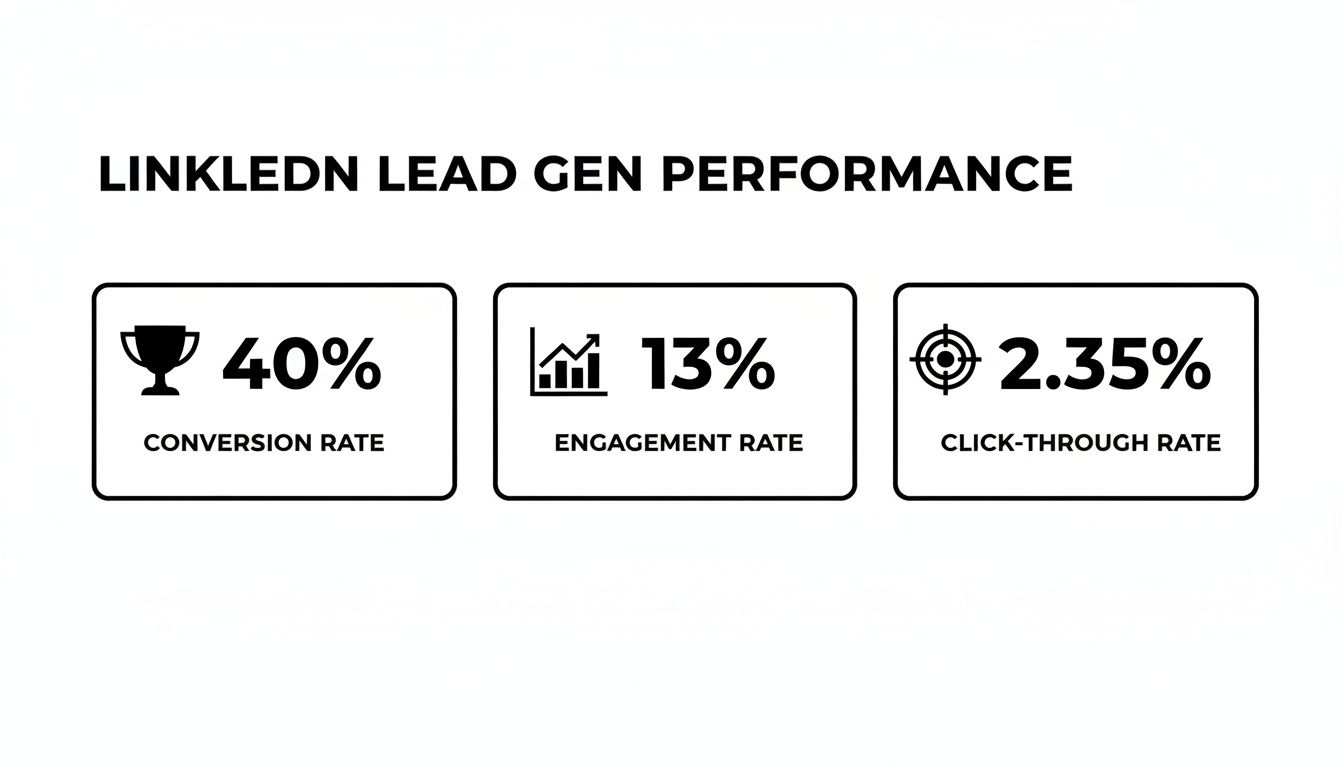
As you can see, the platform is engineered to turn professional engagement into measurable results. It’s not just a nice-to-have; mastering lead generation from LinkedIn is essential for any B2B business serious about growth.
LinkedIn vs Other Platforms for B2B Lead Generation
Still wondering where to focus your energy? This quick comparison highlights why LinkedIn is the superior choice for most Australian B2B businesses.
| Feature | Facebook/Instagram | Google Ads | |
|---|---|---|---|
| Audience Intent | Professional networking, industry insights, career growth. | Social connection, entertainment, personal interests. | Actively searching for a solution to a problem. |
| Targeting | Hyper-specific: job title, industry, company size, seniority. | Broad: interests, demographics, behaviour. Less reliable for B2B. | Keyword-based, but lacks professional context. |
| Lead Quality | Very high. Direct access to decision-makers. | Low to moderate. Often unqualified or not in a business mindset. | High intent, but can be very expensive and competitive. |
| Cost Per Lead | Can be very low with organic strategies; paid ads are moderate. | Generally lower, but requires huge volume to find quality leads. | Can be extremely high for competitive B2B keywords. |
| Best For | Relationship building, high-ticket services, thought leadership. | Brand awareness, B2C products, visual-heavy marketing. | Immediate lead flow for high-intent searchers. |
While platforms like Google Ads are powerful for capturing active buying intent, LinkedIn excels at creating that intent in the first place. It allows you to build trust and authority long before your prospect even realises they need you, which is the cornerstone of modern B2B selling.
Turning Your Profile into a 24/7 Lead Magnet
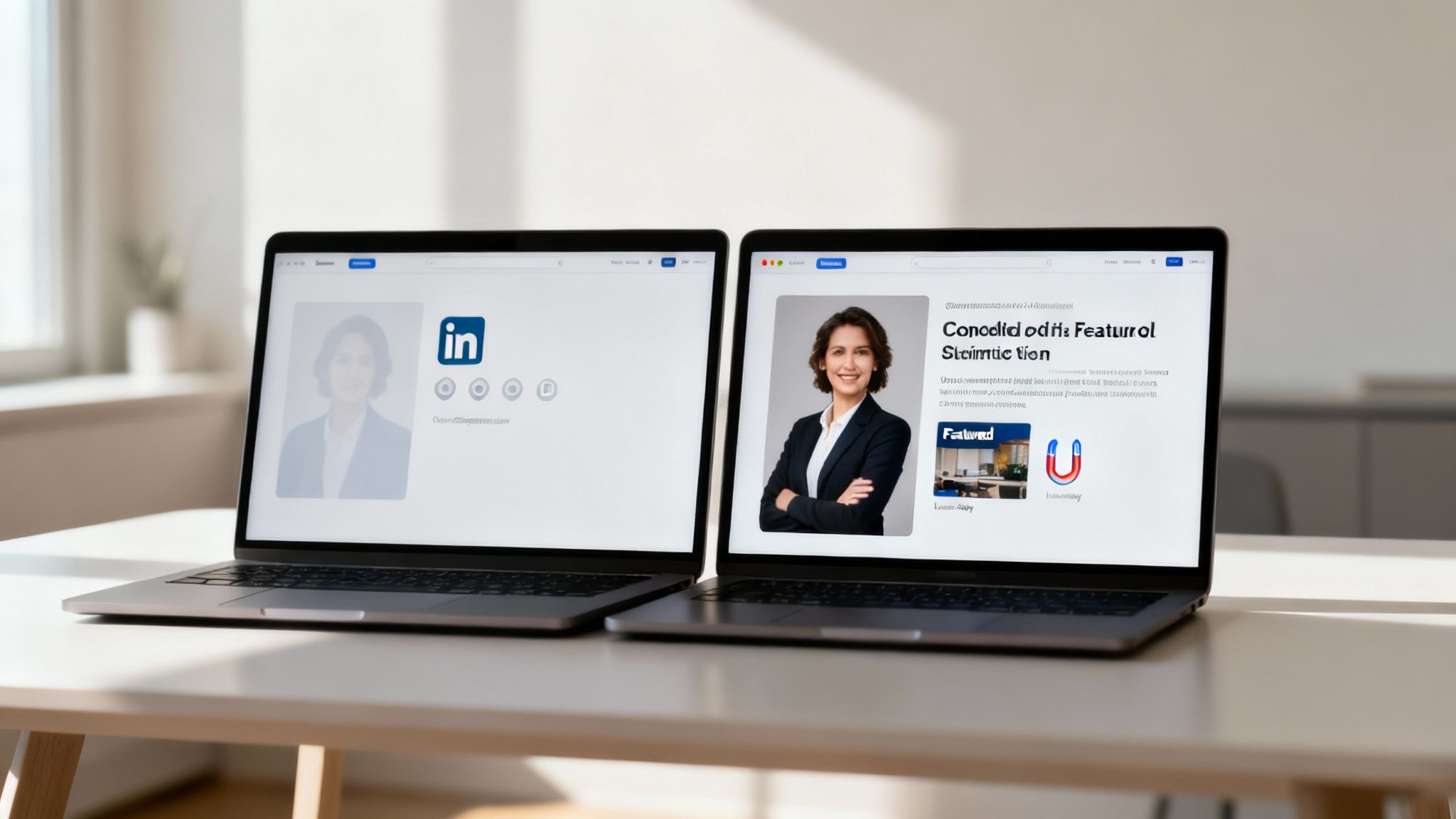
Think of your LinkedIn profile as your digital storefront. It’s your round-the-clock salesperson, and for most potential clients, it’s the first door they’ll walk through to get to your business. A sloppy, half-finished profile sends people running. But a sharp, strategic one builds instant credibility and starts conversations.
The biggest mistake I see service professionals make is treating their profile like a CV. It’s all about them—their job history, their skills, their promotions. That’s a huge turn-off. Your profile needs to be obsessively client-focused. It should scream, "I understand your problem, and I know how to fix it."
Nail Your Professional Headline
Your headline is the most valuable bit of real estate on your entire profile. It follows you everywhere on LinkedIn—in connection requests, comments, and search results. Wasting it on a generic job title like "Managing Director at ABC Company" is a massive missed opportunity.
Instead, your headline should speak directly to your ideal client. Tell them who you help and what you help them achieve. A simple but powerful way to frame it is: I help [Your Target Audience] get [Their Dream Outcome] with [Your Solution].
Let's look at the difference this makes:
-
Before: Financial Adviser at ABC Wealth
-
After: I Help Pre-Retirees in Sydney Secure Their Financial Future with a Personalised Superannuation & Investment Strategy
-
Before: IT Consultant
-
After: Simplifying IT & Cybersecurity for Australian Law Firms | Boosting Productivity & Protecting Client Data
See the shift? The "after" examples immediately tell a potential client if they're in the right place. It’s all about them, not you.
Write an 'About' Section That Actually Sells
Your 'About' section is where you tell a story. Don't just list your credentials. This is your chance to show a prospect you truly get their frustrations and have a clear path to solving them. Keep it scannable and punchy.
A great 'About' section should flow like this:
- Hook them in: Start with a question or a bold statement that hits on a major pain point.
- Show empathy: Briefly outline the struggles you know they're facing. Make them nod along.
- Position your solution: Introduce what you do as the obvious answer to those problems.
- Add a credibility booster: Weave in a quick mention of a key result, a client win, or your years of experience.
- Tell them what to do next: End with a clear call to action (CTA). Should they book a call? Download a guide? Visit your website?
Your 'About' section should feel less like a biography and more like the first page of a killer proposal. The goal is to make your ideal client think, "Finally, someone who gets it."
Use the 'Featured' Section as Your Portfolio
The 'Featured' section is a visual portfolio sitting right at the top of your profile. Leaving it blank is like having a shop window with nothing in it. It’s your prime spot to show, not just tell, people what you can do.
Load it up with high-value assets that build trust and pull people deeper into your world:
- Case Studies: Show off real results you’ve delivered for clients. Numbers and specifics are king here.
- Video Testimonials: Nothing builds trust faster than a happy client saying great things about you on camera.
- Lead Magnets: Link straight to a valuable checklist, guide, or webinar that captures their email address.
- Your Website's Service Page: Funnel targeted traffic directly to the page that matters most.
- Articles or Media Features: Got featured somewhere? This is instant authority.
Don’t Forget Your Company Page
While your personal profile is where you build relationships, your Company Page is where you establish brand credibility. It’s where prospects go to check if you’re a legitimate, professional operation.
Make sure your Company Page is complete. The tagline should echo the client-focused messaging on your personal profile. And don't just leave the call-to-action button as the default 'Visit website'. Change it to something more compelling like 'Learn more' or 'Contact us' depending on your goal. A polished, active Company Page is the final piece of the puzzle, cementing the professional image you've worked hard to create.
Developing a Content Strategy That Actually Converts
Content is the engine that drives your entire lead generation effort on LinkedIn. But forget vague advice like ‘post valuable content’. You need a solid framework that builds your authority, sparks conversations, and brings in a steady flow of inbound enquiries.
Without a clear plan, you're just shouting into the void.
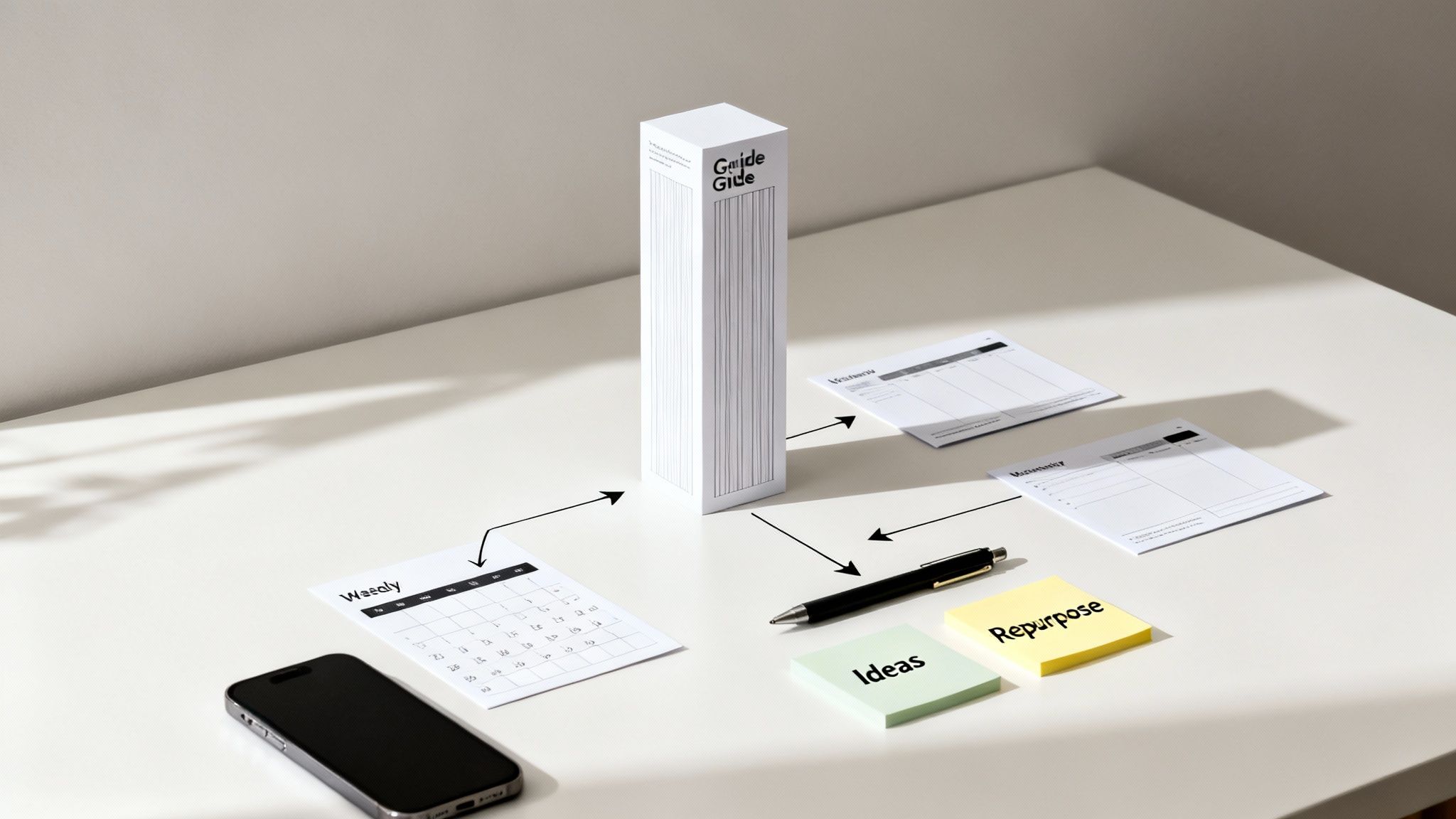
A powerful strategy I’ve seen work time and time again is the ‘Pillar and Post’ model. This approach flips content creation from a daily grind into a smart, efficient system. It’s all about working smarter, not harder, to get the most out of every piece you create.
The Pillar and Post Model Explained
Here’s how it works. You create one big, comprehensive piece of content—the Pillar—that dives deep into a major topic your ideal client cares about. Think of it as your cornerstone asset. It could be a detailed guide, an ultimate checklist, or even a webinar recording.
From that one Pillar, you then pull out dozens of smaller content pieces—the Posts. These can be short text updates, carousels, video clips, or infographics. Each one highlights a specific nugget of gold from your main Pillar content. This keeps your feed fresh and constantly guides people back to your high-value resource.
Let's say a Sydney-based business coach creates a Pillar piece titled "The Ultimate Guide to Scaling Your Service Business Beyond Six Figures."
From that single guide, they could easily create a month's worth of smaller Posts:
- A text post on the top 3 mindset shifts needed for growth.
- A carousel detailing the 5 systems every scaling business needs.
- A short video clip discussing the biggest hiring mistake founders make.
- An infographic showing the path from $10k to $100k per month.
Every single post delivers standalone value while subtly pointing back to the full guide, capturing leads who are ready to learn more.
Content Ideas Tailored for Australian Service Businesses
To really hit home, your content needs to speak to the local market. Generic, one-size-fits-all advice from overseas just doesn’t land the same way. Focus on topics that solve the specific headaches your Australian clients are facing right now.
Actionable Content Ideas:
- Local Client Success Stories: Don't just post a generic case study. Frame it as "How we helped a Melbourne-based construction company cut project delays by 20%." That local context builds instant trust.
- Analysis of Local Industry Trends: Talk about how new Aussie legislation, shifts in the property market, or local economic factors are impacting your clients. This immediately positions you as a relevant, switched-on expert.
- "Behind-the-Scenes" of Your Process: Service businesses can often feel a bit abstract. Showing your process, your team, or a "day in the life" helps humanise your brand and builds a much stronger connection.
The goal of your content isn't just to inform. It's to make your ideal client feel seen and understood. Address their specific local challenges, and you’ll stand out from competitors pushing generic fluff.
A Sample Weekly Content Calendar
Consistency is everything for building momentum on LinkedIn. But that doesn't mean you need to post multiple times a day and burn yourself out. A simple, repeatable schedule can deliver fantastic results.
Here’s a practical weekly schedule built on the Pillar and Post model:
| Day | Content Type | Example (For a Financial Adviser in Perth) |
|---|---|---|
| Monday | Insight Post | A short, sharp text post sharing a surprising statistic about superannuation performance in WA. |
| Tuesday | Carousel/Visual Post | A 5-slide carousel breaking down the "First Home Super Saver Scheme" for WA residents. |
| Wednesday | Video Post | A 90-second video answering a common client question: "Should I consolidate my super?" |
| Thursday | Client Story/Testimonial | A post celebrating a client from Fremantle who successfully planned their retirement using your strategy. |
| Friday | Engagement Question | A simple poll asking, "What's your biggest concern about retirement planning in the current market?" |
This schedule gives you variety, delivers value in different formats, and encourages people to actually engage with you. By planning your content, your LinkedIn activity shifts from random acts to a deliberate strategy that nurtures prospects and generates leads.
For a deeper dive into crafting your messages, check out our expert guide on LinkedIn marketing. It’s packed with advanced techniques that slot in perfectly with this content strategy.
Mastering Targeted Prospecting and Outreach
Once you've built a magnetic profile and your content engine is humming along, it’s time to switch gears from passive attraction to proactive engagement. This is where you go out and find your ideal clients, and frankly, it's where the real money is made with lead generation from LinkedIn. Forget casting a wide net. We're talking precision spear fishing—targeting the exact decision-makers who need what you offer.
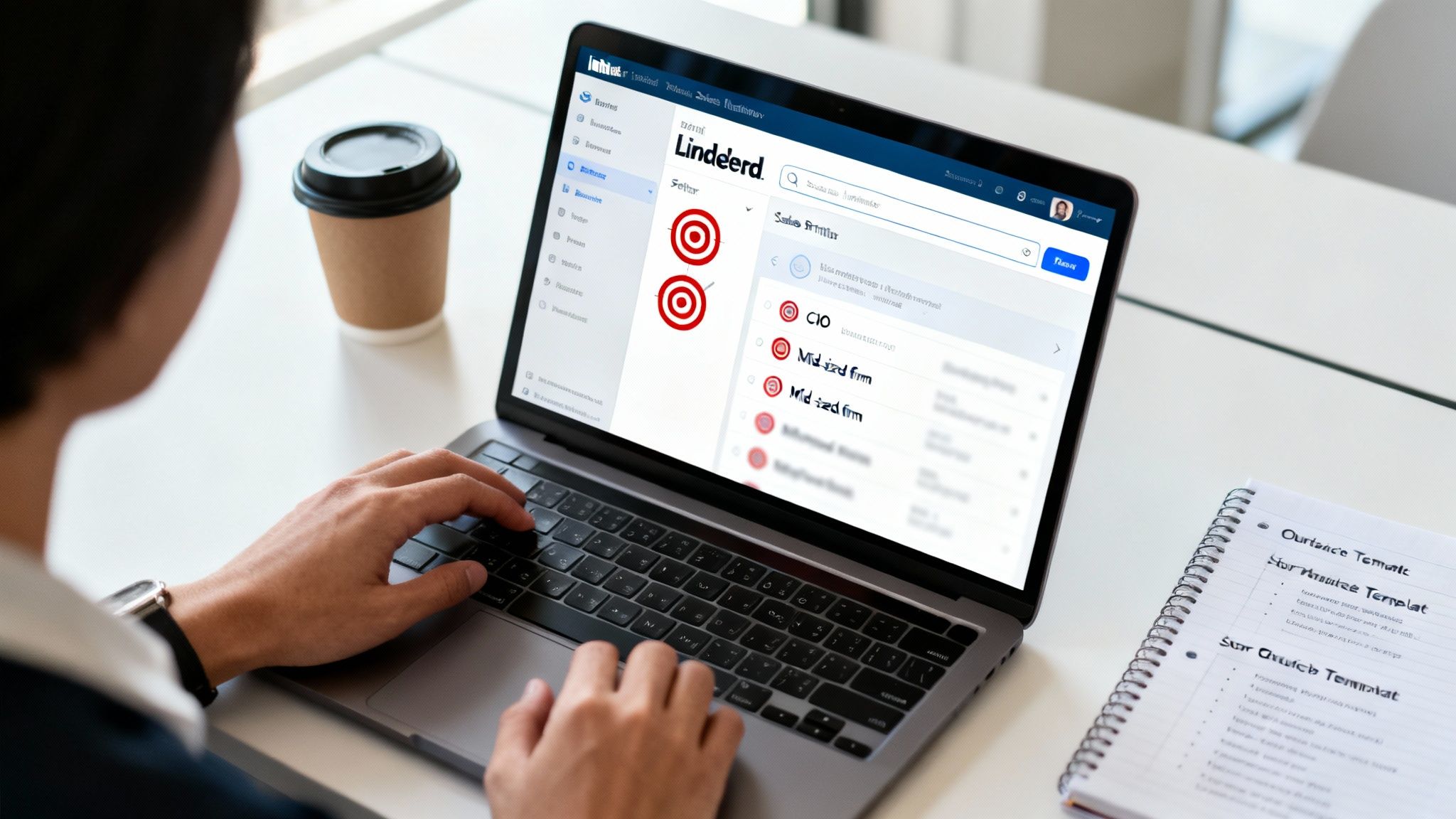
This means moving beyond the standard search bar. While the free version of LinkedIn is a decent start, serious prospecting demands a more powerful tool. The real game-changer here is LinkedIn Sales Navigator. It unlocks advanced search filters that let you build hyper-specific prospect lists with scary accuracy.
Building Your Ideal Client List
With the right tools, you can pinpoint prospects based on criteria that actually matter. This isn't just about job titles; it's about identifying companies that are a perfect fit.
You can filter your search by:
- Company Size: Want to work with businesses that have 11-50 employees? No problem.
- Industry: Focus only on prospects within the ‘Financial Services’ or ‘Construction’ sectors.
- Seniority Level: Go straight to the C-suite, VPs, or Directors.
- Recent Company Activity: Find companies that have recently scored funding or are on a hiring spree—these are huge buying signals.
This level of detail means you spend your time talking to qualified leads, not tyre-kickers who will never become clients.
Crafting Connection Requests That Actually Get Accepted
Got your list? Great. Now you need to reach out, and this is where most people fall flat. They fire off generic, templated connection requests that just scream, "I want to sell you something." Unsurprisingly, these get ignored.
Your connection request is your first impression. The goal isn't to pitch; it's simply to open the door for a conversation. Personalisation is absolutely non-negotiable.
A winning connection request prioritises value over a hard sell. It should be short, specific, and focused entirely on the recipient, not on you. Your only goal is to start a conversation.
Here’s a simple template that works wonders.
Template for Connecting with E-commerce Managers
-
Subject: Connecting with a fellow e-commerce pro
-
Message: "Hi [First Name], I noticed your work on the recent [Campaign Name or Website Feature] for [Company Name]—very impressive. I specialise in helping e-commerce brands like yours boost their conversion rates through [Your Specific Service]. Would be great to connect and follow your work."
Why does this work? It’s specific, it's complimentary, and it shows you’ve done your homework. It immediately separates you from the 90% of generic rubbish they get every day.
The Multi-Touch Message Sequence
Getting the connection accepted is just the first step. The real magic happens in the follow-up messages. A multi-touch sequence lets you gently build a relationship without coming across as pushy or desperate.
Let's stick with our example of a Melbourne marketing agency targeting e-commerce managers.
The Outreach Blueprint:
- Connection Request: Use the personalised template from above.
- The "Thank You & Give" Message (24 hours after connecting): "Thanks for connecting, [First Name]. As promised, I thought you might find this case study useful. We helped a similar e-commerce brand increase their checkout conversions by 18% in 60 days. Happy to share how we did it if you're curious."
- The "Value Add" Message (3-4 days later): "Hi [First Name], I saw you shared an article about [Relevant Topic]. Great points. It reminded me of a recent report on Australian e-commerce trends I thought you'd appreciate. You can find it here: [Link to valuable, non-gated content]."
- The "Soft Ask" Message (1 week later): "Hi [First Name], hope you're having a productive week. I’ve enjoyed our brief exchange. Would you be open to a quick 15-minute chat next week to explore if our conversion strategies could be a fit for [Their Company Name]?"
This methodical, value-first approach builds trust and positions you as a helpful expert, not just another salesperson trying to hit a quota.
And the effort is absolutely worth it. In Australia, LinkedIn's audience hit 17 million users by early 2025, covering over 80% of Australians aged 18 and older. This explosive growth gives you unparalleled access to decision-makers who are active and engaged on the platform.
While LinkedIn is a powerful channel on its own, integrating AI-powered outreach can seriously amplify your results. You can even explore how to leverage AI-powered outbound calls for real estate lead generation to complement your digital strategy. This mix of personalised digital outreach and smart automation is the key to building a predictable lead pipeline.
Using LinkedIn Ads and Automation Smartly
So, your organic LinkedIn strategy is humming along nicely. What's next? If you're ready to scale up and get leads faster, layering in some paid advertising and smart automation is the way to go.
This isn't about ditching genuine connection. It's about pouring fuel on the fire – using technology to amplify what's already working, reach a bigger, more targeted audience, and streamline the grunt work without losing that all-important human touch.
You don't need a huge budget to get started. In fact, a small, strategically targeted campaign will almost always outperform a big, scattergun approach. The key is to be smart about it.
A Beginner-Friendly Guide to LinkedIn Ads
LinkedIn Ads give you a direct line to your ideal clients. Think of it as skipping the queue and putting your best message right in their news feed. To keep things simple, let's focus on the two ad formats that deliver the most bang for your buck in B2B.
-
Sponsored Content: This is the easiest place to start. You’re essentially "boosting" a great organic post – a helpful article, a case study, or a short video – to a specific audience outside your network. It shows up naturally in the feed and is perfect for building brand awareness and sending traffic your way.
-
Lead Gen Forms: This is where the real lead-capture magic happens. These forms attach directly to your ad and pre-fill with a user's LinkedIn info (name, email, company, job title). This makes it incredibly easy for prospects to give you their details in a couple of clicks, all without leaving LinkedIn. The less friction, the more leads.
Seriously, LinkedIn's Lead Gen Forms are a game-changer. For Australian B2B companies, they hit an average conversion rate of 13%. That's more than five times the 2.35% industry standard for website landing pages.
A Perth-based tech firm I know used these forms to generate 200 qualified leads per quarter, slashing their cost-per-lead by 28% compared to what they were getting on Google Ads. If you want some visual ideas, check out these compelling LinkedIn video ad examples.
Using Automation Responsibly
Automation tools can save you a mountain of time on outreach and follow-ups, but you have to be careful. The goal is to automate the repetitive stuff, not the real conversations.
Think of it as a virtual assistant who handles the initial admin, freeing you up to focus on building actual relationships. You can automate sending a connection request or that first follow-up message. The crucial next step is plugging these tools into your CRM, so new leads are automatically dropped into your pipeline. No more letting people fall through the cracks.
But get it wrong, and a bad automation strategy can wreck your reputation fast. For a deeper look at how a paid strategy can work for you, have a look at our complete guide on running effective LinkedIn ads.
Key Takeaway: Automation should handle the mechanics of outreach, not the relationship. The moment a prospect replies, the bots stop, and a real person takes over. End of story.
Automation Do's and Don'ts Checklist
Stick to these simple rules to make sure technology is building your reputation, not burning it.
| Do ✔️ | Don't ❌ |
|---|---|
| Do personalise messages with custom fields like {FirstName} and {CompanyName}. | Don't blast out generic, spammy templates. Everyone can spot a robot a mile away. |
| Do set reasonable daily limits to look like a human, not a bot. | Don't try to connect with 500 people a day. That's a surefire way to get your account restricted. |
| Do immediately stop the automation for a prospect as soon as they reply. | Don't let a bot try to have a conversation. It's awkward, unprofessional, and just plain weird. |
| Do use automation for systematic follow-ups with new connections who haven't engaged. | Don't go in for the hard sell in your very first message. Lead with value, always. |
Common Questions About LinkedIn Lead Generation
Even with the best blueprint, you’re bound to hit a few questions when you dive into generating leads on LinkedIn. Getting past these common hurdles is often the final piece of the puzzle before you start seeing real, consistent results. Let's tackle the questions that come up most often, so you can move forward with confidence.
How Long Does It Take to See Results from LinkedIn?
This is the big one, and the honest answer is: it’s a marathon, not a sprint. While you might snag a couple of quick wins in the first few weeks, building a proper lead generation engine takes time and consistency.
Think of it in phases. The first 1-2 months are all about laying the groundwork. This is where you're polishing your profile, making those initial connections with ideal clients, and finding your content rhythm. You're planting seeds.
Real momentum, especially from your content, usually starts building between months 3-6. By this stage, you’ve built up some authority, and people are starting to recognise your name. A predictable flow of qualified leads often cements itself after the six-month mark, once your network is solid and your outreach process is running like a well-oiled machine.
What Is a Realistic Starting Budget for LinkedIn Ads?
Good news – you don't need a massive war chest to make an impact. For most Australian small to medium businesses, a test budget of around $25-$50 per day is a smart place to start.
The goal at the beginning isn't to get hundreds of leads overnight. It's to prove your concept and gather data. Run one tightly focused campaign aimed squarely at your ideal client profile. The only metric that really matters at this point is your cost-per-lead (CPL). Once you know that number, you can weigh it against the lifetime value of a client to figure out your return on investment and decide if it's worth scaling up.
The key is to start small, validate your offer and audience, and only open up the wallet once you have data proving it works. A small, focused budget is always smarter than a large, unfocused one.
Should I Use My Personal Profile or Company Page?
The most effective strategy isn't an "either/or" choice — it's a "both/and" approach. Your personal profile and your company page have distinct, complementary roles.
Your Personal Profile is for building genuine human relationships. At the end of the day, people connect with and buy from other people, not faceless logos. This is where you share insights, jump into conversations, and do your personalised outreach. It's where you build trust.
Your Company Page is where you establish brand credibility. It’s your business's official headquarters on the platform. Use it to share company news, post official content like case studies, and, crucially, run your LinkedIn Ads. You can bet that a prospect you connect with personally will almost always click over to your Company Page to legitimise your business.
What Are the Biggest Mistakes to Avoid in LinkedIn Outreach?
Getting your outreach right without sounding like a spam bot is everything. A few common mistakes can absolutely kill your results, but they’re easy to avoid.
Here are the top three blunders I see all the time:
- Sending Generic, Lazy Connection Requests: A request with the default "I'd like to connect" message is a waste of everyone's time. Always add a short, personalised note. It shows you’ve at least glanced at their profile.
- Pitching Immediately in the First Message: This is the digital version of proposing on a first date. It just doesn’t work. Your first message after someone accepts should be about starting a real conversation or offering value, not asking for a sale.
- Failing to Engage After Connecting: The connection is just the starting line. The biggest mistake is doing nothing next. Like, comment on, or share their posts. Stay on their radar in a natural, helpful way.
Steering clear of these traps reinforces that you’re there to provide value first, turning cold connections into genuinely warm opportunities.
At Homer Digital Marketing, we build these exact lead generation systems for service-based businesses like yours. If you're ready to stop guessing and start getting real, measurable results from LinkedIn, let's talk.
Book a discovery call with us today and find out how we can build a client attraction system that works for you.
