

At its core, professional content marketing services are about creating valuable, relevant online material to help your business attract, engage, and convert your ideal clients. But it's much more than just writing blog posts; think of it as a strategic system for building trust and authority that works for you 24/7, turning your expertise into your most powerful lead-generation tool.
What Exactly Are Content Marketing Services?
Let's ditch the old-school marketing playbook. Cold calling and interruptive ads are out. Instead, imagine building a digital magnet that pulls in qualified leads who are already on Google, actively searching for the exact expertise you offer. That’s the fundamental shift a provider of content marketing services brings to your service-based business.
This isn't about just making noise online. It's about engineering a system that turns your knowledge into a powerful, lead-generating asset. The goal is simple: stop chasing clients and start attracting them organically.
From Marketing Task to Business Asset
Too many business owners see content as just another chore on an endless to-do list. But when done right, content marketing is a strategic investment that builds serious long-term value. Every piece of content—a detailed guide, a helpful video, or an insightful case study—becomes a digital employee, generating leads for you for years to come.
This approach is especially powerful for Australian service businesses, whether you're a consultant, real estate agent, or wellness coach. It allows you to:
- Build Unshakable Authority: When you consistently answer your audience's biggest questions, you become the go-to expert in your field. It's that simple.
- Dominate Google Search Results: Strategic content helps you rank for the valuable keywords your ideal clients are typing into Google, driving high-intent traffic directly to your website.
- Nurture Leads Automatically: A well-planned content system guides potential clients from their first click to a sales conversation, often without you lifting a finger.
The Modern Approach to Client Attraction
In short, content marketing services reframe how you connect with your market. Instead of pushing a sales pitch, you pull clients in with genuine value. This builds a foundation of trust long before a sales call ever happens, making the whole conversion process feel smoother and more natural. A key part of this is embracing formats like video. Implementing A Modern Video Content Marketing Strategy can really elevate your brand's connection with its audience.
The numbers back this up. Australia's content marketing industry has ballooned to a market size of $453.2 million, growing at a solid 4.3% each year for the past five years. This isn't just a trend; it's proof that service-based businesses are successfully using content to get seen and attract their ideal clients.
Content marketing is the only marketing left that’s not about the stuff you make, but about the stories you tell. It’s a commitment, not a campaign.
Ultimately, these services are about building a reliable, scalable engine for business growth. It's about transforming your website from a simple online brochure into a machine that consistently brings you new business.
Breaking Down a Powerful Content Marketing Engine
Think of content marketing services less like a checklist of tasks and more like a high-performance engine. Every part has a crucial job, and they all need to work together perfectly to drive your business forward. Let's pop the hood and look at the essential components that make this engine hum.
This image below perfectly captures the shift from old-school, interruptive methods like cold calling to the magnetic pull of modern content marketing.
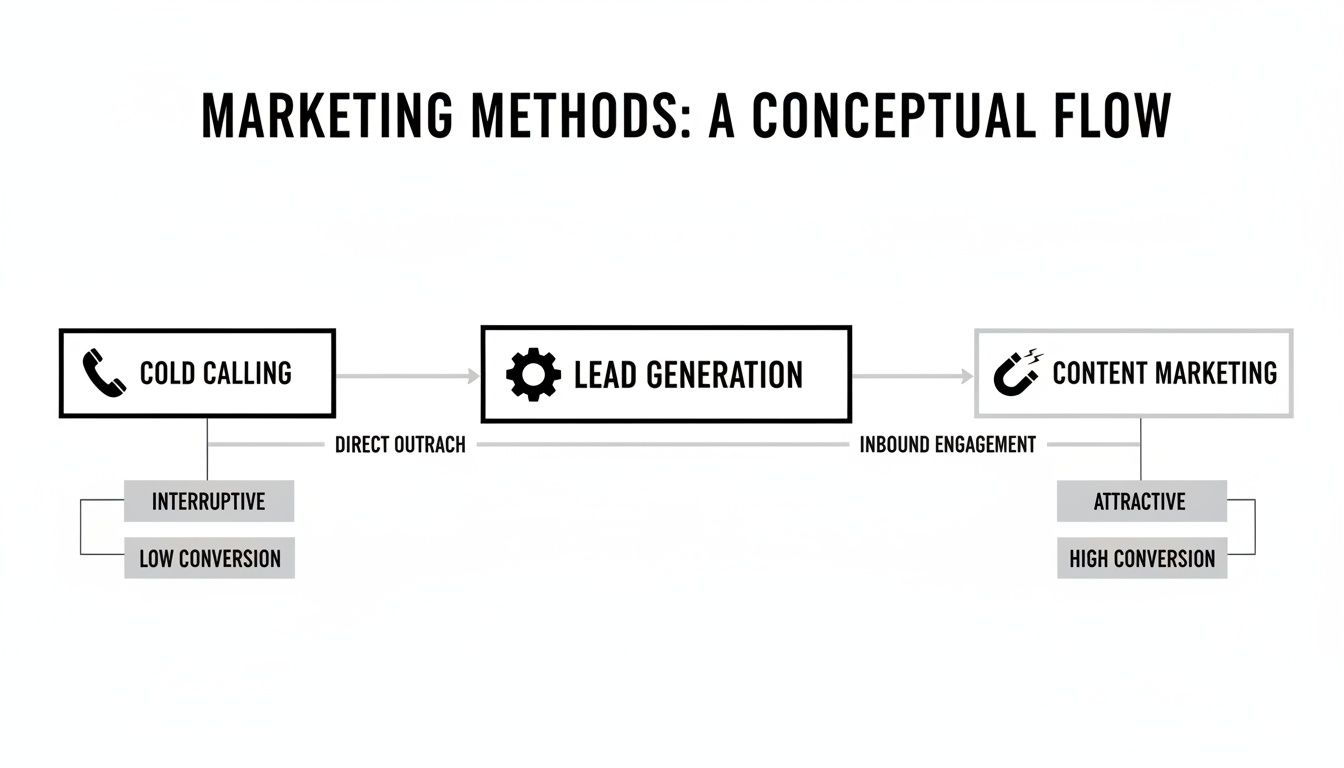
The real takeaway here? You stop chasing clients and start attracting the ones who are already searching for exactly what you offer.
A comprehensive content marketing service is built on several core functions working in sync. Each piece builds on the last, creating a system that consistently attracts, engages, and converts your ideal clients.
Here’s a breakdown of what that looks like in practice for a service-based business.
Key Components of a Content Marketing Service
| Component | Core Purpose | Example Activities for a Service Business |
|---|---|---|
| Strategy & Planning | To create a clear roadmap that aligns every piece of content with specific business goals, ensuring maximum ROI. | Profiling your ideal client, researching keywords they use to find solutions, and analysing competitor content to find gaps you can own. |
| Content Creation | To produce high-value, problem-solving content that builds trust, demonstrates expertise, and answers your audience's questions. | Writing in-depth blog posts that solve common client problems, creating case studies that prove your results, and drafting LinkedIn articles. |
| Distribution & Promotion | To ensure your valuable content actually reaches the right people on the channels where they spend their time. | Optimising every article for Google (SEO), sharing content strategically on social media, and using email newsletters to nurture leads. |
| Performance Analytics | To track what’s working (and what’s not), allowing for data-driven adjustments that continuously improve results. | Monitoring website traffic from blog posts, tracking lead conversions from downloadable guides, and measuring engagement on social media. |
| Automation & AI | To streamline repetitive tasks, scale content production, and personalise the client journey, freeing up time for high-value work. | Using AI to generate content ideas and first drafts, automating email nurture sequences, and scheduling social media posts in advance. |
This integrated approach ensures that you're not just creating content for the sake of it, but building a strategic asset that works for your business 24/7. Let's look a little closer at each of these moving parts.
The Four Pillars of a Successful Content Marketing Service
1. Strategic Planning: The GPS for Your Content
Before you write a single word, you need a destination. Strategic planning is the GPS that makes sure every piece of content you create is directly tied to your business goals, whether that’s generating qualified leads or becoming the go-to expert in your field.
Without a solid strategy, you're just guessing. It's like driving without a map—you're moving, but you're not actually getting anywhere.
This foundational stage is all about deep-diving into:
- Audience Profiling: Getting crystal clear on who your ideal client is, what keeps them up at night, and what questions they're typing into Google.
- Keyword Research: Finding the exact search terms your audience uses when they're ready to buy, not just browse.
- Competitor Analysis: Seeing what your competitors are doing right, and more importantly, spotting the content gaps they've left wide open for you.
A goal without a plan is just a wish. Strategic planning turns your business goals into a concrete, actionable roadmap.
This process sets the stage for everything else, making sure every dollar and hour you invest is focused, efficient, and built to deliver a real return.
2. Content Creation: The Vehicles for Your Message
Once the strategy is locked in, it's time to build the vehicles that will carry your message. Content creation is all about producing high-value, relevant material that educates, solves problems, and builds trust with your ideal clients.
HubSpot research found the number one reason people read blogs is to learn something new (33%). Your content has to deliver. It’s not about the hard sell; it’s about serving your audience with genuine expertise.
A quality content marketing service will create a mix of assets, including:
- In-depth Blog Posts: Authoritative articles that answer specific client questions and position you as the expert.
- Case Studies: Real-world success stories that provide powerful social proof and show the tangible results you get for clients.
- LinkedIn Articles: Thought leadership pieces designed to build your professional brand and connect with decision-makers.
- Downloadable Guides: High-value resources like checklists or e-books that capture lead information and nurture potential clients down the funnel.
Each piece of content is a purpose-built vehicle designed to meet your audience exactly where they are in their journey.
3. Intelligent Distribution: The Fuel System
Creating fantastic content is only half the job. Intelligent distribution is the fuel system that gets your valuable content in front of the right people at the right time. It’s all about placing your content across the channels where your target audience is already active.
This is much more than just hitting 'publish'. It involves a coordinated push across platforms like Google (through SEO), social media, and email marketing to maximise reach and engagement. By optimising a blog post for search, for instance, you're creating an asset that can attract organic traffic for years to come.
4. Analytics and Refinement: The Dashboard
Every high-performance engine needs a dashboard. Analytics and refinement is how you monitor performance, understand what's connecting with your audience, and continuously optimise your strategy for better results.
This data-driven approach takes the guesswork out of marketing. It answers the critical questions: Which blog posts are bringing in the most leads? What topics get the most traction on LinkedIn? Where are our best clients coming from?
By using this data, you can double down on what works and fix what doesn't. This constant loop of measurement and improvement is what turns good content marketing into great content marketing. You can even explore our guide to understand more about marketing automation for small business to see how technology supercharges this process.
How Content Transforms Your Business Growth
It can feel a bit abstract connecting the dots between writing a blog post and actually seeing your business grow. But when you have a strategic content marketing service on your side, the results are anything but. It’s about turning what you know into a reliable system that directly impacts your bottom line.

This isn't about chasing likes or shares. It’s about attracting serious leads, building solid authority, and creating assets that keep bringing in business for years to come.
Let's break down how this transformation actually happens.
Attracting High-Intent Leads Not Just Traffic
Look, anyone can get clicks. But a healthy business runs on conversations with people who are actually ready to buy. Good content acts like a powerful filter, pulling in prospects who are actively searching for the exact solution you offer.
Instead of writing generic fluff, a professional service creates content that answers very specific, high-intent questions. For instance, a financial advisor doesn’t just write about "saving money." They create a detailed guide on "how to structure investments for early retirement in Australia."
This targeted approach does a few critical things:
- Filters Out Tyre-Kickers: The specific nature of the content naturally pushes away casual browsers, leaving you with an audience that has a real problem to solve.
- Pre-Qualifies Prospects: By the time someone finishes your in-depth guide, they already see you as the expert. They’re warmed up and far more open to a sales call.
- Reduces Acquisition Costs: Organic leads that come from genuinely helpful content are almost always more cost-effective than leads from paid ads, which lowers your overall cost per acquisition (CPA).
Ultimately, this means your sales team spends less time trying to convince people and more time closing deals with prospects who already trust you.
Building Unshakable Authority in Your Market
In a packed marketplace, being seen as the go-to expert is your biggest advantage. Consistently publishing high-quality, valuable content is the single best way to build that authority and become the trusted voice people turn to.
Think of it this way: when you repeatedly solve your audience’s problems for free, you earn a reputation for being valuable. This makes you the first person they think of when they’re finally ready to pull out their wallet.
Authority isn't claimed; it's earned. Every piece of high-value content you publish is a deposit into your brand's trust account, building an asset that competitors can't easily replicate.
This authority pays off in real business. An IT consultant who regularly posts articles on cybersecurity best practices for small businesses will be top-of-mind the moment a local company needs to upgrade its security. That reputation is built one helpful article at a time.
Improving Google Rankings for Profitable Keywords
Ranking on the first page of Google for your most important service keywords is a total game-changer. It puts your business right in front of potential clients at the exact moment they’re looking for a solution.
A well-oiled content marketing services machine is designed to make this happen. By creating optimised, in-depth content that gives both search engines and users exactly what they want, you steadily climb the rankings for the terms that actually drive revenue.
This isn't about just stuffing keywords into a page. It’s about creating the best, most thorough answer on the internet for a specific problem. For a buyer's agent in Sydney, that might mean creating the definitive guide to "navigating the Sydney property market for first-home buyers."
Creating Evergreen Assets for Long-Term Growth
Finally, one of the most powerful outcomes is creating what we call evergreen assets. Unlike a social media post that's gone in a few hours or an ad that vanishes the second you stop paying, a great blog post can generate leads for years.
These are your digital employees, working 24/7 to attract and educate prospects. An article you publish today could easily become your number one source of leads for the next three years, delivering a compounding return on that initial investment. It’s a sustainable approach that builds a rock-solid foundation for predictable, long-term growth.
How to Choose the Right Content Marketing Partner
Choosing a provider for content marketing services is a massive decision for your business's growth. This isn't about hiring a vendor to tick off tasks; it's about finding a genuine partner who gets your vision. The right agency becomes an extension of your team, driving real, measurable results.
Get it wrong, though, and you’re looking at wasted money, missed opportunities, and a whole lot of frustration. A mismatched partner will slap a generic, one-size-fits-all strategy on your business that just doesn’t connect with your audience, leaving you with content that completely misses the mark.
The Non-Negotiables Checklist
Before you even start your search, you need a clear set of criteria. These are the absolute must-haves when you’re sizing up a potential partner. Don't compromise here—these are the foundations of a successful, profitable relationship.
Here's what to look for:
- Proven Experience with Australian Service Businesses: The Aussie market is unique. Your partner needs a solid track record of helping businesses just like yours—whether you're a consultant, real estate agent, or wellness coach—succeed right here.
- A Transparent and Clear Process: They should be able to walk you through their entire game plan, from strategy and onboarding to creation, distribution, and reporting. If their process feels like a black box, it's time to walk away.
- A Portfolio of Client Success Stories: You need to see concrete proof. Ask for case studies or work examples that clearly show how their efforts led to tangible business outcomes, like more leads or better search rankings for their clients.
A true content marketing partner doesn't just deliver content; they deliver a clear strategy tied to your business goals. Their success should be measured by your success, creating a powerful alignment from day one.
Critical Questions to Ask Any Potential Agency
Once you've got a shortlist, it's time to dig a bit deeper. The answers you get to these questions will reveal a lot about an agency's strategic thinking, client focus, and overall approach. Don't be afraid to press them for specific, detailed answers.
Arm yourself with these questions for your initial chats:
"How will you measure success specifically for my business?" Their answer needs to go beyond fluffy metrics like "traffic" or "engagement." A great partner will want to talk about the KPIs that actually matter to your bottom line, like lead quality, cost per acquisition (CPA), and client lifetime value (CLV).
"What does your client onboarding process look like?" A thorough onboarding is the sign of a well-oiled machine. They should be able to explain exactly how they'll get to know your business, your ideal clients, your brand voice, and your industry to make sure the strategy is spot-on from the get-go.
"Can you show me examples of content you've created for a similar service-based business?" This is how you gauge the quality of their work and their ability to get their head around complex service offerings. It also shows if they can adapt their style to different industries and brands. For a deeper dive, check out our guide on how to choose the best content marketing agencies in Australia.
"Who will be my main point of contact, and how often will we communicate?" Clear and consistent communication is non-negotiable. You need to know exactly who you'll be dealing with and what to expect when it comes to updates, meetings, and reports.
Spotting the Red Flags
Knowing what to look for is important, but knowing what to avoid is just as crucial. Certain warning signs can tell you an agency is more interested in getting you to sign a contract than in delivering results. Keep an eye out for these red flags.
Be wary of any provider that:
- Makes Unrealistic Guarantees: No reputable agency can promise you the #1 spot on Google overnight. If it sounds too good to be true, it almost always is. Look for partners who set realistic goals backed by data.
- Pushes a "One-Size-Fits-All" Strategy: If they’re pitching you the exact same package they give to everyone else without taking the time to understand your unique business, they lack strategic depth.
- Is Vague About Reporting: If they can't clearly explain how they’ll track and report on performance, that's a major warning sign. You need transparent data to understand the return on your investment.
Finding the right partner is a deliberate process, but putting in the effort now is absolutely worth it. A strong content marketing partnership will become a powerful engine for sustainable, long-term growth.
Making Sense of Pricing and Measuring Your ROI
Alright, let's get down to the numbers. Investing in content marketing services is a big decision for any business, and it’s only natural to want to know what it costs and what you get back.
It’s not just about spending money. It’s about putting your resources to work in a way that generates real, measurable growth for your business. When you understand the costs and the returns, you can make a confident choice that moves the needle.
Understanding Common Pricing Models
When you start looking for a content marketing partner, you’ll quickly see a few standard pricing structures. There’s no single “best” way—it all comes down to what your business needs and the scope of work you have in mind.
Getting familiar with these models is the first step to finding the right fit.
Monthly Retainers: This is the most popular option for a reason. You pay a set fee each month for an agreed scope of work, like a certain number of blog articles, social media management, and reporting. It’s perfect for building long-term momentum where consistency is everything.
Project-Based Fees: Got a specific, one-off job in mind? A project-based fee is your answer. This works well for things like a complete website content refresh or creating a flagship e-book. You get a clear price for a defined project with a clear start and finish line.
Hybrid Options: Some agencies offer a bit of both. This might look like a base retainer for your core, ongoing activities, plus project-based fees for bigger, one-off campaigns. It gives you a great balance of predictable costs and the flexibility to go big when you need to.
Measuring the Real Return on Your Investment
This is where the rubber really meets the road. Vanity metrics like "likes" and "shares" feel good, but they don't keep the lights on. The real ROI is about how your content marketing directly impacts your bottom line.
Your goal isn't just to create content; it's to create customers. Measuring ROI means connecting your content efforts directly to lead generation, client acquisition, and revenue growth, proving the value of your marketing spend.
To get this right, you need to track the key performance indicators (KPIs) that actually matter. These are the numbers that show you how your content is turning browsers into buyers. If you want to dive deeper into this, our guide on why it can be difficult to measure marketing ROI offers some extra perspective.
Below are the essential KPIs every service-based business should have on its dashboard.
Essential KPIs to Measure Content Marketing ROI
This table breaks down the crucial metrics you should be tracking to see the true financial impact of your content marketing. Forget the fluff—these are the numbers that matter.
| KPI | What It Measures | Why It Matters for Your Business |
|---|---|---|
| Lead Quality | The percentage of leads from your content who are a genuine fit for what you offer. | High-quality leads mean your team spends less time chasing dead ends and more time closing deals with your ideal clients. Simple. |
| Cost Per Acquisition (CPA) | The total cost of your content marketing divided by the number of new clients you actually sign up. | This tells you exactly how much it costs to win a new client. It’s the key to making sure your marketing is profitable and sustainable. |
| Customer Lifetime Value (CLV) | The total revenue you can expect from a single client over the entire time they work with you. | When your CLV is much higher than your CPA, you know your content marketing is delivering a seriously strong, positive return. |
Tracking these figures gives you the clarity to justify your marketing spend and see exactly how content is driving revenue. To really get the full picture, learning how to measure webinar ROI can also be a game-changer for proving impact. This data turns content from a simple expense into a predictable engine for business growth.
Your Action Plan for Scaling with Content
A good strategy is useless if it just sits on a piece of paper. This is where we turn all that planning into action and give you a clear roadmap to get moving—without the overwhelm. Real growth from content marketing services comes from taking focused, deliberate steps, not trying to do everything at once.

So far, we’ve covered why strategy is so important, what goes into a solid content engine, and how to find the right partner to help you. Now it's time to build some momentum.
Your Immediate Next Steps
Getting started is simpler than you think. Forget about launching a massive, multi-channel campaign from day one. Instead, focus on these three foundational tasks to build a solid base for everything that follows.
Define Your Ideal Client Profile (ICP): I mean really define it. Go beyond the basic demographics. Pinpoint their biggest frustrations, their ultimate goals, and the exact words they use to describe the problems keeping them up at night. A crystal-clear ICP is the compass for every piece of content you create.
Audit Your Existing Digital Footprint: Take an honest look at your current website, blog, and social media profiles. Does your content actually speak to the ICP you just defined? Look for the gaps and the low-hanging fruit—the quick wins where you can add real value fast.
Set One Clear 90-Day Goal: Just one. Pick a single, measurable objective to aim for. It could be generating five qualified leads from your website each month or ranking for one specific, high-intent keyword. A focused goal stops you from getting distracted and drives real progress.
The most effective content marketing isn’t about doing more; it’s about consistently doing what matters most. Your 90-day plan is the first step towards building that consistency and achieving sustainable growth.
These actions are the bedrock of a powerful content system. They make sure that when you do invest in creating content, every single piece has a purpose, is aimed at the right person, and is designed to deliver a tangible return for your business.
For any serious business owner, the next logical step is to turn these initial actions into a comprehensive, working strategy. If you’re ready to use content to build predictable and sustainable growth, the path forward is clear.
Frequently Asked Questions
Let's tackle the questions that most service business owners have before they decide to go all-in on a strategic content plan.
How Long Does It Take to See Results?
While you might see some quick wins like a jump in social engagement, think of content marketing services as a long-term growth asset, not a quick fix. You can usually expect to see some real movement in organic traffic and lead generation within 3 to 6 months.
The serious, compounding growth—the kind that builds lasting authority and a steady stream of ideal clients—really kicks in after about 6 to 12 months of consistent, high-quality work. It’s like planting a tree; it takes time to grow, but the results are solid and lasting.
Is Content Marketing Suitable for My Industry?
Absolutely. The core idea behind content marketing—building trust, solving problems, and showing you're the expert—works everywhere. No matter your industry, your ideal clients are online right now, searching for answers you can provide.
Whether you're a consultant, a real estate agent, a wellness practitioner, or an IT provider, the trick is to tailor the strategy. It's about picking the right content formats and channels to connect with your specific audience. That’s exactly what a specialised provider is brilliant at.
The goal is not to be good at content marketing; the goal is to be good at business because of content marketing. It's a tool that works for any industry when focused on the customer's needs.
I Am Already Busy. How Much Time Is Required from Me?
One of the biggest wins of hiring professional content marketing services is getting your time and mental energy back. While your input is crucial at the start for strategy and for final sign-off on content, the agency does all the heavy lifting.
Realistically, you should plan to invest a few hours a month for strategy calls, interviews, and reviews. Your provider handles the time-sucking tasks of research, creation, optimisation, and getting it all out there. This frees you up to do what you do best: serve your clients.
Ready to stop chasing clients and start having them come to you? The team at Homer Digital Marketing builds strategic content engines that deliver real, measurable results for service businesses just like yours. Book a no-obligation strategy call today, and let's map out your plan for sustainable growth.
