

Is your agency stuck in a frustrating feast-or-famine cycle? One month you’re swamped with client work, the next you’re frantically scrambling for new business. This isn’t just stressful; it’s a barrier to sustainable growth. Before you even think about outreach, you need a solid foundation. This isn’t the flashy part of agency lead generation, but trust me, it’s where the real money is made. It’s the strategic work of figuring out exactly who you help and why they should care, then making sure your online presence actually backs that up. This guide will provide a solution to build a predictable pipeline of high-quality leads.
A structured agency lead generation strategy helps agencies move away from inconsistent referrals and build a predictable pipeline of qualified clients.
Building a Rock-Solid Lead Generation Foundation
Chasing every lead that moves is a fast track to burnout. I’ve seen it happen countless times. Real, sustainable success in agency lead generation comes from a focused strategy that starts long before you send a single email. Successful agency lead generation always starts with clarity about your ideal client and the specific outcome your agency delivers.
You have to get crystal clear on who you serve and what makes you the only logical choice for them. This isn’t just a box-ticking exercise; it’s the single most critical factor in attracting high-quality clients who see you as a genuine partner, not just another vendor on a spreadsheet.
Let’s break down what that actually looks like.
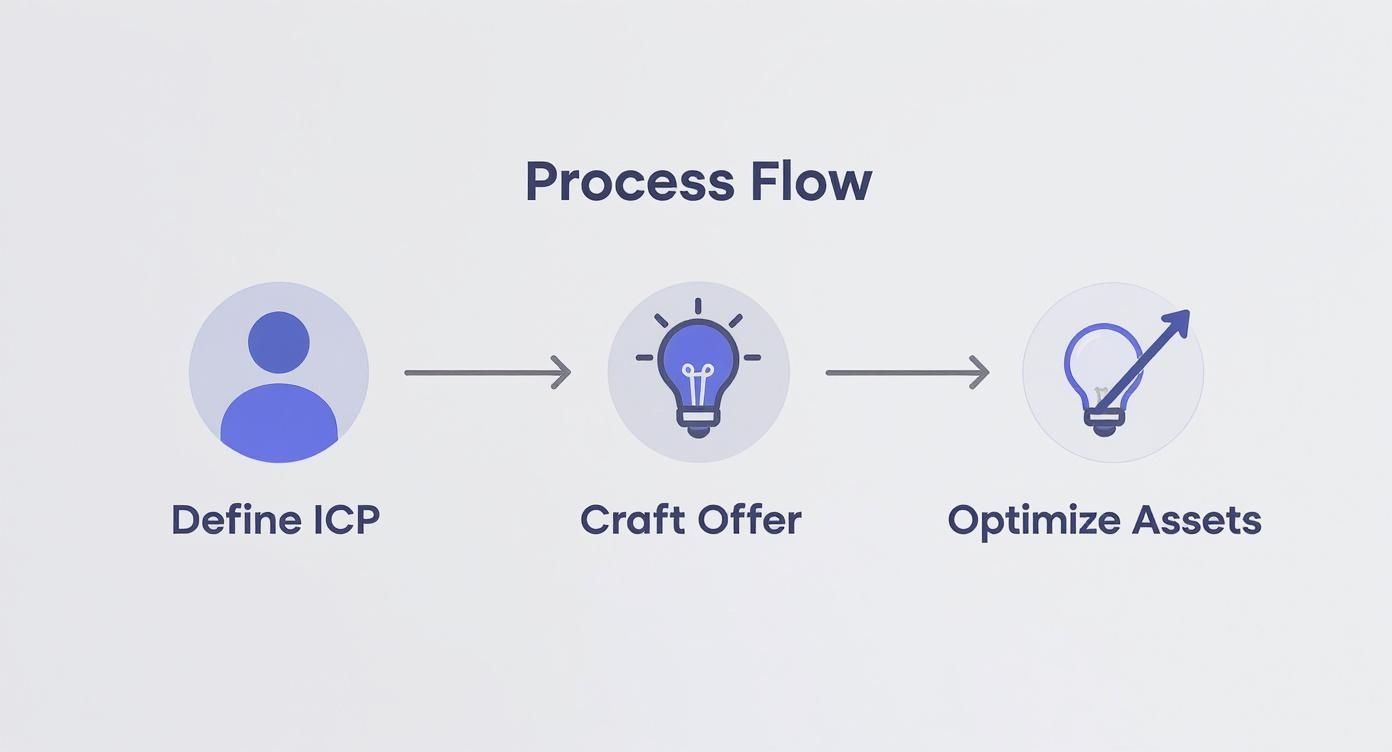
This process maps out the essentials: from pinpointing your ideal client to getting your online shopfront ready for business. Get these steps right, and you create a smooth, natural path for prospects to find you, trust you, and ultimately, hire you.
Define Your Ideal Customer Profile
Forget generic demographics. A powerful Ideal Customer Profile (ICP) digs deep into the real-world problems your clients face.
What are their biggest business frustrations? What goals are keeping them up at night? What specific words do they use to describe their challenges? Answering these questions lets you create marketing that feels like you’re reading their mind.
Your ICP should feel like a real person you could have a coffee with. For instance, instead of targeting “manufacturing companies,” get specific: “Operations Managers at mid-sized Australian manufacturing firms who are tearing their hair out over supply chain mess-ups and clunky, outdated inventory systems.”
That level of detail makes every other marketing decision a hundred times easier.
Craft an Irresistible Value Proposition
Your value proposition isn’t a boring list of services. It’s the clear, powerful solution to your ICP’s biggest headache. It needs to immediately answer the question, “So what? Why should I pick you?”
A strong offer connects what you do directly to a tangible business outcome they desperately want, like boosting revenue, slashing costs, or just getting some precious time back.
Key Takeaway: A weak offer describes what you do (e.g., “We offer SEO services”). A powerful offer describes the outcome you deliver (e.g., “We help B2B consultancies get booked solid by ranking them on page one for high-intent keywords”).
See the difference? One is a commodity; the other is a solution.
Optimise Your Digital Assets
Think of your website and LinkedIn profile as your digital storefronts. They absolutely must be aligned with your ICP and your powerful new offer.
When you audit these assets, ask yourself: does my messaging speak directly to my ideal client’s pain points? Is it consistent across the board? This alignment is a cornerstone of the entire process.
Here in Australia, the B2B world is getting smarter and more tech-driven. We know that mature lead nurturing practices, often powered by AI, can generate 50% more sales-ready leads at a 33% lower cost. This just hammers home how important it is to have your digital assets ready to capture and nurture those leads the moment they show up.
For a deeper dive into setting this up correctly, check out these B2B lead generation best practices.
Mastering LinkedIn for High-Value Clients
Let’s be honest, LinkedIn is where your ideal clients live, but the old “spray and pray” approach is dead. Sending out a hundred spammy connection requests and generic pitches is just a fast track to getting ignored. If you want to generate high-value agency leads on this platform, you have to completely shift your mindset from selling to building genuine relationships.
The goal isn’t to be just another service provider in their inbox. It’s to become a recognised authority. This means ditching the impersonal automation and focusing on value-driven interactions that actually spark real conversations. When you lead with insight and helpfulness, the sales chat becomes a natural next step, not a forced one.

Identify and Engage Your Ideal Prospects
Before you even think about reaching out, you need absolute clarity on who you’re talking to. Use LinkedIn’s search filters to build a laser-focused list of prospects who are a perfect match for your Ideal Customer Profile. Go deeper than just job titles and company size—look at their recent activity, the content they’re sharing, and the groups they’re active in.
Once you’ve got your list, your first move isn’t a connection request. It’s engagement.
- Follow First: Start by following your key prospects. This lets you see their content and get on their radar without immediately asking for something in return.
- Add Insightful Comments: Don’t just post “great article!” Actually read their content and leave a thoughtful comment that adds to the conversation. Ask a smart question, share a relevant experience, or offer a different perspective.
- Share Their Content: If they post something genuinely useful, share it with your own network and be sure to tag them. It’s a simple act of amplification that gets you noticed in a very positive way.
This patient, value-first approach builds familiarity and quietly positions you as a helpful expert.
Crafting Outreach That Gets a Response
After you’ve warmed up a prospect through genuine engagement, then it’s time to send that connection request. But even this needs to be done right. Always, always add a personalised note that references a shared interest, a recent post they made, or a mutual connection.
Here’s an example that actually works:
“Hi [Name], I really enjoyed your recent post on [Topic]. Your point about [Specific Insight] was spot on. I’ve been following your work for a while and would love to connect and continue learning from you.”
See the difference? This message is personal, non-threatening, and it’s all about them, not you. It opens the door for a real conversation, which is the entire point.
In Australia, this relationship-first strategy is everything. The digital marketing scene here is heavily influenced by social channels, with LinkedIn accounting for an incredible 80% of social media-generated B2B leads. This stat alone shows how vital these connections are for building trust and generating qualified leads.
Once you’re connected, just keep the conversation going naturally. Ask open-ended questions about their business challenges and goals. Only when you’ve clearly identified a genuine need should you even think about suggesting a call. This approach transforms LinkedIn from a simple networking site into a powerful client acquisition machine. For more in-depth strategies, check out our guide on advanced LinkedIn tactics.
Turning Your Website into an Inbound Lead Machine
While proactive outreach on platforms like LinkedIn gets you in front of prospects, your website is your silent salesperson, working around the clock. A solid agency lead generation strategy means turning your digital shopfront from a simple brochure into a powerful inbound engine that attracts and converts your ideal clients while you sleep.
It all starts with a simple realisation: decision-makers aren’t searching for “marketing agency.” They’re hunting for solutions to very specific, urgent problems.
Targeting High-Intent Keywords
The secret to pulling in the right visitors is targeting long-tail keywords. These are longer, more specific search phrases that signal someone is much closer to making a buying decision. So instead of a broad term like “SEO services,” a high-intent prospect might be searching for “SEO for real estate agents in Melbourne.”
This screenshot shows exactly how search demand is spread out. That “long tail” represents a massive volume of more specific, less competitive searches just waiting to be captured.

By zeroing in on these niche queries, you attract traffic that’s not only more relevant but also far more likely to convert into a qualified lead. It’s about quality, not just quantity.
Creating High-Value Content Assets
Once you know what your audience is desperately Googling, you need to give them the answers. This is where high-value content comes in. And I don’t just mean blog posts; I’m talking about resources built to solve a specific problem for your ideal client.
- Detailed Case Studies: Don’t just say you get results—prove it. A killer case study walks a prospect through the problem, your solution, and the real, tangible business outcomes you delivered for a client just like them.
- Webinars and Workshops: Host a free online workshop that tackles a common pain point in your industry. This instantly positions you as an expert and captures lead information from people actively looking for help.
- Downloadable Guides: Create a comprehensive guide or checklist that helps your ideal client score a small but meaningful win. This builds trust and shows off your value before you even ask for a cent.
These assets are the fuel for your SEO efforts and act as powerful lead magnets.
Optimising for Local Search and Conversion
For many agencies, local clients are the lifeblood of the business. So, optimising your Google Business Profile (GBP) is completely non-negotiable. Make sure your services, opening hours, and contact details are spot on.
More importantly, actively encourage your happy clients to leave reviews. Social proof is a massive trust signal. In fact, research shows 72% of consumers will only take action after they’ve read positive reviews.
Pro Tip: Your website’s design has a direct and immediate impact on conversions. A cluttered, slow, or confusing site will send high-quality leads running straight to your competitors. To dig deeper into this, check out our guide on the key elements of modern website design.
Finally, every single page on your site needs a clear and compelling Call to Action (CTA). Don’t make visitors guess what to do next. Guide them with obvious buttons and links like “Book a Free Strategy Call,” “Download the Guide,” or “Watch the Case Study.” Strategic CTAs are what turn passive website visitors into active, engaged leads for your agency.
Using AI and Automation to Scale Smarter
Scaling your agency’s outreach often feels like a painful choice. Do you spend endless hours writing one-to-one personalised messages, or do you blast generic templates to thousands and just hope something lands? It’s a false dilemma. Smart automation is how you amplify your efforts without losing the human touch that actually gets a reply.
The real goal here isn’t to replace human conversation. It’s to automate the grunt work that comes before the conversation, freeing you up to build real relationships with high-value prospects.
Accelerate Prospect Research with AI
Let’s be honest, one of the biggest time-sucks in outreach is finding that perfect, personal hook for each person you contact. AI tools can now do this deep dive in seconds, not hours.
Imagine an AI agent scanning a prospect’s latest LinkedIn posts, company press releases, and even podcast appearances to pinpoint the perfect conversation starter. This goes way beyond lazy compliments and finds hyper-relevant openers that prove you’ve done your homework.
Here’s what that looks like in the real world: Instead of a generic “I saw your profile and was impressed,” an AI-powered message could say, “Just saw your company expanded into the Brisbane market—congratulations. We helped a similar SaaS firm navigate that exact growth phase and tripled their leads in six months.”
See the difference? That level of specific detail makes your message impossible to ignore. It’s a powerful way to kickstart your agency lead generation with immediate relevance.
Build Smart Follow-Up Sequences
The real money is made in the follow-up. We all know it. Research consistently shows that 80% of sales require at least five follow-ups, yet most of us give up after one or two tries. This is where automation becomes your secret weapon, ensuring no warm lead ever slips through the cracks.
And a smart sequence is much more than just sending the same email every three days. It’s a dynamic system that reacts to what your prospect actually does.
- They click a link to a case study? The next email can dig deeper into that specific service.
- They don’t open your email after two tries? The system can automatically send a LinkedIn connection request instead.
- The moment they reply, the sequence stops, and you jump in to take over the conversation personally.
The table below breaks down just how much time and effort you can save by moving from manual tasks to an AI-powered workflow.
Manual vs AI-Powered Lead Generation Tasks
| Task | Manual Approach (Time/Effort) | AI-Powered Approach (Time/Effort) | Key Benefit |
|---|---|---|---|
| Prospect Research | 20-30 mins per prospect | <1 min per prospect | Hyper-personalised openers at scale |
| Initial Outreach | 5-10 mins per message | Seconds per message | Frees up time for strategy, not typing |
| Follow-Up Cadence | High mental load, inconsistent | Fully automated, consistent | Never miss a follow-up, higher conversions |
| A/B Testing | Slow, manual analysis | Real-time, data-driven suggestions | Faster optimisation and better results |
| Scheduling Meetings | Back-and-forth emails | Automated calendar links | Eliminates friction and speeds up sales |
It’s clear that the efficiency gains aren’t just minor tweaks; they fundamentally change how much you can achieve in a day.
To truly tap into this, your agency needs the right tools. There are plenty of options out there, so it’s worth checking out reviews of the best marketing automation software platforms to see which ones fit your workflow and budget. By combining AI-driven insights with solid automation, you build a system that scales beautifully, feels personal, and ultimately drives more revenue.
Blending Digital Outreach with a Human Touch
In a world flooded with automated emails and copy-paste LinkedIn messages, a real human conversation is your secret weapon. Digital tools give you incredible scale, sure, but closing a high-value client often comes down to a personal touch that automation just can’t replicate.
It’s all about creating a genuine omnichannel experience. You need to show prospects you’re more than just another algorithm clogging up their inbox.
This is where you weave your digital groundwork together with old-school direct outreach. The real art is knowing exactly when to switch from a digital chat to a real one, which helps you shorten the sales cycle and build serious trust.
The Power of the Warm Call
The mere thought of “cold calling” probably makes you cringe. But a warm call? That’s a completely different game. A warm call isn’t an annoying interruption; it’s the natural next step in a conversation you’ve already started online.
Picture this: for two weeks, you’ve been engaging with a dream client on LinkedIn. You’ve left thoughtful comments on their posts and even swapped a few DMs about a shared industry problem.
So, when you finally pick up the phone, you’re not a stranger. You’re a familiar name with real context.
Your opening line transforms instantly:
- Cold Call: “Hi [Name], I’m [Your Name] from [Your Agency]…” (Click. They’ve already hung up).
- Warm Call: “Hi [Name], it’s [Your Name]. We were just chatting about [Topic] on LinkedIn the other day, and it got me thinking…” (This starts a real dialogue).
This approach respects their time, proves your interest is genuine, and immediately lifts you above all the digital noise. It shows you’re willing to put in the real work.
Bringing in Proven Direct Outreach
While digital is efficient, don’t write off traditional methods. When you mix them in correctly, they can deliver incredible results. Take telemarketing—it’s still a major strategy for agency lead generation in Australia, especially when it’s part of a bigger plan.
One Australian business study found that over three months, around 1,200 targeted outbound calls resulted in 250 qualified leads and 45 appointments with decision-makers. Better yet, a massive 35% of those appointments moved to the proposal stage. That’s proof it works.
A big part of their success? They used local telemarketers with neutral Australian accents, which helped them build rapport straight away. You can see a more in-depth analysis of lead generation strategies and how to modernise these tactics for today’s market.
Blending digital rapport-building with a direct, personal phone call is a seriously powerful combo. The digital side warms up the lead and gives you intel, while the human touch solidifies the connection.
Ultimately, this whole strategy is about quality, not quantity. You use technology for reach and efficiency, but you deploy your most valuable asset—your ability to connect as a human—when it matters most. It sends a clear message: you’re a partner, not just another service provider.
When implemented consistently, agency lead generation becomes a repeatable system that delivers a steady flow of qualified opportunities.
Common Agency Lead Generation Questions
Even with a killer plan, you’re bound to have questions. This is where we tackle the most common hurdles agency owners hit when they’re trying to nail down a lead generation system that actually works. Let’s get you some clear, direct answers.
How Long Until I See Results?
This is the big one, isn’t it? The honest answer is, it really depends on the channel you’re using. You’ll see results from your agency lead generation efforts coming in at two different speeds.
- Short-Term Wins (Direct Outreach): If you’re consistent and personal with your outreach on platforms like LinkedIn, you can expect to start having conversations and booking meetings within 30-60 days. This is your active, quick-win strategy for getting cash flow in the door.
- Long-Term Growth (Inbound SEO): Building up your website’s authority and ranking for those valuable keywords is more of a long game. Realistically, you’ll start seeing decent inbound traffic and leads roll in after about 4-6 months of consistent content and optimisation.
The smartest agencies do both at the same time. You use direct outreach to land clients now, while your long-term inbound engine warms up and starts building sustainable momentum in the background.
What Is the Biggest Mistake Agencies Make?
Hands down, the single most destructive mistake is inconsistency. Too many agencies get trapped in a stressful “feast or famine” cycle. They’ll go hard on outreach, land a couple of new clients, and then get so swamped with client work that all their lead gen activities just stop.
Then, once that project wraps up, panic sets in and the frantic scramble for new business starts all over again.
The only way to break this cycle is to build a sustainable, multi-channel system that runs consistently in the background, whether you’re busy or not. Automation and a clear process are your best friends here.
This is how you build a predictable pipeline of opportunities. It smooths out your revenue and kills the stress of constantly chasing the next project. You’re not just launching random campaigns; you’re building a machine.
How Much Should an Agency Budget for Lead Generation?
There’s no magic number, but a solid industry benchmark is to set aside 5-10% of your target revenue for your entire marketing and sales engine. And no, this isn’t just for ads; it’s a direct investment in the health and growth of your business.
This budget should cover the essentials that make the system work:
- Key Software: Your CRM, email marketing, and automation tools. This is the backbone of your whole setup.
- Content Creation: Whether that’s writing articles, creating case studies, or producing video content.
- Targeted Advertising (Optional): Once you know your messaging works, a small budget for LinkedIn or Google Ads can really speed things up.
The best approach? Start small, track the Return on Investment (ROI) from each channel like a hawk, and then confidently double down on what’s proven to work for your agency and your ideal clients.
Editorial Note
Homer Digital Marketing publishes research, guides and insights on digital marketing strategy, lead generation and business visibility.
