

Struggling to stand out in a crowded market? It often feels like you're shouting into the void, wondering why your ideal clients aren't finding you. The secret isn't shouting louder—it's building a powerful personal brand that draws them in. This guide will show you exactly how to do it.
So, what is personal branding? Forget the fluffy marketing buzzwords. It’s the intentional, strategic process of shaping what people think, feel, and say about you when you're not in the room. It’s your professional reputation, meticulously crafted for the digital age, and it’s the key to unlocking sustainable growth for your service business.
Understanding Personal Branding Beyond the Buzzwords
Ever wondered why some professionals seem to attract high-value clients effortlessly, while others are stuck constantly chasing leads? The difference isn't always about skill. It's often the power of their personal brand.
Your personal brand is the silent ambassador working for your service business 24/7. It’s what makes you the obvious choice in a crowded market.

Put it this way: your business offers a service, but your personal brand is what gives clients the confidence to choose you to deliver it. It's the sum of your expertise, your values, and the unique way you solve problems, all packaged into a clear and consistent message.
This isn’t just a nice-to-have anymore. In Australia, nearly one in three people (32%) now use social networks to research brands, a 7.3% jump from the previous year. With Aussies spending an average of 2 hours and 4 minutes on social media daily, your personal brand is your direct line to a highly engaged audience. You can discover more about Australian social media habits and their implications for brand research in the latest reports.
The Core Purpose of a Personal Brand
When you get down to it, the goal is simple: build a reputation that precedes you and creates a magnetic pull for your ideal clients.
A solid personal brand will:
- Establish Credibility: It showcases your expertise and positions you as the go-to authority in your field.
- Build Trust at Scale: Consistent, valuable content creates a genuine connection with your audience long before they’re ready to buy.
- Differentiate You from Competitors: In a sea of similar services, your unique story, perspective, and results become your most powerful advantage.
A strong personal brand doesn't just tell people what you do; it shows them who you are and why you're the only person they should trust to solve their problem. It turns your professional reputation into your most valuable asset.
Why It Matters for Service Businesses
If you're a consultant, coach, or any other kind of service professional, you are the business. Clients aren't just buying a service; they're buying your expertise, your process, and your promise of a result.
Without a clear personal brand, you're just a commodity, forced to compete on price.
But a well-defined brand changes the entire dynamic. It allows you to stop listing services and start articulating the unique transformation you provide. This clarity doesn't just attract better clients—it gives you the confidence to charge premium prices, because your value is already understood and sought after.
The Real Business Impact of a Strong Personal Brand
Let’s get straight to it. A powerful personal brand does more than just give you a polished profile and a few slick posts. It delivers real, bottom-line results for your business. It’s the direct line connecting your reputation to attracting better leads, closing deals faster, and having the confidence to charge what you’re worth.
Think of it as your ultimate business differentiator. In a market where clients are drowning in choice, your personal brand makes you the only choice. It answers the question, "Why should I pick you over everyone else?" before they even think to ask.
From Expert to In-Demand Authority
When your personal brand is sharp and consistent, you stop being just another service provider. You become a recognised authority. This changes the entire game. Instead of chasing prospects, your ideal clients start looking for you because they already trust what you have to say.
For example, an accountant who builds a personal brand around advising tech startups isn't just "an accountant" anymore. They become "the go-to accountant for the tech industry." That kind of specialisation, amplified by a strong brand, makes their services more valuable and their marketing a whole lot easier.
Suddenly, you’re building a pipeline of pre-qualified leads who are already sold on your value before the first call.
The Financial Upside of a Strong Reputation
A killer brand isn't just about how people see you; it's about profitability. The link between brand strength and financial performance is undeniable. The Brand Finance Australia 100 2023 report found that the nation's top 100 brands grew 15% in value to AU$194 billion. That’s not a fluke. It shows a clear principle that service businesses can use to grow in their own niche. You can read more about these brand valuation findings and see how strong brands drive real economic success.
For your business, this translates into direct financial wins:
- Premium Pricing Power: A strong brand builds perceived value. That gives you the justification—and the confidence—to command higher fees. Clients don’t pay for time; they pay for certainty and expertise, and your brand screams both.
- Reduced Client Acquisition Costs: When the best clients find you through referrals and your reputation, you spend far less time and money on cold outreach and ads.
- Increased Lifetime Value: Trust is everything. A personal brand built on real expertise and authenticity creates loyalty. That means repeat business and a steady stream of high-quality referrals.
Investing in your personal brand is one of the smartest things a service professional can do. It's not an expense; it’s a direct investment in the long-term health and profitability of your business.
Ultimately, building your personal brand means you're no longer just selling your services by the hour. You're building an asset that works for you 24/7, opening doors that would otherwise stay shut. It becomes the engine for your business growth, transforming you from a hidden gem into a recognised industry leader.
Building Your Personal Branding Blueprint Step by Step
Strategy without action is just a dream. So, let's move from understanding what personal branding is to actually building one. A solid personal branding blueprint isn't some complicated document you'll never look at again; it's your practical roadmap.
Forget the guesswork. This is the step-by-step process for defining, crafting, and launching a brand that consistently pulls in the clients you actually want to work with.
Step 1: Define Your Unique Positioning
Before you can build anything, you have to know what you stand for. Your positioning is the specific space you own in your ideal client's mind. It’s the straight answer to the question: "Why should I choose you over everyone else?"
To nail your positioning, you need absolute clarity on three things:
- Who you serve (Your Niche): You have to be specific here. "Small businesses" is way too broad and means nothing. "Australian e-commerce startups in the sustainable goods sector" – now that’s a powerful niche.
- What problem you solve (Your Specialisation): Don't just list your services. Talk about the specific, high-value problem you make disappear for your niche.
- How you do it differently (Your Differentiator): This could be your unique process, your deep industry experience, or the incredible client journey you’ve perfected.
Your positioning is the foundation. It’s non-negotiable. When you’re trying to build a personal brand that truly matters, this clarity ensures every piece of content you create and every conversation you have reinforces why you’re the expert.
Step 2: Craft Your Core Message and Brand Story
Once your positioning is locked in, it's time to give it a voice. Your core message and brand story are what connect your expertise to your audience’s needs. This is how you go from being just another service provider to a trusted guide they can’t imagine working without.
Your core message is your value proposition in a nutshell. Think of it as your brand's elevator pitch. It has to clearly state who you help, what you help them achieve, and the outcome they can expect.
Your brand story, on the other hand, adds the human element. It's the "why" behind what you do. Share the journey that led you here, the stuff-ups you learned from, and the passion that keeps you going. This isn't about bragging; it's about making a genuine connection.
People don't just buy what you do; they buy why you do it. Your story is what turns a transaction into a relationship and a client into a loyal advocate for your brand.
Step 3: Develop a Cohesive Visual Identity
How your brand looks is just as important as what it says. A cohesive visual identity makes you instantly recognisable everywhere, from your LinkedIn profile to your website. Consistency builds trust and signals professionalism.
Here are the key elements you need to get right:
- Professional Headshot: This is often the very first impression someone has of you. Invest in a high-quality photo that actually looks like you and reflects your personality.
- Colour Palette: Pick two or three primary colours that capture the feeling of your brand (e.g., blue for trust, green for growth). Keep it simple.
- Typography: Choose one or two clean, readable fonts for headings and body text. That’s it.
These simple visual cues create a powerful sense of unity and help your content stand out in a ridiculously crowded feed.
This diagram shows exactly how a strong personal brand impacts your bottom line.
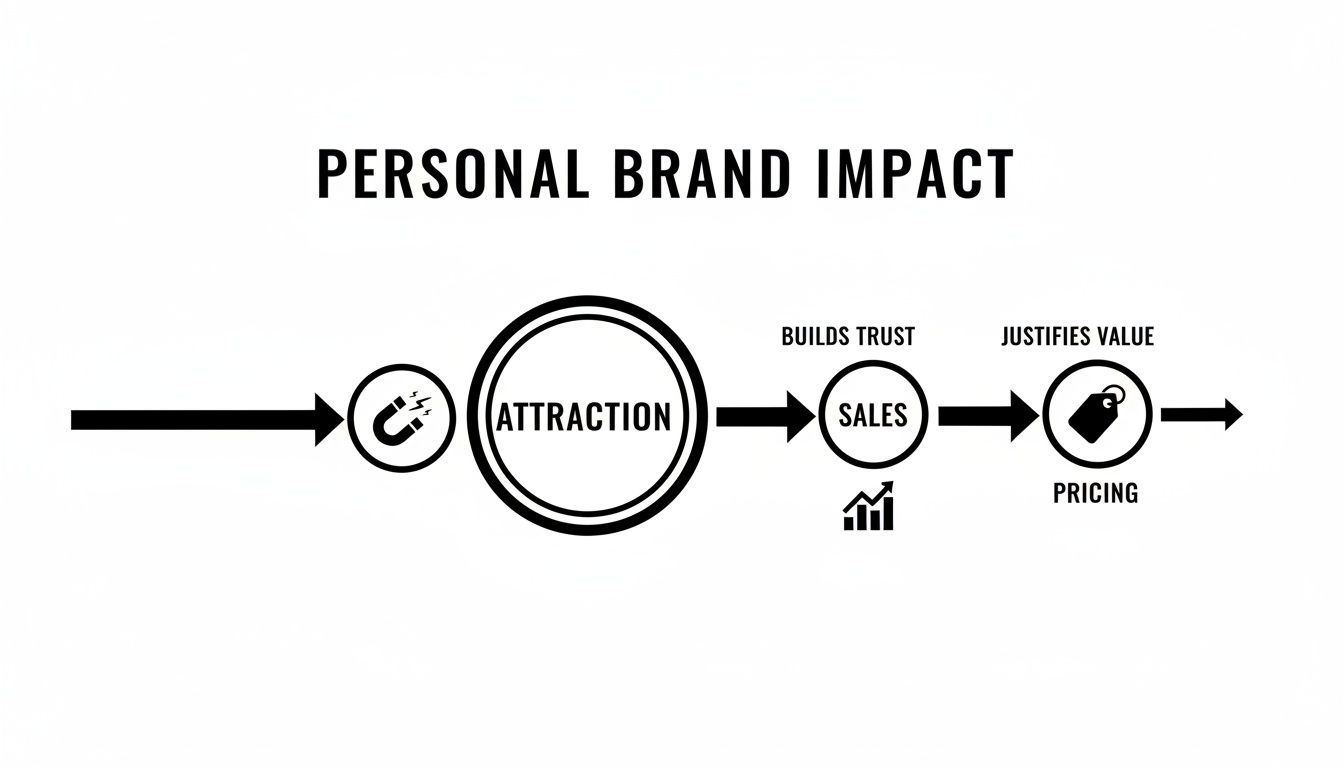
As you can see, a well-built brand first attracts the right people, then makes the sales process smoother, and ultimately gives you the authority to charge premium prices.
Step 4: Create Your Content Strategy
Finally, your content strategy is how you take your brand out into the world. It’s the engine that proves your expertise over and over, delivers real value to your audience, and builds the trust you need to turn followers into paying clients.
Your content should revolve around a few core themes, or "content pillars," that tie directly back to your unique positioning.
For example, a financial advisor who works with creative freelancers might have pillars like:
- Managing wildly unpredictable income.
- Tax strategies for sole traders that don’t suck.
- Investing for long-term creative freedom.
By consistently creating content on these topics—whether it's a LinkedIn article, a short video, or a client case study—you prove your expertise instead of just claiming it. This is how you build a reputation that does the heavy lifting for you, attracting a steady stream of ideal clients who already see you as the only solution to their problem.
Activating Your Brand on LinkedIn and Google
Having a brilliant personal brand strategy is one thing, but if no one sees it, it might as well not exist. Now it’s time to put that blueprint to work where it counts: on LinkedIn and Google.
These aren’t just platforms where you have a profile; they are powerful client-attraction engines when you use them correctly. Your ideal clients are right there, right now, actively searching for the solutions you offer. Your brand needs to be the answer they find.
The goal here is to shift from being a passive observer to an active authority. Let’s walk through the practical, repeatable steps you can take to amplify your visibility and get a steady stream of high-quality leads knocking on your door.
Transforming LinkedIn into a Lead Generation Tool
Too many professionals treat their LinkedIn like a dusty online CV. This is a huge missed opportunity. Your LinkedIn profile should be a dynamic sales page that speaks directly to your ideal client's biggest problems and frames you as the only solution.
Your headline is the most valuable real estate on your entire profile. Don't just list your job title. Clearly state who you help and the result you deliver. For instance, instead of “Financial Advisor,” switch to “Financial Advisor Helping Tech Founders in Australia Secure Their First Round of Funding.”
That tiny change immediately qualifies your audience and screams value. Your "About" section should then expand on this, telling a compelling story about the transformation you create for your clients.
Think of your LinkedIn profile not as a record of your past, but as a promise of your future client's success. Every section should be crafted to build trust and guide them toward taking the next step.
There are some excellent guides out there that go deep into optimizing your LinkedIn profile for real-world results.
Networking with Purpose and Creating Authority Content
Once your profile is dialled in, it’s time to engage. The secret is focusing on quality interactions, not just racking up connections. Meaningful engagement builds real relationships and showcases your expertise far better than firing off random connection requests.
Here’s a simple framework for effective LinkedIn activity:
- Engage Intelligently: Spend 15 minutes each day leaving thoughtful, insightful comments on posts from key players in your industry and potential clients. This builds visibility and shows you know your stuff.
- Create Value-Driven Content: Post 2-3 times per week with content that solves your audience's biggest frustrations. Mix it up with text posts, articles, and short videos to keep things fresh.
- Connect with Intention: When you send a connection request, always add a personal note. Mention a shared interest, a post they wrote that you admired, or how you think you could help them.
This consistent, value-first approach turns LinkedIn from a static database into your most powerful networking and lead-generation machine. Our detailed guide offers more advanced strategies on how to create a standout LinkedIn profile that attracts clients.
Leveraging Your Personal Brand for Google Visibility
Many service professionals completely miss the link between their personal brand and their search engine optimisation (SEO). But every time you publish an article, appear on a podcast, or get quoted in an industry blog, you’re building your digital footprint.
Google’s entire job is to serve up the most relevant, authoritative answers to a searcher’s question. When you have a strong personal brand—backed by consistent, high-quality content across multiple platforms—you send powerful signals to Google that you’re an expert in your field.
This means when a potential client searches for a solution you provide—like "business coach for tradies in Melbourne"—your name, your website, and your content are far more likely to show up. Your personal brand directly fuels your SEO, creating a web of credibility that Google simply can't ignore. This organic visibility is one of the most sustainable ways to attract high-value clients who are already looking for exactly what you do.
How Australian Professionals Win with Personal Branding
Theory is one thing, but seeing personal branding deliver real-world results is where it gets interesting. Let's look at how service-based business owners across Australia are turning their expertise into a magnet for high-value clients. These aren't just abstract case studies; they're relatable stories of strategic brand building in action.

From a Brisbane financial advisor becoming the go-to expert on LinkedIn to a Perth consultant who absolutely owns local search, these examples are a proven model for success. They show that a well-crafted personal brand isn't just about looking good online—it’s about generating real, measurable business growth.
Example 1: The Brisbane Advisor Dominating LinkedIn
Picture a financial advisor in Brisbane who helps medical professionals navigate their complex investment structures. Instead of grinding away with cold calls, she went all-in on building her personal brand on LinkedIn.
Her strategy was simple but incredibly powerful:
- Niche-Specific Content: Twice a week, she published articles breaking down topics like "Tax Minimisation Strategies for Surgeons" or "Investing for Early Retirement as a GP." This content spoke directly to the exact problems her ideal clients were facing.
- Purposeful Engagement: She became an active voice in LinkedIn groups for doctors and healthcare administrators, offering genuine insights without ever pushing a sale.
What happened? Within six months, over 80% of her new client enquiries were coming straight from LinkedIn. She stopped chasing leads because high-calibre clients were now seeking her out, already sold on her expertise before they even had a conversation. Her personal brand had become her number one lead generation machine.
Your personal brand is your most effective salesperson. It works 24/7, building trust and demonstrating value so that when ideal clients are ready to buy, you're the only person they think of.
Example 2: The Perth Consultant Ruling Google with Reviews
Now, let's head west to a marketing consultant in Perth who helps local retail businesses sharpen their online presence. She knew her target clients weren't scrolling LinkedIn for advice—they were firing up Google with urgent problems like, "how to get more local customers."
Her personal brand focus was simple: build an unshakeable reputation with client testimonials. After every successful project, she put a simple system in place to ask for a detailed Google review. She made it dead easy for clients, sending a direct link and a prompt asking them to share the specific results they achieved.
This relentless focus on social proof completely changed her business. Her Google Business Profile now has dozens of five-star reviews packed with the keywords her ideal clients are searching for. She dominates the local map pack, and her phone rings consistently with pre-sold leads who tell her, "I saw your reviews and knew I had to work with you."
This taps into a massive trend. With influencer marketing spend in Australia rocketing to $520 million and projected to hit AU$1.3 billion by 2029, it's crystal clear that people trust individuals more than faceless companies. This gives you the power to build "micro-influencer" status in your niche, creating the exact kind of trust that fuels this huge industry. You can discover more insights about Australian social media trends on meltwater.com and see just how this trust economy works.
Your Personal Brand Action Plan and Checklist
Feeling fired up? Good. Let’s turn that energy into action. Building a personal brand is definitely a marathon, not a sprint, but those first 90 days are where you lay the groundwork and build momentum.
Think of this checklist as your roadmap. It breaks down everything we've covered into a simple, phased plan you can follow, taking you from idea to execution.
Phase 1: The First 30 Days (Foundation)
Your first month is all about getting crystal clear. The biggest mistake people make is rushing this stage. The goal here is to define the bedrock your entire brand will stand on.
- Task 1: Define Your Niche. Get brutally specific. Who is your perfect client? What industry are they in, what keeps them up at night, and where do they spend their time online? Write it all down.
- Task 2: Pinpoint Your Unique Value Proposition. Finish this sentence: "I help [your niche] achieve [specific outcome] by [your unique method]." This becomes your North Star.
- Task 3: Run a Personal Brand Audit. Google yourself right now. What shows up? Look at your existing social media profiles. Do they reflect the expert you want to be seen as?
- Task 4: Secure Your Digital Real Estate. Make sure your name is consistent across every platform that matters. If you haven't already, grab your personal website domain.
Phase 2: Days 31 to 60 (Optimisation and Presence)
With your strategy locked in, it's time to build out your digital home. This phase is about turning your online profiles from static resumes into active, client-attracting assets. Your online presence is a huge part of your brand's health, making active oversight a key part of effective reputation management for small businesses.
- Optimise Your LinkedIn Profile. Rewrite your headline, "About" section, and work experience to scream your unique value. And please, get a professional headshot.
- Clean Up Other Social Profiles. Make sure your bio and links on other relevant platforms are consistent and point back to your core message.
- Gather Social Proof. Reach out to 3-5 of your best past clients and ask for a detailed testimonial or a LinkedIn recommendation. Don't be shy.
- Create a Simple Content Calendar. Map out 8-12 content ideas (that's just two or three a week) based on the biggest problems and questions your niche has.
Phase 3: Days 61 to 90 (Execution and Engagement)
Okay, it’s go-time. This final phase is all about showing up consistently, sharing what you know, and actually talking to people.
- Execute Your Content Calendar. Start publishing the content you planned in Phase 2. Forget perfection—focus on being consistent and genuinely helpful.
- Engage for 15 Minutes Daily. Jump on your main platform (for most service businesses, this is LinkedIn) and leave thoughtful comments on posts from potential clients and industry peers. No "great post!" comments allowed.
- Track Your Progress. At the end of the 90 days, check your numbers. Look at the change in your LinkedIn profile views, connection requests, and the quality of people reaching out to you. This data tells you what to do next.
Got Questions About Personal Branding? We've Got Answers
Even with the best plan, jumping into personal branding can feel a bit daunting. That's perfectly normal. We hear the same questions time and again from service professionals, so let's clear them up right now and get you moving with confidence.
How Much Time Does This Actually Take Each Week?
Consistency beats intensity, every single time. You don’t need to block out entire days. Just aim for 2-3 hours per week, broken into small, manageable chunks.
Use that time for high-impact tasks. Write one solid piece of content. Spend 15 minutes a day engaging on LinkedIn. Reach out to a few new people. It’s about building a sustainable habit, not a sprint to burnout.
I'm an Introvert. Can I Still Build a Strong Personal Brand?
Absolutely. In fact, you might have an advantage. Personal branding isn't about being the loudest person in the room—it's about being the most trusted one. Introverts are often brilliant at this because they thrive on deeper connections and creating thoughtful, well-researched content.
Your strength is in listening, observing, and delivering real value. Forget feeling pressured to be on video 24/7. Focus on what you do best, like writing articles or connecting one-on-one. Authenticity is your superpower.
What are the Biggest Branding Mistakes I Need to Avoid?
Most of the common slip-ups are easy to dodge once you see them coming.
- Being Inconsistent: If your message is all over the place, you’ll confuse your audience and weaken your impact. Stay on track.
- Making It All About You: A simple rule: your content should be 90% about solving your audience's problems and only 10% about you or your services.
- Trying to Be Everywhere: Don't spread yourself thin. Pick one or two platforms where your ideal clients hang out and go deep there.
How Long Until I Start Seeing Real Results?
Think of your personal brand as an asset you’re building, not an overnight ad campaign. You’ll see early signs of life—like more profile views and better engagement—within the first 90 days.
But for a steady stream of inbound leads? That typically starts to build between 6 to 12 months of consistent effort. Be patient. Every article you write and every conversation you have is another brick in a foundation that will pay you back for years to come.
At Homer Digital Marketing, we help service-based business owners like you build powerful personal brands that do the heavy lifting for you. When you’re ready to turn your expertise into a machine that attracts your ideal clients, let's have a chat.
