

Struggling to find high-value clients by casting a wide net on other social platforms? LinkedIn advertising is your direct pipeline to the professionals who actually make the big decisions. It’s a focused environment where your message lands in front of people already in a work mindset—less casual scrolling, more professional development. This guide provides actionable steps to leverage LinkedIn advertising costs and strategies for maximum ROI.
Why LinkedIn Advertising Is a B2B Game Changer
Unlike platforms built for entertainment, LinkedIn is the premier online space for professional networking, industry deep-dives, and career growth. This professional context is what makes LinkedIn advertising so different and, for B2B companies, exponentially more powerful.
When people are on LinkedIn, they’re actively thinking about their business challenges, industry trends, and what solutions could make their work lives easier. This means your ads aren’t seen as an annoying interruption; they’re a relevant part of the conversation. You’re connecting with potential clients at the exact moment they’re most receptive to business-focused ideas.
Reaching Decision-Makers Directly
The real power of LinkedIn ads lies in the targeting. You can go far beyond basic demographics and zero in on your ideal clients with surgical precision. Imagine being able to filter your audience by:
- Industry: Showing your ads only to accounting firms or real estate agencies.
- Company Size: Focusing specifically on small businesses with 10-50 employees.
- Job Title: Getting your message directly in front of CEOs, Marketing Directors, or HR Managers.
- Seniority Level: Making sure your ads are seen by the senior influencers and key decision-makers who can say "yes."
This level of detail means you stop wasting your budget on people who will never buy from you and start focusing on those with the authority to sign off on your services. It’s a huge reason why 40% of B2B marketers say LinkedIn is their most effective channel for generating high-quality leads. While a tool like Sales Navigator is fantastic for one-on-one outreach, paid ads let you scale that precision to a much larger audience. If you want to dig deeper into that, check out our guide on leveraging Sales Navigator for lead generation.
A Platform Built for Business Growth
The Australian market has certainly caught on. Recent data shows LinkedIn advertising in Australia saw a solid 10% year-on-year increase in demand during the first quarter of the 2025 fiscal year. That jump shows just how much confidence advertisers have in the platform's ability to connect with over 15 million professional users across the country. It’s proving itself as a primary B2B marketing channel. Discover more insights about LinkedIn advertising stats on radiateb2b.com.
For service-based businesses in Australia, this isn't just another social media platform. It's a strategic asset for building brand authority, fostering client relationships, and driving measurable growth in a professional setting.
Ultimately, LinkedIn provides a unique space where quality conversations lead to quality business. It’s where you can position your brand as a thought leader, educate your target market, and guide high-value prospects through their buying journey, making it an essential tool for any serious B2B company.
Choosing the Right Ad Formats for Your Goals
Getting started with LinkedIn advertising feels a bit like a builder staring at a toolbox. You have a job to do, but picking the wrong tool will waste time, money, and effort. The trick is to match the ad format to your specific business goal, ensuring every dollar you spend moves you closer to a result.
Think of each ad format as a different way to start a conversation. Some are like shouting from a rooftop to get everyone's attention, while others are more like a quiet, one-on-one chat over coffee. Knowing which conversation you need to have is the first step to building a campaign that doesn't just get clicks, but genuinely moves your business forward.
This diagram shows how LinkedIn’s core strengths—precise targeting, lead generation, and brand growth—all work together to support your business.
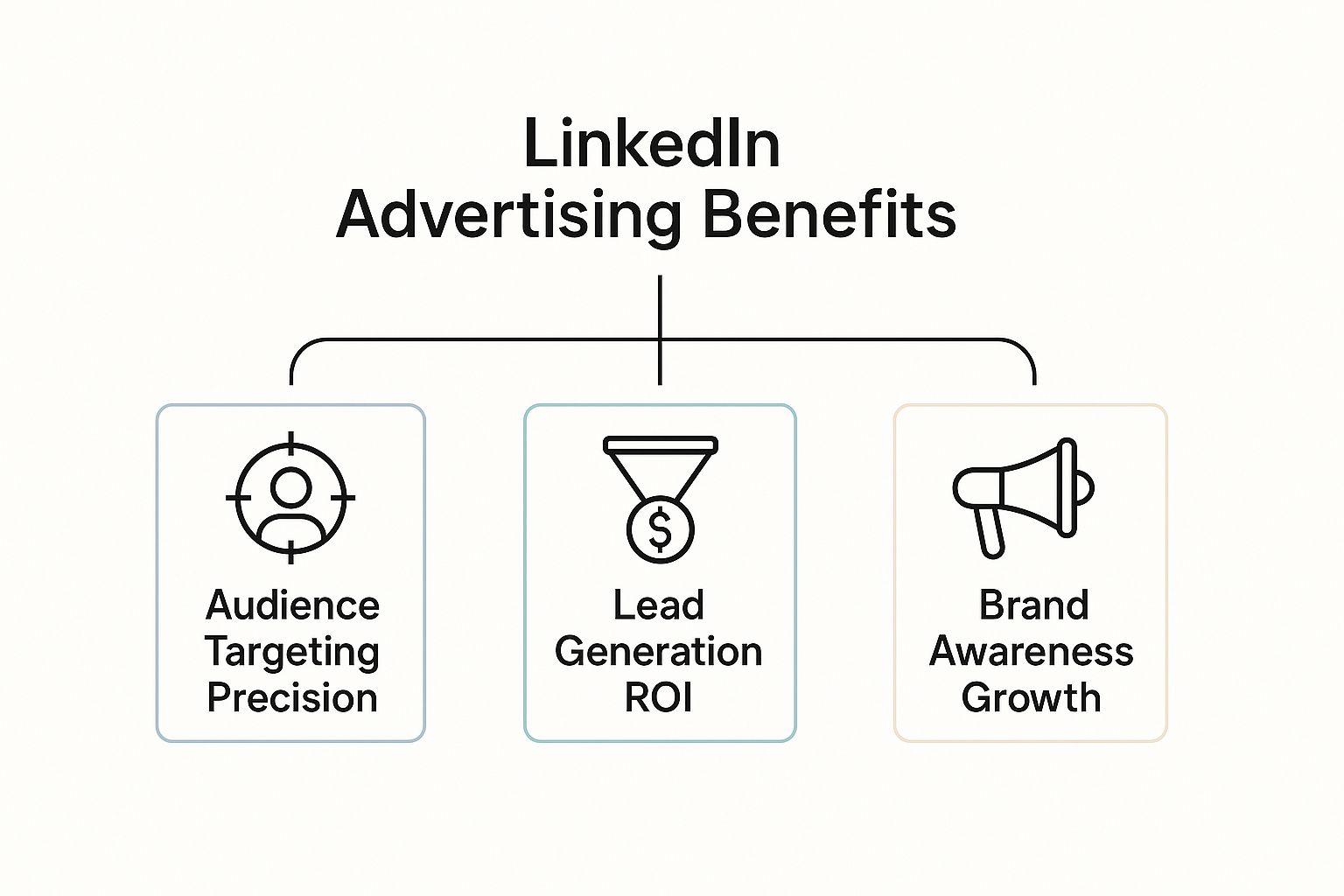
As you can see, the real power isn't in any single feature, but in how these three pillars combine to create a solid marketing strategy.
Sponsored Content: The Digital Thought Leader
Sponsored Content ads are what you see in your LinkedIn news feed, designed to look and feel just like regular posts. These are your thought leadership pieces—your articles, videos, and case studies—given a paid boost to reach a much wider, yet still highly relevant, audience.
This format is incredibly flexible and brilliant for building brand awareness and starting conversations. By sharing valuable insights, you position your brand as the go-to expert in your field. For instance, a Sydney-based consultancy could promote a short video explaining a new industry regulation, instantly reaching thousands of local managers and executives who need to know about it.
Key takeaway: The goal with Sponsored Content isn't a hard sell; it's to educate and inform. You're building trust and credibility, which is what turns into business enquiries down the track.
This approach keeps your brand top-of-mind, so when potential clients are finally ready to buy, you’re the first one they think of.
Sponsored Messaging: The Professional Introduction
Previously known as Sponsored InMail, Sponsored Messaging lets you send a direct message straight into the LinkedIn inbox of your target audience. It’s the digital equivalent of a professional, one-on-one introduction at an exclusive networking event, but you can do it at scale.
This format is a powerhouse for driving conversions with a specific offer. Because it lands in their inbox, it feels far more personal and demands more attention than an ad people just scroll past in their feed.
A recruitment agency, for example, could send a personalised message to software developers with a specific skill set about an exclusive job opening. It’s direct, relevant, and lands right where they'll see it. The key, however, is to offer genuine value so it doesn’t come across as just another piece of spam.
Lead Gen Forms: The Seamless Business Card Exchange
Lead Gen Forms are a game-changer for capturing high-quality leads without friction. You can attach these forms to your Sponsored Content or Messaging ads, and they automatically pre-fill with a user's LinkedIn profile information—think name, email, company, and job title.
The process is completely seamless, like swapping business cards digitally. The user clicks your call-to-action, glances over their pre-filled details, and hits submit. That's it. This simplicity dramatically boosts conversion rates because it removes the pain of manually typing everything out, especially on a mobile phone.
This is your go-to tool when your primary goal is generating leads for a webinar, a downloadable guide, or a free consultation. You can dive deeper into these tactics in our guide on how to use LinkedIn for business growth.
Matching LinkedIn Ad Formats to Your Business Goals
Choosing the right ad format is the secret to a successful LinkedIn advertising campaign. This quick-reference table breaks down which format to use based on your primary marketing goal.
| Marketing Objective | Recommended Ad Format | Why It Works |
|---|---|---|
| Build Brand Awareness | Sponsored Content (Single Image, Carousel, or Video Ads) | Puts your brand in front of a broad but targeted audience with engaging, shareable content that builds authority. |
| Drive Website Traffic | Sponsored Content | Perfect for promoting blog posts, case studies, or landing pages with a clear call-to-action to click through to your site. |
| Generate Qualified Leads | Lead Gen Forms (attached to Sponsored Content or Messaging) | The ultimate tool for frictionless lead capture. It removes barriers, making it incredibly easy for prospects to hand over their details. |
| Personalised Outreach | Sponsored Messaging | Ideal for delivering a tailored offer, event invitation, or high-value message directly to a niche audience's inbox. |
By making a conscious choice about your ad format before you spend a cent, you stop guessing and start strategising. This is how you ensure your budget is spent effectively, driving the specific results your business needs to grow.
Mastering LinkedIn's Powerful Targeting Options
The real magic of LinkedIn advertising isn't just about reaching professionals; it's about reaching the right professionals. Forget casting a wide net. LinkedIn gives you a direct line to your ideal client based on their actual career, industry, and company. This is the secret to making your ad spend work smarter, not harder.
Think of it like fishing. You could chuck a massive net into the ocean and hope for the best. Or, you could use a high-tech fish finder to pinpoint the exact species you're after and drop your line right on top of them. LinkedIn’s targeting is that fish finder. It cuts out the guesswork and connects you straight to high-value prospects.
This incredible level of detail is why LinkedIn has become such a powerhouse for B2B marketing here in Australia. By early 2025, it's expected to have between 15 to 17 million users down under—that’s roughly 60-65% of Australia's entire internet-using population. A huge chunk of those users are in the 25-34 age bracket, a key demographic of ambitious decision-makers. You can discover more insights about social media statistics in Australia from Sprout Social.
Starting with the Fundamentals
Before you get fancy with advanced strategies, you must nail the basics. These foundational targeting filters are your bread and butter, letting you build a strong, relevant audience from the ground up. Get this right, and you ensure your ads are only seen by people who can actually benefit from what you offer.
Here are the core targeting categories you need to get familiar with:
- Company Targeting: Zero in on businesses by their industry (like "Financial Services"), company size ("11-50 employees"), or even target specific, named companies you want to work with.
- Job Experience Targeting: This is where the serious power lies. You can target people by their exact job title ("Marketing Manager"), their general job function ("Human Resources"), or their seniority level ("Director" or "C-Level").
- Education and Demographics: You can also filter your audience by what they studied, which university they went to, their age, or their gender.
By layering these options, you can build a hyper-specific audience. For example, a Sydney-based software company could target "IT Managers" (Job Title) who work at "Financial Services" companies (Industry) with "500+ employees" (Company Size). That’s how you turn a broad campaign into a finely-tuned, lead-generating machine.
This image from LinkedIn gives you a glimpse of the sheer number of professional criteria you can use to build your perfect audience.

As you can see, it goes way beyond simple demographics, letting you target professionals based on their real-world career path.
Unlocking Advanced Targeting with Matched Audiences
Once you’ve got the basics down, Matched Audiences is where you take your LinkedIn advertising to the next level. This brilliant feature lets you connect with people who already have some kind of relationship with your brand, making your ads feel incredibly timely and relevant.
Matched Audiences lets you skip the cold outreach and start conversations with a warm audience—people who have already shown they’re interested in what you do. This is a massive factor in improving conversion rates and getting the most out of your ad spend.
There are three main ways you can use Matched Audiences:
- Website Retargeting: Pop the LinkedIn Insight Tag on your website and you can start creating audiences based on what people do there. You could retarget everyone who visited your site, or get more specific and target people who checked out your pricing page but never booked a call.
- Contact Targeting: Got an email list from your CRM or newsletter? Upload it. LinkedIn will match those email addresses to user profiles, letting you run hyper-focused campaigns aimed squarely at your existing contacts.
- Account-Based Marketing (ABM): This is a game-changer for B2B service businesses. Upload a list of the exact companies you want to land as clients. Then, you can layer on job title or seniority filters to make sure your ads are only seen by the key decision-makers inside those specific organisations.
By combining foundational targeting with these advanced Matched Audiences strategies, you create a complete approach. You can attract fresh prospects based on their professional profile while, at the same time, nurturing relationships with people who already know who you are.
Setting a Smart Budget and Bidding Strategy
Talking money can feel daunting, but setting a budget for your LinkedIn advertising campaigns doesn’t have to be a guessing game. Think of your ad budget as fuel in your car. Too little, and you’ll run out before you leave your neighbourhood; too much without a map, and you'll just burn through it aimlessly.
The trick is to start with a smart, calculated approach. Let’s be clear: LinkedIn is a premium platform. The costs are higher than what you might see on Facebook or Instagram, but you're not paying for noise. You’re paying for precision and quality.
Understanding the Main Bidding Models
When you launch a campaign, you need to tell LinkedIn how you’re willing to pay. This is your bidding strategy, and getting it right means your spending is directly tied to your goals.
It's a bit like handing out flyers for your business. You have a few ways to measure if it's working:
- Cost Per Click (CPC): This is like only paying when someone takes your flyer and walks through your front door. You’re charged each time a person clicks your ad. It’s perfect when your main goal is driving traffic to your website or a landing page.
- Cost Per Impression (CPM): This is more like paying for every 1,000 people who see your flyer, whether they take it or not. You pay for eyeballs, not actions. Go for this model when your goal is pure brand awareness and getting your name in front of as many relevant professionals as possible.
- Cost Per Send (CPS): This one is specific to Sponsored Messaging ads. It's like paying a small fee for every personalised letter you successfully deliver. You pay per message sent, making it a powerful choice for direct, high-value outreach.
The best bidding strategy isn't just about finding the cheapest option. It’s about choosing the one that most efficiently gets you what you want, whether that's website visitors, brand recognition, or direct conversations.
How to Set a Realistic Starting Budget
So, the big question for a small or medium-sized Australian business is, "How much should I actually spend?" While there's no single magic number, a good rule of thumb is to commit to a test budget that’s big enough to give you real data.
For most businesses dipping their toes in, a monthly budget of $500 to $1,500 AUD is a solid starting point. This gives your campaigns enough runway for LinkedIn's algorithm to learn and for you to see what’s actually connecting with your audience.
Think of this first phase as R&D. The goal isn't necessarily a massive, immediate return. It's about gathering intelligence—understanding your audience, testing your messages, and figuring out a baseline cost per lead. That data is gold. It becomes the foundation for scaling your campaigns profitably down the track.
Creating Ads That Professionals Actually Click
Great targeting gets your LinkedIn advertising in front of the right people, but it’s your ad creative that makes them stop scrolling. In a feed cluttered with self-proclaimed gurus and bland corporate updates, your biggest advantage is being authentic and offering immediate value.
Your ad copy and visuals need to team up to answer one simple question for the busy professional scanning their phone: "What's in this for me?" If they can't figure that out in a split second, they're gone.
Writing Copy That Connects
The best ad copy on LinkedIn doesn't try to be clever; it speaks directly to a professional's problems. It's about being clear, empathetic, and showing you have the solution they’ve been looking for.
Start with a hook that grabs them. Instead of a boring headline like "Marketing Automation Software," try something that hits a nerve, like "Tired of Manually Tracking Leads?" This instantly connects with your ideal client and hints at a better way.
The rest of your ad text should deliver on that promise. Use simple, direct language and skip the jargon. Focus on the real, tangible results your service provides.
Key Takeaway: Professionals on LinkedIn are short on time. Your ad copy needs to act like a sharp elevator pitch—get straight to the point, communicate your value, and build instant trust.
Choosing Imagery That Builds Trust
Generic stock photos are the fastest way to get ignored. Professionals can spot a cheesy, staged image from a mile away, and it instantly makes your brand look cheap and untrustworthy.
Go for authenticity instead. Real photos of your team, your office, or even a happy client (with their permission, of course) will almost always outperform polished stock images. If you must use stock photos, pick ones that look natural and relatable, not like they came from a 90s corporate brochure.
And remember, a huge chunk of your audience is on their phone. In fact, in Australia, 57% of LinkedIn traffic comes from smartphones. Your visuals need to be bold, simple, and easy to understand on a small screen. Complicated charts or images packed with tiny text just won't cut it. You can read more about the latest LinkedIn advertising trends in the Asia-Pacific region on Statista.
The Art of the Call-to-Action
Your Call-to-Action (CTA) is arguably the most critical part of your ad. It's the final instruction telling your audience exactly what to do next. A weak or vague CTA is a guaranteed way to kill your results.
Be direct and use action words. Ditch the passive "Learn More" for something specific and compelling that matches your offer.
- Download the Free Guide
- Book Your Discovery Call
- Get Your Custom Quote
- Register for the Webinar
Your CTA has to line up perfectly with what you promised in the ad. If you offered a guide, the button must say "Download Guide." This simple consistency removes any confusion and makes it effortless for interested people to take the next step. When you combine a strong value proposition with a clear directive, you get an ad that doesn't just get seen—it gets results.
Measuring Performance and Optimising Your Campaigns

Hitting ‘launch’ on your LinkedIn advertising campaign isn’t the finish line; it’s the starting block. The real magic happens when you start digging into the results, figure out what’s resonating, and make smart tweaks. This is how your ad spend stops being an expense and starts becoming a powerful investment in growth.
The difference between a good and a great campaign manager is the ability to look past vanity metrics like impressions and zero in on the numbers that actually move the needle for your business. It’s all about learning to read the story your data is telling you.
Key Metrics That Truly Matter
Once you open the LinkedIn Campaign Manager, you'll be greeted by a wall of data. It’s easy to get lost. To keep things simple and effective, focus on a handful of key performance indicators (KPIs) that give you a direct pulse on your campaign’s health.
These are the metrics you should be watching like a hawk:
- Click-Through Rate (CTR): This is the percentage of people who saw your ad and were compelled enough to actually click it. If your CTR is low, it’s a big red flag that your creative or audience targeting is off the mark.
- Cost Per Click (CPC): This tells you exactly what you’re paying every time someone clicks your ad. Keeping an eye on your CPC is crucial for managing your budget and seeing how competitive your chosen audience is.
- Conversion Rate: This is the golden metric. It’s the percentage of clickers who went on to take the action you wanted, like filling out your lead form. A high conversion rate means your ad and landing page are working together perfectly.
- Cost Per Lead (CPL): This calculates the total ad spend it took to get one single lead. If your CPL is creeping up, it might be a sign that your targeting has become too broad or your offer just isn't hitting the mark.
Ultimately, all these numbers feed into the most important one of all: Return on Ad Spend (ROAS). Nailing this calculation is how you prove your campaigns are actually making money. Figuring this out can be tricky, which we cover in our guide on why it is difficult to measure marketing ROI.
A Simple Framework for Optimisation
So, what do you do when an ad is underperforming? Don't panic and definitely don’t just throw more money at it. Instead, take a step back and work through the problem methodically. This cycle of testing, learning, and refining is the secret sauce to long-term success on LinkedIn.
Key Insight: Successful LinkedIn advertising isn't a "set and forget" activity. It’s a constant feedback loop of listening to your data and making calculated adjustments to improve your return.
Start by asking these three questions:
- Is the Audience Right? If you’re getting plenty of impressions but a low CTR, you’re probably talking to the wrong people. Try refining your audience by job seniority, or even add negative filters to weed out industries that aren’t a good fit.
- Is the Creative Compelling? Maybe the audience is right, but your ad is boring. A/B test your headlines, switch up your images, or try a different call-to-action. You’d be amazed at how a small change, like using an authentic photo of your team instead of a generic stock image, can boost engagement.
- Is the Bid Strategy Correct? If your ads are barely being shown, your bid might be too low to compete. You could try switching to an automated bidding strategy and let LinkedIn’s algorithm do the heavy lifting to find the most efficient way to spend your budget.
Common Questions About LinkedIn Advertising
Dipping your toes into the world of LinkedIn advertising always brings up a few practical questions, especially if you're new to the game. Here are some straight-shooting answers to the queries we hear most from Australian business owners, designed to give you clarity and confidence.
How Much Does LinkedIn Advertising Cost in Australia?
Look, LinkedIn is a premium platform, so you won't find bargain-basement prices here. The costs can swing wildly depending on who you're trying to reach and what industry you're in, but you should expect your bids to start somewhere around $5-$8 AUD per click for most campaigns.
For a small Aussie business just starting out, a monthly test budget of $500 to $1,500 is a sensible place to begin. That’s usually enough to get the ball rolling, gather some solid data, let the algorithm do its thing, and see some early signs of life before you decide to ramp things up.
Is LinkedIn Advertising Worthwhile for Small Businesses?
Absolutely, and here’s why. While the ticket price might seem higher than other platforms, its superpower is its laser-focused targeting. You’re not wasting money trying to reach everyone and their dog; you’re putting your budget directly in front of the specific job titles, industries, and company sizes that make up your ideal client list.
This shift from quantity to quality is what really drives high-calibre leads and a much stronger return on your investment. You’re not just chasing clicks; you’re starting meaningful conversations with the right people.
How Long Until I See Results from My LinkedIn Ads?
You'll see the machine start whirring pretty quickly. Initial data like impressions and clicks will begin to trickle in within the first 24-48 hours after you launch. This early feedback is perfect for making sure everything is running smoothly and your ads are actually getting seen.
But let’s be real—meaningful business results like qualified leads and new clients don't happen overnight. You need to give it time. Plan for a testing window of at least 2-4 weeks to collect enough data to make smart optimisations. To generate a real, sustainable return, you're looking at a 1-3 month journey of consistent effort, testing, and fine-tuning. It's a strategic long game, not a quick fix.
Ready to stop guessing and start growing? The team at Homer Digital Marketing uses proven strategies to help service-based businesses like yours attract ideal clients and scale with LinkedIn advertising. Book your free strategy call today and let’s build a campaign that delivers real results.
